



前言
一直想要為本校師生在世紀末作一個特殊的展覽以迎接新的千禧年──這個展覽一定要具有歷史意義而且是與中華文化及中國人密切相關的。真的是心想事成,「年畫珍賞」就這樣“順理成章”地來了。
其實,這個緣份早在二十年前就已播下了種子。一九七八年我從北美首次返國,曾經去上海圖書館參觀,留下深刻的印象。九零年馬遠良教授來港訪問,那還是學校草創時期,我們在尖沙咀的大學臨時辦公室見了一面。九七年底與王世偉教授交換了幾次意見,討論一些合作項目,一旦知道了上海圖書館的年畫特藏就被它深深地吸引住。年畫經過漫長的發展過程,成為民間在年節時張貼的吉祥裝飾品。在世紀之交作這項展覽,為我們的地球及地球上的居民祈福迎祥是再也適合不過。
感謝上海圖書館的馬館長,王副館長及促成這次展覽的工作人員。由於他們熱情的幫助,這批尚未披露過的精彩年畫,才能在今天展示在我們眼前。相信大家從這次年畫展覽中,會有一次視覺及思想上的豐收。
周敏民
Exhibition Introduction
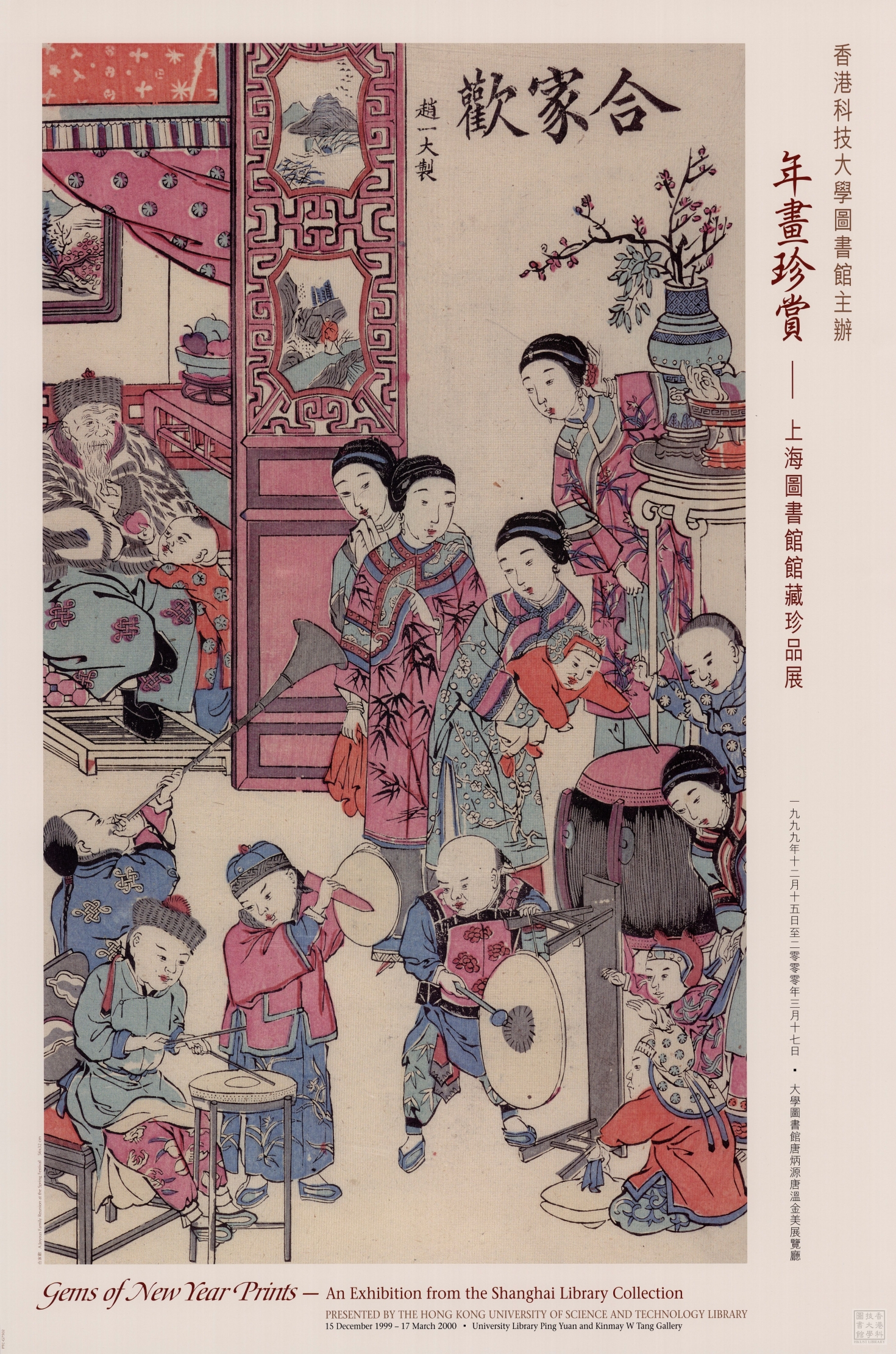
The Chinese New Year print is an important art form for several reasons. It casts a wide influence on the history of Chinese art, especially woodcut prints. New Year prints also reveal a wealth of information about folk customs, local operas, folk literature, and people’s views of current events; and finally, they may be enjoyed for their own aesthetic qualities.
The origins of Chinese New Year prints can be traced back to the Zhou dynasty (841-256 BC). As a formal art form, it flourished from the Ming dynasty (1368-1644) up to the mid-twentieth century. The Shanghai Library’s collection of New Year prints totals over 3,000, mostly dating from the late Qing (1644-1911) and early Republican period. Displayed in this exhibition are sixty fine examples from this collection. They can be divided into four groups:
Folk Customs
In ancient times artisans drew pictures of “door gods” to drive away evil spirits. By the Song dynasty (960-1279), rather than just being simple pictures of protective spirits and gods, the content of the New Year print began to show local customs, particular locales, detailed portraits of local life. New Year prints showing “slices of life” became the most common type of picture made and sold.
Local Operas
During the reign of the Kangxi Emperor (1662-1722) and the Qianlong Emperor (1736-1795), New Year prints depicting local operas became popular, perhaps because of the greater stability and prosperity of the times. Local operas were often adapted from popular folk novels. The New Years pictures that depict operas show an enormous amount of detail in the arrangement of the tableaux; individuals’ postures often show vivid movement. The costumes dazzle the eye and facial expressions are incredibly lifelike. One can easily see why local opera depictions became one of the most popular themes for New Year prints.
Folk Stories/Literature
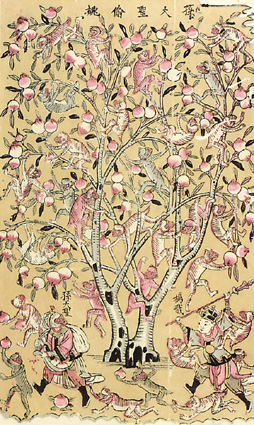
From generation to generation people have handed down stories. The battles between beauty and ugliness, truth and falsehood, and good and evil are the topic of fairy tales and folk stories worldwide. Chinese folk-tales like “The Herd Boy and the Weaving Girl”, “Meng Jiangnu Looks for Her Husband”, and “The Story of White Snake” are just a few examples of the types of stories that were shown in New Year prints. In addition, legends, ballads, fables, riddles, proverbs, and songs, a wealth of folk literature, were illustrated by New Year prints. The folk literature enriched the pictures and the pictures inspired the literature in their turn. This dynamic enriched artistic themes and helped to form distinctive local and national styles of art.
Current Events
New Year prints depicting current events began to appear after the mid-nineteenth century. Following the outbreak of the Opium War and the consequent “opening” of China, social and political life began to change rapidly. Soon, New Year prints showing Chinese battles against Western incursion and others, depicting favorable aspects of Western science and technology, became popular. Current Events New Year prints uniquely reflected this historical backdrop.
It is hoped that in addition to providing pleasant viewing, this exhibition will help to increase appreciation for this art form and foster greater knowledge and understanding of the past.
A Brief Introduction to Chinese New Year Prints
In China, New Year print is a decorative folk art form, deeply rooted in the taste and preoccupations of common people; their social significance cannot be ignored. For centuries people loved New Year prints for their busy and compact composition, their loud and eye-catching colors, their handsomely delineated figures, and for their auspicious themes. More important is that the topics of New Year prints reflected the wishes of the people, and that their content matched the people’s mindsets.
New Year prints evolved from Lunar New Year celebration practices over the centuries. One can trace their origins to the nature worship and pantheistic beliefs of ancient times. During the Ming dynasty, the popularity of illustrations in printed novels and folk stories grew apace, giving great impetus to the development of New Year print. The design, printing, purchase, and posting of New Year prints gradually became part of the festive and decorative activities leading up to the celebration of the New Year.
New Year print reached its zenith in the Qing dynasty. The era of the Kangxi and the Qianlong emperors, a period of peace and prosperity, provided the environment for the flourishing of the New Year prints. The immensely popular folk novels at the time offered the many print ateliers with an abundant material from which to create New Year prints. There are two major characteristics of New Year prints of the early Qing dynasty. In terms of subject, there was frequent thematic use of historical events, myths, legends, and figures from folk stories and epic novels. In terms of expression, techniques of perspective and chiaroscuro (light and shadow) began to be applied as a result of the influence of Western style painting introduced by Ricci, Castiglione, and others. New Year prints thus became a channel through which Western ideas came to the East.
During the late Qing period, the internal turmoil and the external pressures on China increased, creating the most complicated social conditions in modern Chinese history. New Year print was the art form that reflected these turbulent issues most quickly. The end of the Qing and the beginning of the Republican period was the last phase of popularity for this art. During these years, news and current affairs were depicted in the New Year prints; using a traditional form to express social conditions and news. This was an innovation rare among other arts. Because these New Year prints reflect the history and folk customs of their times, the prints from this period are especially valued and highly regarded by researchers.
4:30 pm
Ping Yuan and Kinmay W Tang Gallery
Gallery Talk
Speaker: Mr. Zhang Wei
Date: 14 December 1999
Time: 2:30 – 4:00 pm
Language: Putonghua
Ping Yuan and Kinmay W Tang Gallery