


All of us are Related – Each of us is Unique
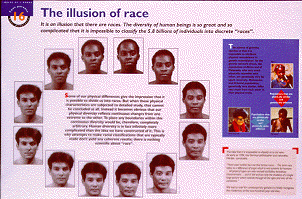
This exhibition reveals that the idea of “race” is a misleading way of conceptualizing human diversity.
A core theme of the exhibition is that there are no biological barriers between the 5.7 billion human beings that today inhabit the earth. The exhibition emphasizes how recent research on human diversity leads to the conclusion that we all have the same ancestors and that the genetic diversity of contemporary human populations reflects the paths followed by our ancestors in the course of human migrations over the past 100,000 years. These movements are illustrated graphically in a series of maps that are part of the exhibition.
Because the physical diversity of human populations today is continuous, whatever boundaries have been placed within this continuous diversity are arbitrary, even those pertaining to skin color. The exhibit reveals dramatically that there is simply no such thing as “white people”, “black people”, “yellow people”, or the like, except as social constructs. (These constructs, of course, have potent political and social significance.) The exhibition asserts that, in a world in which intergroup hostility has long been based on erroneous beliefs in biologically determined characteristics of so-called “races”, our habitual way of thinking about how we relate to each other needs seriously to be re-examined.
Examine each of the eighteen panels carefully, reading the text and examining the graphic displays. Work your way through this exhibition, panel by panel, taking them in sequence, from Number 1 through Number 18. In that way you will appreciate the complexity of the findings that have emerged from recent research in population genetics, findings that challenge many popular beliefs about “races”. The story is complex, but clear, provided you let the story unfold across the eighteen panels.
When you have digested the messages on the panels, you should view the 27-minute video “Six Billion Races” which complements the panels and is an integral part of this exhibition.
May you enjoy this exhibition and may it inspire you to think again about how we are all related while, simultaneously, each of us is unique!
Marshall H. Segall
Professor Emeritus, Syracuse University
If there is no such thing as ‘race’, why do we still have racism?
Lecture and Panel Discussion
Date: 23 March 1999
Time: 4:00 – 5:30 pm
Venue: Lecture Theater G
Lecture
Marshall Segall
Professor Emeritus, Syracuse University
Panel Discussion with
Christine Loh
Citizens Party and Hong Kong Against Race Discrimination
Mak Hoi Wah
City University and Movement Against Discrimination
Barry Sautman
Hong Kong University of Science & Technology
All of Us Are Related; Each of Us Is Unique
The Library is sponsoring an exhibit on “race” in the Library Gallery from 19 March to 16 April. This is an effort to support the Division of Social Science’s lecture and panel discussion on this topic, which was held on 23 March.
This thought-provoking exhibit consists of 18 prints, 3 introductory panels, and a film entitled “Six Billion Races”. Produced originally by a team of biological anthropologists at the University of Geneva in Switzerland, the exhibit was first shown at the Musee de l’Homme in Paris in 1992 under the title “Tous Parent, Tous Differents”. Professor Segall at Syracuse University translated the exhibition into English, and it is now touring the world.
Supported by recent scientific evidence, the exhibit claims that every person on earth is kin to every other because we all have the same ancestors. The exhibit begs the question: “If there is no such thing as ‘race’, why do we still have racism? As suggested by Dr. Kimberly Chang: “Given the unique history of racism in Hong Kong, as well as the current usage of the term “race” in political debates about Chinese identity and citizenship, this exhibit would find an apropos setting in Hong Kong at this time.”
Extracted from Issue No. 32 of Notes from the Library
3:30 pm
University Atrium & Library Gallery
University Library Gallery