



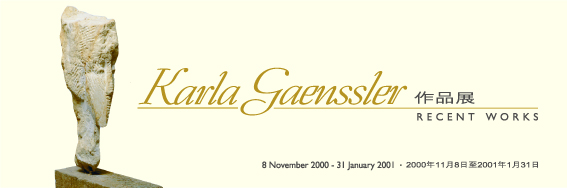
Foreword
It was in the spring of 1997 when I first saw Karla Gaenssler’s work at the home of Professor Reinhard Renneberg. I was immediately attracted by the colors and materials in her work, and by her meticulous yet unconstrained style. Her choice of topics is simply intriguing. Though deeply impressed by Ms. Gaenssler’s work, I did not think it was feasible to hold an exhibition of hers in our library gallery.
It is due to Professor Renneberg’s tireless effort that we could, for the first time, bring Ms. Gaenssler’s art to Hong Kong. He has my gratitude. I wish also to thank the Goethe-Institut Hong Kong and Schenker International (H.K.) for providing funds to ship the artworks from Berlin to Hong Kong.
We are very proud to have the opportunity to display these extraordinary art pieces in the HKUST Library Gallery.
Min-min Chang
HKUST Library
On the Art of Karla Gaenssler
Karla Gaenssler’s work enciphers, as it were, states of being and human intercourse, forever precarious and yet holding promise of fleeting moments of joy.
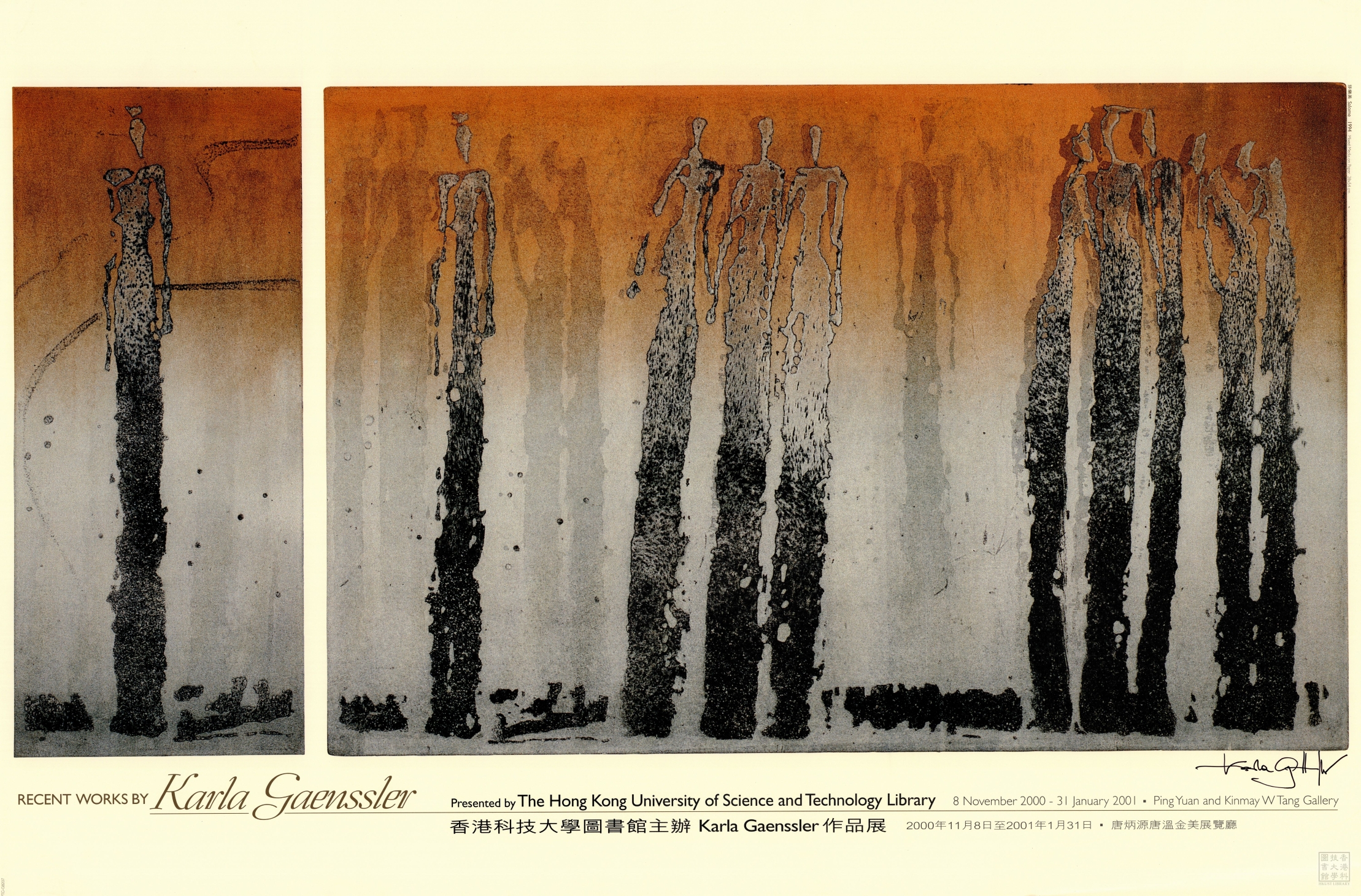
The vertical forms – thin and fragile and gaunt, and assembled rhythmically in patterns evocative of human contiguity and distance – are supremely variable modules, evoking man’s eternal steadfastness. Volume, fundamental to the sculptor’s discourse, is subjected in Karla Gaenssler’s work to a distinctive reduction. With the elongation and attenuation of her figures she aims at a composition in which the distribution of structures in space suggests multiple interrelationships and shifting perspectives. Thus, the upright forms suggestive of human figures, are more than just verticality. They have a rhythmic function: what appear to be staves form cage-like structures, and the eye is led to apertures in fields of contiguous and overlapping stripes and planes. Elongation suggests prideful perseverance, indeed arrogance, and a certain sad remoteness, fortitude, supplication heavenwards. Shapes suggestive of figures allude to humanity and hint at emotional states. There is something classically theatrical, something archaic about the subtle materials and colors used, evocative of mythic encounters, ages long gone by. Here and there, flashes of royal blue and a sudden blaze of plebeian earthen tones appear, embedded in noble metal or in plain, untreated wood and stone.
Whether sculpture or hand-made paper compositions, the works of Karla Gaenssler cannot in any sense be considered simply decorative. Serenity takes on a serious quality, and there is something easy and natural about the majesty that is expressed in these works.
At the root of the attraction these works exert on us lie contradictions. Something is always in the process of transformation, something that challenges the viewer and defies all simplistic interpretation; something that a moment later can be seen in an entirely different light. This might be colors that appear to have the quality of lava, luminous, earthy and sometimes intoxicating, or are recognizable as material, some chance discovery, and we suddenly find ourselves perceiving the rust of ordinary metal as the astonishingly sumptuous expression of warmth and passion, and the spent blue tones of paper tatters as pleasant coolness. One may see the way her shadowy figures seem to tentatively touch as a tender ritual, or simply as a rhythmic pattern. “Orpheus” can be seen as the singer himself or as his harp. Whether the trouvailles retain their authentic character or are absorbed in the paper-making process; or are given the chance to resurface in a strange and unexpected way: we may speculate, but the artist takes a stand.
Karla Gaenssler is by nature a decisive person, a woman who knows her mind. Of course, she’s a teacher as well as an artist. Yet we, the viewers, are never pressured into seeing her work in one particular way. On the contrary, she presents us with an offering of deliberately arranged elements and sensuous materials and color. We may approach her work, enter into discourse with it, be astonished, be delighted.
One is tempted to touch some of these works of art. This is a temptation that is innate to sculpture – the longing for the truth of knowing by direct experience, the sensation of the metallic smoothness, the dry roughness of stone, and the transparent and fragile fibrous quality of paper. What a temptation it is to touch, knowing as we do how fragile these creations are.
The contradictions inherent in our age and in our lives are reflected in Karla Gaenssler’s art as zest, on the one hand, and as the consciousness of the burden of existence, on the other.
Her zest arises from experiencing the depth and individuality of life itself and the primal nature of things in general, of which her materials are of course a part. Zest for life is something natural, something we recognize in ourselves, something we accept and something that is increasingly demanded of us. This is especially true when zest is coupled with imagination.
The burdens, for their part, are connected with a person’s direct experience of the world and involve accepting social responsibility and consciously bearing all the vicissitudes of life with dignity and appreciation of one’s fellow men. This is the source of true humanity. In her work as an artist, Karla Gaenssler demands not commiseration; rather, in her configurations lie signs with which she attempts to soften, not obfuscate life’s burdens. The sheer possibility of zest for life makes life with its burdens easier to bear.
And thus, although suggestive of oppression, although bearing the weight of life, Karla Gaenssler’s figures are upright and proud. Though intense, her colors are always exquisite. Her materials provoke sensuous curiosity, which quickly turns to alarm and astonishment. Her zest vacillates, as it were, between Eros and Thanatos, and the full measure of life is taken. What is above all satisfying in Karla Gaenssler’s work is the remarkable aesthetic quality of the materials she employs with such sensitivity and integrity. Everything blends almost organically into structures and figures whose fragility and archaic stateliness arouse compassion, while at the same time it seems as if our very existence, our coming and going, is for one fleeting, touching moment captured in a sign.
Hohen Neuendorf, Germany
April 2000
(Translated from German by Adriane Heinrichs)
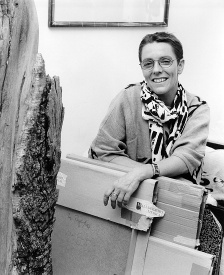
| 1954 | Born in Rudolstadt, Thuringia |
| 1977 | Studied in art education/history, Karl Marx University, Leipzig |
| 1978-79 | Ceramic form specialist, Torgau Earthenware Works |
| 1979-85 | Studies in sculpture, Art Academy of Berlin (Weissensee) |
| 1985-86 | Research Assistant, Art Academy of Berlin (Weissensee) |
| Since 1986 | Freelance |
| 1986, 1987, 1990, 1994 | Participant in stone sculptors’ symposia in Reinhardtsdorf |
| Since 1991 | Teaching at various institutions: – Department of Art Education of Humboldt University, Berlin (1991-97); – Free Art School of Berlin (1992-95), Brandenburg Institute for Advanced Teacher Training, Potsdam (1996), etc. |
| 1992, 1993 | Art education projects in Berlin schools |
| Since 1992 | Paper-making technique acquired Lives and works in Berlin and Friedenfelde |
Solo Shows
| 1991 | “Landschaften” (“Landscapes”): painting and sculpture, Berlin |
| 1995 | “Sein und Schein: Zeitspuren” (“Being and Illusion: Time’s Traces”): works in handmade paper and sandstone, Berlin "Vertikales" (“The Vertical”): works in handmade paper, Berlin Works in handmade paper works and sandstone, Glienicke |
| 1997 | Paper and Stone, Berlin |
| 1998 | “Vertikale Figurationen” (“Vertical Figurations”): works in handmade paper, graphics, sculpture, Berlin |
| 1999 | Works in handmade paper, stone and bronze, Berlin |
| 2000 | Works in handmade paper, graphics, works in sandstone, Berlin Works in handmade paper, graphics, sculpture, Saalfeld Recent works by Karla Gaenssler, Hong Kong University of Science and Technology Library |
Group Exhibitions (selected)
| 1986 | First Annual Exhibition of Young Berlin Artists |
| 1988 | Werkstatt 88, with Maria Luise Faber, Kerstin Zilger, Hans-Joachim Niemann, Berlin |
| 1991 | “Zeitspuren” (“Time’s Traces”), Inventor e.V., Berlin |
| 1995 | “Informelle Poesie” (“Informal Poetry”), Inventor e.V., Berlin |
| 1997 | Second Annual Sculptors’ Symposium, New Art League of Saxony, Dresden |
| 1998 | Sculpture and graphics, with Helmut Mueller, Eichwalde |
| 1999 | Wood and stone sculptures, Fehmarn, with Puck Steinbrecher and Hilde Leiss |
4:30 pm
Ping Yuan and Kinmay W Tang Gallery
Ping Yuan and Kinmay W Tang Gallery