



Foreword
The 1930s was an extraordinary period during which many schools of thought and many outstanding scholars and talents emerged. It was during this period that the first climax of Chinese watercolor paintings came into being.
Watercolor painting, originating in Europe in the fifteenth century, grew to be an independent branch of painting in the eighteenth century England. It is still a popular art form in the West today. Most of the Chinese artists who studied in Europe and Japan in the 1930s, in addition to oil painting, were proficient in watercolor. Fengmian Lin, Xunqin Pang and Jintang Liu were among the renowned masters. Most of the painters in that period were not only skillful artists, but also scholars with broad vision, engaging in high pursuits. Even today, their works are inspiring models.
The 1950s witnessed the second climax of watercolor painting in China, centering in Shanghai. Mingti Fan, Ximing Li, Roujian Sheng, Chongren Zhang, Jianchen Li and many others were all famous for their watercolor painting.
The third climax of watercolor painting happened in the 1980s. During this period, with numerous watercolor painters and frequent watercolor painting exhibitions, a national watercolor painters association was founded. It is not an exaggeration to say that during this period, watercolor painting reached an unprecedented popularity and success.
Zhinan Jiang entered the field of watercolor painting in the 1990s. In 1991, his painting “Sea” was displayed at the Watercolor Paintings Exhibition of Beijing for the first time and received favorable criticism. In 1992 he was invited to show his “Kangling Stone Tablet” in Taiwan at the First Exhibition of Works by Renowned Mainland Watercolor Painters. His works were frequently exhibited in the following years and he gradually established his academic status in the field of Chinese watercolor painting.
Majoring in dyeing art, Zhinan Jiang graduated from the Central Academy of Arts and Design. Before the application of computers, dyeing design was done solely by hand, using gouache or watercolor. This training provides Jiang a good foundation for later mastery of watercolor.
In my opinion, Jiang’s watercolors can be divided into three stages. His works in the first stage are mainly sketches from daily life. He painted rice fields, flowers, village scenes, his wife and her cat. These subjects might seem to be the result of random selection, however they are all the persons and things close to his heart. This stage has two characteristics: one is his respect for light; by using warm colors, he creates a sense of intimacy in life; the second characteristic is his careful brushwork, in which he uses the natural veins of objects as the medium to establish the visual order of his paintings. These concrete images transmit a certain sense of abstractness. It is this abstract quality that seems to be the real backbone of the structural logic of his pictures.
In the second stage, Jiang painted the Bicycle Series. Like all his work, these paintings are characterized by leaping and shining light. Objects and their shadows reflect upon each other; it is hard to differentiate which is the main part of a picture. In fact, the bicycles are nothing but a medium, for the order of pictures is obviously abstract. It was a breakthrough for Jiang: to go from imitating the concrete objects to expressing the logical order of his inner mind. His strokes became more fluid, lively but still forceful, more compatible with the nature of watercolor.
In the third stage, he painted what he saw in Europe during the time he was studying in Paris. Although he reproduced the actual scenes before him, in order to keep the memory vivid, his choice of subject shows more reason and rationality in the structure of pictures and in color tones than his earlier works. More importantly, the spiritual aspect of the scenes became the first thing he expected to describe and reproduce. They are obviously different from the works in the first stage. He has achieved even better mastery of technique, the coordination of hands and mind, and the integration of scenes and feelings. Hands reflect mind; scenes integrate feeling. He has matured as a watercolor painter.
Light is very significant in Jiang’s watercolors. It is not only a medium, but also a goal for Jiang. I respect his sensitivity to light and am startled by the fact that he deals with light so vividly and spiritually. Light is not only a necessity of life but also a belief. I have no doubt that Zhinan Jiang also thinks this way.
Jiang regards watercolor painting as his life-long career. It is not easy since it seems that traditional Chinese painting and oil painting are considered to be the mainstream of art in China today. It requires courage and confidence to find a place beyond the mainstream. I believe he will succeed.
Dakai Du
Beijing, 1998
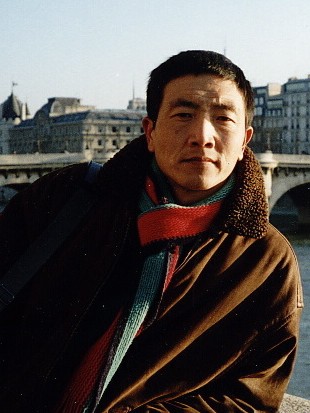
| 1963 | Born in Chengde, Hebei province, China |
| 1981 | Graduated from the School of Arts and Crafts of Hebei |
| 1988 | Graduated from the Central Academy of Arts & Design and appointed as a teacher until the present |
| 1991 | The painting “Sea” was exhibited at the Watercolor Paintings Exhibition of Beijing |
| 1992 | The painting “Kangling Stone Tablet” was exhibited in Taiwan at the First Exhibition of Works by Renowned Mainland Watercolor Painters |
| 1993 | The painting “Baiyangdian Lake” was exhibited in Hong Kong at the Exhibition of Works of Beijing Watercolor Society |
| 1994 | An Exhibition of Watercolor Paintings by Zhinan Jiang was held by Boya Gallery in Shenzhen The Painting “Early Spring” was exhibited in Korea at the Exhibition of Selected Watercolor Paintings by One Hundred Chinese Painters The painting “Family in Taihang Mountain” was exhibited at the Exhibition of Modern Chinese Watercolor Paintings The painting “Stories of the Past” was exhibited at the Invitational Exhibition of Modern Watercolor Paintings Won the special-class prize awarded by the Three Gorges Art Academy for the painting “Untitled” The painting “Rocks” was exhibited in Tokyo at the Associated Exhibition of Paintings of the Central Academy of Arts & Design |
| 1995 | Won the Academic Prize at the First Exhibition of Watercolor Paintings of Chinese Young Painters for the painting “Sunday” |
| 1996 | Won the silver prize at the Third National Exhibition of Watercolor and Gouache Paintings for the painting “The Dialogue between Light and Shadow” Held “The Exhibition of Watercolor Paintings by Zhinan Jiang” in the Xuebai Gallery of Beijing Chosen to design “The Special Stamp of City Scenery” issued jointly by China and Singapore The painting “Cane Chair” was exhibited at the First National Exhibition of Watercolor Paintings. Studied in Paris and held an exhibition there Held an exhibition of paintings at Fontainebleau, France |
| 1997 | The painting “The Cat in Shadow” was exhibited at the Joint Exhibition of Paintings by Chinese and Korean Painters The painting “Days of Brilliant Sunshine” was shown at the Exhibition of Chinese Art Held “Travel in Europe: Exhibition of Watercolor Paintings by Zhinan Jiang” Invited to be a member of the evaluation committee of the National Exhibition of Watercolor Paintings of Young Chinese Painters Two paintings were included in the Watercolor Volume of “The Complete Collection of Chinese Art” |
| 1998 | The painting “Wife and Cat” was exhibited at the Second National Exhibition of Watercolor Art Held exhibitions of paintings in San Francisco and Syracuse, USA Paintings exhibited in Shenzhen at the Invitational Exhibition of Young Chinese Watercolor Painters |
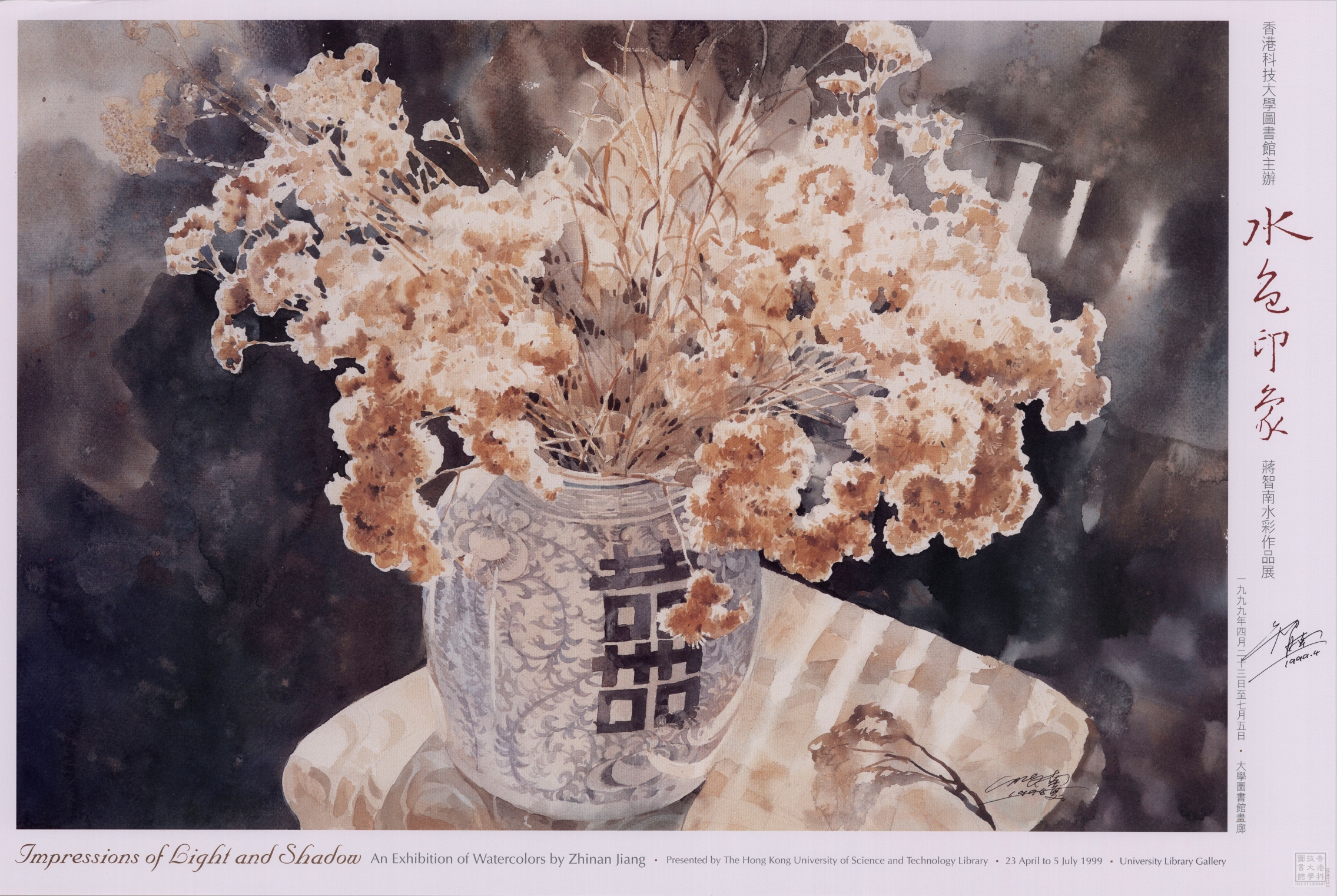
| 1999 | Held “Impressions of Light and Shadow: An Exhibition of Watercolors by Zhinan Jiang” at The Hong Kong University of Science and Technology Library |
4:30 pm
University Library Gallery
Opening Remarks
I feel greatly honored to have been asked to introduce our artist this evening. I also feel a bit embarrassed to speak at an art exhibition. Being a linguist who deals primarily with sounds and graphs, I know very little about art. I must admit, however, that I love art and I adore beauty. I came down to the library three nights ago for a sneak preview of today’s exhibit, and for reasons I cannot explain there was something in the paintings that I connected with right away. An instant click, an attraction at first sight. I got hold of a catalogue, which I took home, where I spent an hour or so studying the illustrations and the introduction by Du Dakai. I felt all the more attracted to the pictures; but I was also all the more lost for words to express my feelings. Mr. Jiang, whose acquaintance I have had the pleasure of making this evening, is very talented. He did not become a professional artist until the early 1990s and within ten short years he has gone through many phases and stages of transformation, as outlined in the preface of the catalogue, and now is one of the most celebrated watercolorists in China. According to Mr. Du, Mr. Jiang’s early works are mainly sketches from daily life, concrete objects that transmit a certain sense of abstractness. In his next phase, as represented by the Bicycle series, he moved from imitating the concrete to expressing the logical order of his inner mind. In his 1998 paintings, the third stage in Mr. Jiang’s art, he is more attracted to the spiritual aspect of a scene, and he has achieved an even better mastery of technique, an integration of scenes and feelings. I am not an artist or an art critic, and I can’t say very much about technique, which is of course one of the chief factors that account for an artist’s success. For me, it is the vision, the feelings, or the spiritual inspiration in a work of art that distinguish a great master from a skilled artist.
One of the pictures I like best in today’s exhibition is “Village Child”. A young child, most likely a girl, leans against a stone stand, trying to catch a few moments of rest, perhaps after a day of hard work. Just behind her sits a bundle of sticks, which, mostly likely, she will soon carry upon her shoulders. She stands in a singularly odd position, as you might have noticed, with her body forming a cross, a sign of crucifixion. In fact, we don’t see a happy child in the picture, but a child whose face betrays little expression. She looks out, but at whom? Is she asking for help? Or telling us to leave her alone? We don’t know. But there is, I noticed, a large empty space in the picture. Even though the child is the focus of the painting, she occupies only one-third of the space and half of the picture is a huge blank. Just imagine what the picture would mean to us if the empty space were removed. The picture would look cluttered, especially where the colors are strong and heavy. Once that extra space is added, the world extends and we feel an instant lifting of a burden and tension. That space seems to invite us to join the girl, and yet the expression on her face is not necessarily one of invitation. An anomaly of some sort, a contradiction that captures our fancy and fantasy.
In fact, I feel that Mr. Jiang has successfully used empty space to invite his audience to join him in constructing or telling a story. And not only in his “Village Child”. Compare the Bicycle series with another recent picture, “Untitled”. The bicycle series features bikes in fast motion, almost too fast to be captured with strokes and lines. We see a montage of colors in different lights, an abstract form of vitality and speed. Yet, we never see the rider. We know a person is there to peddle the wheels. Or, have we transformed ourselves into the riders? In his 1999 picture, which also features a bicycle, we are shown only half of the vehicle, the first half hiding behind a wall in a back alley. Again, it is a picture with no human image, but we feel a human presence. We are presented with an empty or deserted alley. Who was there? Who came on a bike? Where is the rider now? Inside the house behind those walls? Again, an intimate story waits to be told.
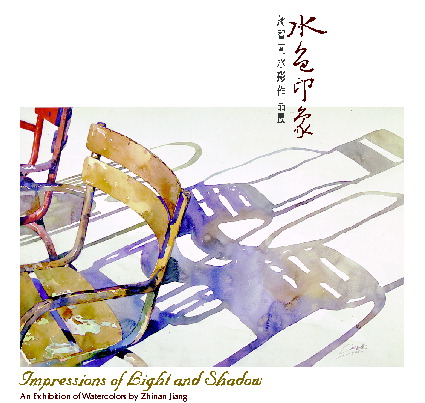
A picture can tell more than a thousand words, and I think the magical powers of Mr. Jiang’s paintings are particularly effective in invoking our imaginations. He manipulates space to create a space for our participation, using shadows to add to that mystery of presence and absence. For example, in the picture of chairs in the Luxembourg Gardens, not only do we see empty seats, we also find that shadows on the ground are depicted in two-thirds of the picture. These are not reflections of people but rather images of deserted, rustic garden chairs. There are no visitors to the park, and we seem to have the entire space all to ourselves. Painted in a sunny brown color and a cooling blue, it is a very warm picture. Don’t we want to take a seat and enjoy a balmy afternoon in this French garden?
Mr. Jiang’s pictures take us to different parts of the world — a pier in Venice, the Berlin Wall, a back alley in a rural town, a lotus pond where we almost seem to witness the passage of time. He shares his visions with us and he lets us into a world of light and shadow, a world that he creates in watercolor, a world whose infinite images of change he reproduces and captures for our appreciation. And, for your generosity in sharing your talents and stories with us, I thank you on behalf of the audience and the University of Science and Technology.
H. Samuel Cheung
Hong Kong, 1999
開幕辭
我非常感謝周館長的邀請,讓我今天能躬逢盛會來參加這個畫展,同時見到畫家本人蔣智南先生。這兩天我已經來過場地數次,先睹為快,看了展出的作品。這次展覽的題目是“水色印象”。水色這個詞,不知是誰給起的,但是比諸水彩,實在高明許多。水彩的「彩」給人一種五彩繽紛,濃艷絢爛的感覺。而水色則還我本色,水色交融,或濃裝飄忽,或淡抹動人。環觀蔣先生這次展出的四十多幅大小製作,燦爛中又見淡雅,給人一種反樸歸真的感覺。水色本來是最難捉摸的形象。水中之色,飄浮不穩定,眩目而又恍忽。蔣先生的畫正是以影以光來捕取對景、對人、對物的剎那印象。我不是內行人,這種外行話,其實是我這兩天來看畫時心裡的感覺。而最使我心動的是蔣先生在畫中對空間的使用。蔣先生的畫,虛實對比很強烈,虛比實似乎還多,更能添增畫裡的空靈感覺。比方這一幅 “村童” 的畫,用色相當的濃,但因為空白佔了二分之一,濃相對地淡化,就不會使人感到沈重壓迫。試想這一幅畫中把空白去掉,突出了村童,畫面就會顯得擁擠,舒暢和擠迫的對比,也許更能表現出畫中的特點。這個小孩,似乎是個女孩,倚石墩而立,雙腳微微交叉,她背後有一捆竹篦,手不離竹。是小孩兒玩耍後的小憩,還是她工作後暫時放下竹筒,偷空喘息?她站立的姿態雙手很像橫伸一個十字架,這象徵什麼?她臉上顯示的不是微笑或童真。是迷惘?是無奈?是漠然?在她面前卻是一大片空白或空地,她不望向空地,而望向畫外。這又是什麼意思?是在邀請看畫的人進入這個空間?沒有留空,畫就會顯得死實;有了空白,就有了想像的空間。蔣先生有一系列的畫,題作自行車。簡單的筆觸,大膽的蒙太奇手法,捕捉了自行車的奔馳和衝勁,但是畫中並沒有騎車的人。我們只通過畫面而感到騎者的存在,活力溢滿紙面。與此相對是蔣先生1999年的近作「無題」,是後巷裡的一輛自行車 — 應該是半輛,車的前半藏在半堵牆後。這不再是奔馳的自行車,一切歸於靜寂。但是畫中留有許多空白,影子更惹人遐思,是誰來了?人又去了那兒?從小門進去了嗎?每一幅畫都是一個故事,而這個故事的發展卻是我們看的人自己添補進去的。畫者一兩筆的勾勒,卻勾引起我們無限的幻想。意在畫外,這是上等的好畫。這次我有機會在這兒看到這許多畫,想了很多故事,又見到了畫者本人,實在感到十分興奮。可惜我不是一個小說家,更不是一個畫家,所以只能野狐禪地說一下自己的感受。不過我也想借這機會代表科大向蔣智南先生再次致謝。
張洪年
一九九九年四月廿二日
University Library Gallery