

The Subtle Sculptural Language of Yuyu Yang
“My sculptures in general, and stainless steel sculptures in particular, harmonize man and his environment spiritually, mentally and physically; this is why I call my sculptures ‘lifescapes’ instead of ‘environmental sculptures.'”
From the early fifties into the seventies, Yang’s work evolved from traditional expressions to abstract, spiritual and simple forms. Yuyu Yang has worked with paper, cloth, wood, clay, bronze, marble, iron and stainless steel. However, he works now almost entirely with stainless steel, which he feels simplifies his ideas perfectly. The thematic symbols of dragon and phoenix – emblems of male and female, sky and earth, and other essential pairings in Chinese philosophy appear frequently. The mirror-like surfaces of the stainless steel unite his sculpture with the environment. Merging environment and sculpture became the central philosophy in Yang’s work from this time forward.
The underlying theme of Yang’s production remains the same: expressing human life with simplicity, bravely achieved out of modern materials and ideas. In the process, he has – single-handedly – created a new contemporary sculpture which has become recognized throughout the world.
Where many artists of our time derive their inspiration from other art (or money), Yang’s true source is nature itself. Even if his primary material, stainless steel, seems more industrial than stone or wood or clay, he has not cut himself off from a deeply committed sense of the environment and what it means. The bridge between art and nature is form. Commenting on “Cosmic Encounter”, Yang notes, “It is shape that brings all things together and sends them apart.” The relationship between square and round, convex and concave, or empty and solid is an erotic one in the old sense of the term, as an expression of two forces brought together. The synthesis is achieved through Yang’s ability to trace the relationship between shapes, lines, the curve of a planet’s path and the curve of a Chinese roof and other similar motifs.
Born in Taiwan, Yang’s education and early career had an unusual international dimension, particularly for those of his generation. He studied at the Tokyo Art Academy, where he learned architecture, as well as at FuJen Catholic University in Beijing and Taiwan Normal University in Taipei. As a reward for helping the Catholic Church relocate FuJen University to Taiwan, he was offered a trip to Rome, where he remained for three years until 1966 to study art. In Italy his paintings and sculptures were widely exhibited, and he won gold and silver medals at the Olimpiade d’Arte Cultura in 1966.
After returning to Taiwan, he kept up the global aspect of his career, completing commissions for major sculptures in Japan, Lebanon, Saudi Arabia, Singapore and Hong Kong. Americans had their first glimpse of his talent in 1973, when his profoundly symbolic “East West Gate” was unveiled in front of Pei’s Orient Overseas Building in the heart of Manhattan’s financial district. A year later in Spokane, Washington, his “Spring Again Over the Good Earth” appeared at the World’s Fair. Since that time, his reputation here in the United States as well as in Europe and Asia has grown, making him without question the pre-eminent contemporary Chinese sculptor. At home, where he is recognized as a pioneer not only in sculpture but also in the use of lasers in art, he assured his place in Taiwan’s art history by establishing the Yuyu Yang Lifescape Sculpture Museum, a spectacular survey of his career from “The Philosopher”, which brought Yang one of his first awards in Paris in 1959, to the most recent work.
In a book about Yang published by the Taiwan Museum of Art, there is a stunning photo of the sculptor sitting cross-legged in front of a monumental statue of the Buddha on which he is putting the finishing touches. In the foreground his wife kneels, nursing his son. The gold and sepia tones of the photograph, the archaic splendor of the statue Yang is carving as well as the ancient scroll behind him, all belie the date of the photograph: 1955. It is as though we have a sudden glimpse of the intimate world of the artist in China in Yang’s beloved Wei dynasty when the formal vocabulary that is the source of so much of Yang’s early sculpture was itself in its infancy. Aside from the usual curiosity that a document like this raises about the context of the artist’s studio and home, the type of art and decorations around him, the natural light flooding a tall window behind him, the spare but elegant traditional living quarters and the old wicker armchair and tatami-style mats of the home, the photo serves a deeper purpose in the study of Yang’s work and career. It underscores the sense of timelessness in Yang’s thought, even to the point of presenting an apparent anachronism. Here is an artist we can meet and greet ourselves, and his hand is finishing an “ancient” Buddhist statue in a traditional Chinese home filled with the basic tools and art of an earlier epoch. Far from being a nostalgic evocation of antiquity – a hokey attempt to invoke the atmosphere of the past – the photo shows Yang participating in the life of the earlier time and in the continuing tradition of sculpture as an expression of both metaphysics and of materials. Nothing could present the impressive “rootedness” of Yang as an artist and an individual better than his photo. It shows the tranquility of traditional Chinese home life, and across a barely perceptible threshold it depicts a studio where the artist works on his individual dreams. Who would guess, looking at this peaceful and timeless scene, that Yang’s work would end up attracting a following in New York, Tokyo, Paris, the Middle East, the American Midwest, virtually around the world. In an era when multicultural currents are moving through the intellectual world, and environmental concern is permeating the political and artistic world, Yang’s work is more timely than ever.
Charles A. Riley
Excerpt of Simply Put
City University of New York, 1994
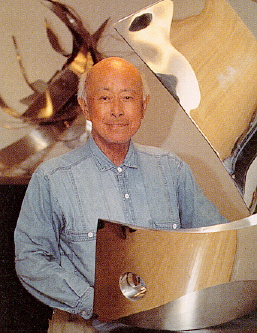
Born in Yilan, Taiwan in 1926; deceased in Hsinchu, Taiwan in 1997.
Education:
- Architecture Department, Tokyo Art School, Japan
- Art Department, FuJen University, Peking
- Art Department, Taiwan Normal University, Taipei
- Sculpture Department, National Academy of Art, Rome
| 1953 | Sculpture, “Recline”, displayed in the Taiwan Provincial Art Exhibition |
| 1959 | Bronze sculpture, “Philosopher”, won honorary mention in the 1st International Youth Arts Festival, Paris |
| 1960 | Bronze statue, “General Claire L. Chennault”, displayed at Taipei Park.” Print & Sculpture Exhibition by Yuyu Yang” held in the National History Museum, Taipei |
| 1961 | Designed giant reliefs for the Sun Moon Lake Teachers’ Hostel, Taichung |
| 1964 | Donated sculpture “Earnest Hope” to Pope Paul VI at the Vatican Organized a “Contemporary Chinese Art Exhibition” at the Modern Art Museum in Rome Sculpture, “Observing Change in Quietude”, exhibited in and collected by the National Museum of Contemporary Art, Rome |
| 1966 | 1964-66, held exhibitions in major cities of Italy (Legnano, Turin, Rome, Messina, Spa, Venice) Awarded Gold Medal for Painting and Silver Medal for Sculpture at the Olimpiade d’ Arte Cultura, Abano Terme, Italy Selected as one of Taiwan’s 10 Outstanding Youths Organized an Italian medallion sculpture exhibition at the National History Museum, Taipei |
| 1968 | Invited to participate in the International Sculptors Association Held a stone sculpture exhibition in Tokyo |
| 1970 | Designed sculpture, “Advent of the Phoenix”, for the Taiwan Pavilion, Expo’70, Osaka |
| 1971 | Designed a series of marble sculptures “Peace and Prosperity” for Mandarin Hotel, Singapore. “Soul Mirror” displayed in the 2nd Modern International Sculpture Museum, Japan |
| 1973 | “East West Gate”, a stainless steel lifescape sculpture, placed in front of Orient Overseas Building, New York City |
| 1974 | Designed “Spring Again over the Good Earth” for the Seattle World’s Fair |
| 1980 | Held “Lifescape Sculpture Exhibition” at Taichi Gallery, Taipei and “From Lifescape Sculpture to Laser Lifescape” Exhibition at Hua Ming Gallery, Taipei Awarded the first Taiwan Golden Tripod for excellence in architectural design |
| 1981 | Organized the first “Laser and Lifescape Exhibition” in Taiwan |
| 1985 | Participated in the “Contemporary Chinese Sculpture Exhibition” held in Exchange Square, Hong Kong |
| 1986 | Participated in the “Experimental Contemporary Art Exhibition” held in the National Palace Museum, Taipei Held “ARTS-UNIS”, a touring exhibition in Japan “Yuyu Yang’s Laser and Lifescape Sculpture Exhibition” presented by Hong Kong Arts Center and Hanart T.Z. Gallery in Hong Kong |
| 1987 | Designed “A Sculpture Series of Ancient Musical Artifacts” for the National Concert Hall at the Chiang Kai-shek Memorial Hall, Taipei |
| 1988 | Designed lifescape sculpture “Stride Forward” for the Chinese Union Bank of Singapore |
| 1989 | Stainless Steel, “Young Phoenix”, collected by the Taipei Fine Arts Museum ”All for the Public” placed in the International Convention Center, Taipei |
| 1990 | Exhibited “Dragon in Flight”, a monumental stainless steel Lantern Festival sculpture at Chiang Kai-shek Memorial Hall, Taipei Created “Phoenix Scales the Heavens” for permanent display in the Peking Olympic Sports Center Designed “New Forever” for Earth Day, displayed at the Chiang Kai-shek Memorial Hall, Taipei |
| 1991 | Held the “Stainless Steel Sculptures Exhibition” in the National Museum of Singapore. Awarded the “Prize for the Promotion of World Peace through Culture and Arts” Reproduced “The Advent of the Phoenix” in stainless steel, originally designed for the Taiwan Pavilion in the ’70 Osaka Expo, for the Taipei Bank, Taipei |
| 1992 | Held “Yuyu Yang’s Stainless Steel Sculptures Exhibition” in Shin Kong Mitsukoshi Department Store, Taipei and in Kaohsiung Designed monumental stone and stainless steel sculptures for the International Golf Course in Tsukuba Kasumigaura, Tokyo. The metal sculptures included “Birth”, “Growth”, “Cosmic Encounter”, and “Source of Life” Founded the Yuyu Yang Lifescape Sculpture Museum. Held a sculpture exhibition at Yilan County Cultural Centre. Participated in “Art Asia Hong Kong” |
| 1993 | Participated in the Miami Arts Fair, Miami Completed “Great Universe” large lifescape sculpture set, commissioned for the lobby of the Kaohsiung World Trade Building Participated in the 2nd “NICAF” (Nippon International Contemporary Art Fair), an international modern art exhibition, Yokohama Completed “Common Lineage”, a large lifescape sculpture commissioned for the Tainan County Stadium “Balance and Harmony”, “Solar Brilliance”, and “Harmony” collected by the Sunrider Museum, Los Angeles One-man show at Shin Kong Mitsukoshi Department Store, Taipei “Yuyu Yang 60-year Retrospective Exhibition” held at the Taiwan Museum of Art, Taichung Participated in the “Foire Internationale d’Art Contemporain” 20th Anniversary Exhibition, Paris |
| 1994 | Participated in the Grand Opening Exhibition of the Shin Kong Mitsukoshi Department Store, Kaohsiung Participated in the 3rd “NICAF” in Japan Participated in international contemporary art fairs in Hong Kong, Miami and New York Held “Yuyu Yang ’94 Exhibition” in New York Displayed “The Wisdom of Life, Treasure Natural Resources”, in a series of activities organized by Hsinchu Culture Centre and Science-Based Industrial Park, Taiwan “Dawn”, a large stone sculpture, displayed at the 3rd International Stone Sculpture Symposium, Kagawaken, Japan Invited to participate in the Asia International Sculptures Exhibition in Japan Held “Yuyu Yang ’94 Exhibition” at Kuang Hwa Gallery, Hong Kong |
| 1995 | Participated in the 4th “NICAF” in Japan. Held “Yuyu Yang Exhibition” at the UC Berkeley Museum of Art, Science & Culture Held “Yuyu Yang Exhibition” at Johnson & Johnson Sculpture Grounds, New Jersey Held “Yuyu Yang Lifescape Sculpture Exhibition” at Shin Kong Mitsukoshi Department Store, Taipei Designed 7 lifescape sculptures and stone arrangements for the opening of Chuan Kuo Golf Course, Miaoli, Taiwan. This 3-month exhibition of Yang’s works, older and recent, was held in celebration of its grand opening “An Ancient Forest”, wooden sculpture, commissioned by Taiwan Museum of Art Selected as first international Fellow of the Royal Society of British Sculptors |
| 1996 | Completed “The Wisdom of Life”, a 6.6 meter high stainless steel lifescape sculpture, in celebration of the 100th anniversary of National Chiao Tung University, Taiwan Invited by the Royal Society of British Sculptors to hold a half-year special exhibition at Chelsea Harbour, London |
| 1997 | Completed “The Wonder of Solidarity” in celebration of the 200th anniversary of Yilan’s development, commissioned by Yilan County Government, Taiwan Participated in the group exhibition “Four Masters from Taiwan” at Art Beatus Gallery, Vancouver Held “Lifescape Sculpture of Yuyu Yang” at Hakone Open-Air Museum, Japan |
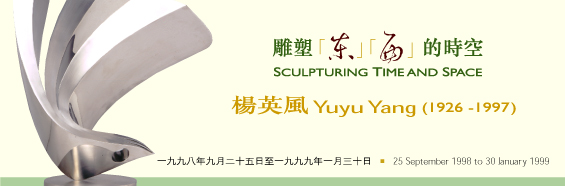
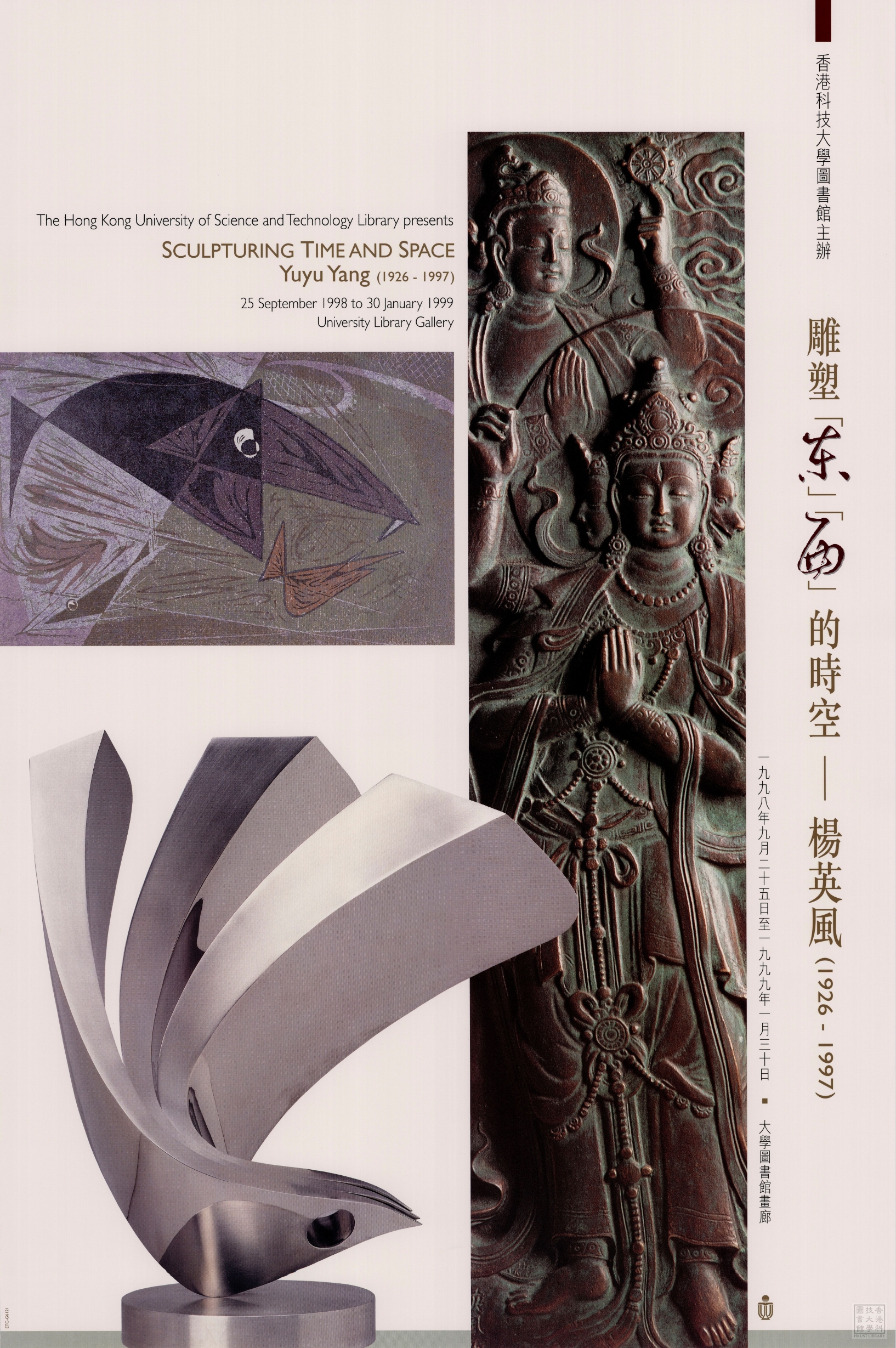
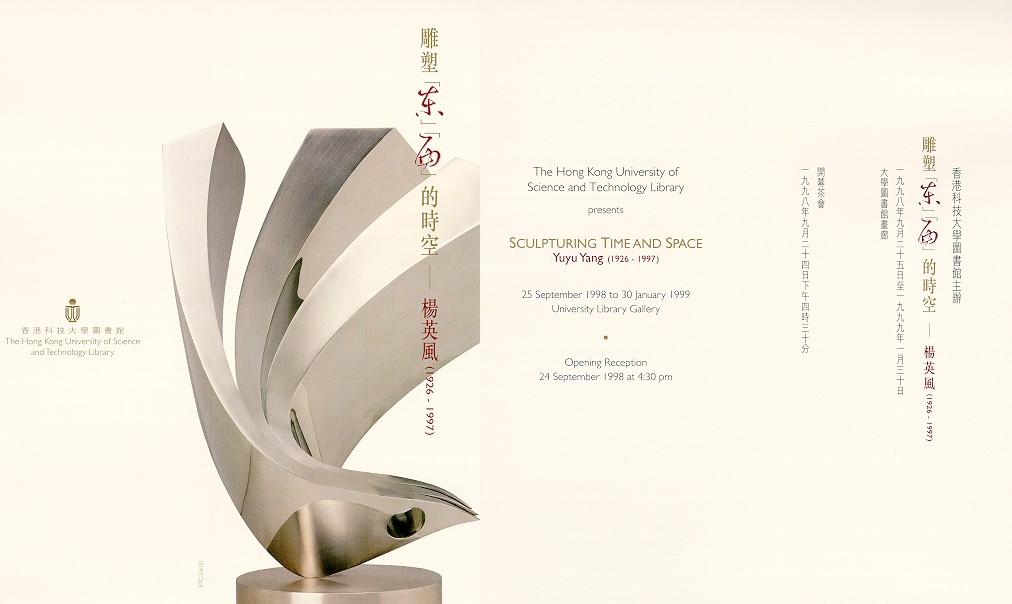
| 1998 | Hong Kong University of Science and Technology Library held “Sculpturing Time and Space – Yuyu Yang (1926-1997)” exhibition |
4:30 pm
University Library Gallery
宏觀美學
我十多歲時,曾到大同雲崗,大陸北方恢宏的自然景觀融合成就了雲崗大佛龐大的氣勢,使我深受感動,那一剎那的宏觀震撼,影響我的創作一直到今天。
回首來時路,從宜蘭到北平到東京以至羅馬,求學階段都剛巧碰上時代轉接點,使我的學習過程有更多的經歷和更廣的視野,也養成我喜愛研究各種媒材應用於創作,漫畫、版畫、木雕、石雕、鑄銅、不銹鋼…等,豐富了創作內涵,也歷練出更自如的環境規劃與景觀雕塑創作。思想起來,我最銘感謝天的,是此生際會的許多善知識善因緣,使我在動盪的時代、艱苦的藝術工作中,得以幸運地埋首發揮理想。
因此,我以「呦呦」為字,畢生以和諧分享的襟懷,以真善美的造型藝術與生活美學,潛移默化為改善人類的生活與未來貢獻心力。
先哲有云:「萬物唯心造」,佛家亦言:「心淨則國土淨」。近代因國際局勢不斷變化,世界各國社會爭端混亂叢生,許多人際、社會、甚至美學的價質觀都面臨重新定位。藝術家本身也不斷地反省、批判,尋求未來美學價質觀應有的發展方向。我之管見:美學為純精神活動,唯精神文化內涵方可充實營養之。西方物質性的機械文明發展出高精密科技,對世人貢獻很大;但東方文化本具而被忽略遺忘百多年的精神境界文化,更應是美學價值觀重新定位的動力來源。我花費六十多年深觀思辨中國的思想菁華,重新思考應用於現代藝術創作,表現於造型與生活美學,希望能為中國文化和世界人類生活與美學價質觀,開闢出一個新方向新境界。邇近四載,我履應邀參與歐美亞洲等地舉辦之國際藝術博覽會,世界各地觀眾對我的作品內涵都能理解、欣賞、喜愛。但我更希望國人也能一起尋思這個重要的、國際性的課題。
時值個展,爰引數語略舒感懷,並謹以造型語言傳達中國文化菁華與宏觀思想的精神內涵,呼應人類內心真善美的本性,共同追求健康、自然、無私、自由、和平的理想。
楊英風
一九九五年 台北
走過從前,精益創新
一般人在談論藝術時常將我歸入抽象藝術中。其實早在1950年代在農復會「豐年」雜誌擔任美術編輯時,我就陸陸續續創作一系列以農村題材為背景的作品,其中包括版畫、插畫、雕塑、水彩……等等。那時我為雜誌設計封面。作漫畫、畫衛生常識、也畫植物解剖圖,這是接近農民的好機會,我常感動於他們的質樸,也結交了許多其它藝術家交不到的朋友,台灣農村秀麗的景緻,民俗節慶鑼鼓喧天的熱鬧也常縈繞在胸懷激發創作靈思,更可愛的是那些樸實的農村人民,終年操勞,無怨無悔,一秉中國傳統勤儉踏實的美德。有時自覺思想、行事都像個鄉下人或農夫,除了和這一系列農村經驗有密切的關係,大概也和幼年生長環境有關吧!
自幼生長在宜蘭鄉下,明媚的山水景緻陶冶了我的心眼去認識美、體會美、並享受美。童年時光單純的心靈被自然環境薰陶著、教育著,自然對鄉土散發出的純樸感覺特別親切。爾後中學至北平求學,首次接觸大城市,深深被古都散發的爾雅氣息震憾著,年青的心便埋下了日後宏揚中國傳統文化的因子。光復後返台娶妻生子,應藍蔭鼎先生之邀入「豐年」雜誌工作,一作11年 ,每月有一、二次機會深入各鄉鎮,對台灣的鄉土民情、風俗習慣、景觀可謂有深度的接觸和認識,這方面的經驗不僅是當時社會環境的映射及工作的機緣,其實是延續著自幼喜好自然的本性。這次展出的作品大部份是這段期間創作的。
1964年代表輔仁大學校友至羅馬向教皇致謝,有機會遠赴歐洲一睹西方精緻而寫實的藝術,看他們大膽表現肉體的愛、慾,並受工業革命物質文明的沖擊陷入精神苦悶,紛紛反思破壞虛偽及人造,回歸自然的純真。畢竟西方文明是源自畜牧文化,以掠奪、競爭的本質追求自然,其所謂的自然乃是不受拘束、不斷變化、野性的和激發熱情的,終究是以個人的感情為依歸。以西方雕塑鼻祖羅丹為例,他將雕塑從紀念碑上歌功頌德之僵化機械性中拯救出來,並使雕像從內在迸發出生命,呈現出內在性格,其題材仍不離人類精神苦悶。爾後西方藝術落入物質、材質之迷思,鑽研牛角尖,呈現破碎、紊亂的局面。
而中國人的自然是屬於自然界的自然,回到渾沌未開、萬物合一的起源,是追求物我交融的感情融合,所以呈現「天人合一」的性格。反思回歸自然的精義,在羅馬三年,我深深地思索這些問題。並堅定自己未來創作方向,是故在歐洲藝術氣氛薰陶下,我反而創作了一系列以書法線條表現的作品,題材也多以自然界動植物為主,完全迴異西方寫實赤祼的表達方式。
但中國自鴉片戰爭後民族自信喪失殆盡,全盤西化的結果,藝術也迫不及殆拾其餘緒發展,藝壇也呈現中西交雜的狀況。回國後痛心國人菲薄民族文化的珍寶也看穿西方文明趨向破碎、迷亂。便以中華民族五千年孕育的文化精髓為創作靈思,尤其是擷取魏晉至唐宋,佛教傳入中國,提昇中國人精神境界,豐富文化層次最精緻的一段。
我的創作歷程由鄉土轉向民族,風格由寫實而抽象,便不難看出軌跡了。
而今回首1950年代這段歷程,其實是擴大藝術創作視野的重要基石,沒有中國人克勤向上的個性就沒有楊英風不斷歷新的歷程。而這民族性格潛藏在中國人生存的地域和空間,無論是在文化昌盛的都會或純樸實在的鄉村。
走過從前,創作者不斷精益創新,期待觀者珍惜先人純樸踏實的個性,瞻望未來。
楊英風
一九九零年 台北
The Subtle Sculptural Language of Yuyu Yang
“My sculptures in general, and stainless steel sculptures in particular, harmonize man and his environment spiritually, mentally and physically; this is why I call my sculptures ‘lifescapes’ instead of ‘environmental sculptures.'”
From the early fifties into the seventies, Yang’s work evolved from traditional expressions to abstract, spiritual and simple forms. Yuyu Yang has worked with paper, cloth, wood, clay, bronze, marble, iron and stainless steel. However, he works now almost entirely with stainless steel, which he feels simplifies his ideas perfectly. The thematic symbols of dragon and phoenix – emblems of male and female, sky and earth, and other essential pairings in Chinese philosophy appear frequently. The mirror-like surfaces of the stainless steel unite his sculpture with the environment. Merging environment and sculpture became the central philosophy in Yang’s work from this time forward.
The underlying theme of Yang’s production remains the same: expressing human life with simplicity, bravely achieved out of modern materials and ideas. In the process, he has – single-handedly – created a new contemporary sculpture which has become recognized throughout the world.
Where many artists of our time derive their inspiration from other art (or money), Yang’s true source is nature itself. Even if his primary material, stainless steel, seems more industrial than stone or wood or clay, he has not cut himself off from a deeply committed sense of the environment and what it means. The bridge between art and nature is form. Commenting on “Cosmic Encounter”, Yang notes, “It is shape that brings all things together and sends them apart.” The relationship between square and round, convex and concave, or empty and solid is an erotic one in the old sense of the term, as an expression of two forces brought together. The synthesis is achieved through Yang’s ability to trace the relationship between shapes, lines, the curve of a planet’s path and the curve of a Chinese roof and other similar motifs.
Born in Taiwan, Yang’s education and early career had an unusual international dimension, particularly for those of his generation. He studied at the Tokyo Art Academy, where he learned architecture, as well as at FuJen Catholic University in Beijing and Taiwan Normal University in Taipei. As a reward for helping the Catholic Church relocate FuJen University to Taiwan, he was offered a trip to Rome, where he remained for three years until 1966 to study art. In Italy his paintings and sculptures were widely exhibited, and he won gold and silver medals at the Olimpiade d’Arte Cultura in 1966.
After returning to Taiwan, he kept up the global aspect of his career, completing commissions for major sculptures in Japan, Lebanon, Saudi Arabia, Singapore and Hong Kong. Americans had their first glimpse of his talent in 1973, when his profoundly symbolic “East West Gate” was unveiled in front of Pei’s Orient Overseas Building in the heart of Manhattan’s financial district. A year later in Spokane, Washington, his “Spring Again Over the Good Earth” appeared at the World’s Fair. Since that time, his reputation here in the United States as well as in Europe and Asia has grown, making him without question the pre-eminent contemporary Chinese sculptor. At home, where he is recognized as a pioneer not only in sculpture but also in the use of lasers in art, he assured his place in Taiwan’s art history by establishing the Yuyu Yang Lifescape Sculpture Museum, a spectacular survey of his career from “The Philosopher”, which brought Yang one of his first awards in Paris in 1959, to the most recent work.
In a book about Yang published by the Taiwan Museum of Art, there is a stunning photo of the sculptor sitting cross-legged in front of a monumental statue of the Buddha on which he is putting the finishing touches. In the foreground his wife kneels, nursing his son. The gold and sepia tones of the photograph, the archaic splendor of the statue Yang is carving as well as the ancient scroll behind him, all belie the date of the photograph: 1955. It is as though we have a sudden glimpse of the intimate world of the artist in China in Yang’s beloved Wei dynasty when the formal vocabulary that is the source of so much of Yang’s early sculpture was itself in its infancy. Aside from the usual curiosity that a document like this raises about the context of the artist’s studio and home, the type of art and decorations around him, the natural light flooding a tall window behind him, the spare but elegant traditional living quarters and the old wicker armchair and tatami-style mats of the home, the photo serves a deeper purpose in the study of Yang’s work and career. It underscores the sense of timelessness in Yang’s thought, even to the point of presenting an apparent anachronism. Here is an artist we can meet and greet ourselves, and his hand is finishing an “ancient” Buddhist statue in a traditional Chinese home filled with the basic tools and art of an earlier epoch. Far from being a nostalgic evocation of antiquity – a hokey attempt to invoke the atmosphere of the past – the photo shows Yang participating in the life of the earlier time and in the continuing tradition of sculpture as an expression of both metaphysics and of materials. Nothing could present the impressive “rootedness” of Yang as an artist and an individual better than his photo. It shows the tranquility of traditional Chinese home life, and across a barely perceptible threshold it depicts a studio where the artist works on his individual dreams. Who would guess, looking at this peaceful and timeless scene, that Yang’s work would end up attracting a following in New York, Tokyo, Paris, the Middle East, the American Midwest, virtually around the world. In an era when multicultural currents are moving through the intellectual world, and environmental concern is permeating the political and artistic world, Yang’s work is more timely than ever.
Charles A. Riley
Excerpt of Simply Put
City University of New York, 1994
時移世遷與永恆的意象
回顧楊英風教授漫長的創作生涯,最叫人迷惑不解的是他的作品不斷往返於兩類似乎不能相容的藝術表現之間。一方面楊英風創作了純粹超然的造形雕塑,另方面他又製作不少通俗主題的作品。再且,他的創造路程上穿插了很多在材質和技術的實驗創新,其中有實驗成功而後被忘懷的,有成功而後蛻變新貌的,也不少是嚐試階段過後被擱置一旁的。儘管如此複雜的履歷,一點不能否認的是楊英風在中國現代雕塑史的地位。他旺盛的創意,探索的精神,和豐富駁雜的作品,將是當代中國藝術最佳的一個研究對象;也是新藝術反省諸種複雜的民族藝術問題,時代遷移對符號轉換問題的反思,以及個人風格和時代風貌的矛盾等等基本問題時,不可忽視的創作先驅。
現代人看藝術家,首先要考慮他的個人風格面貌。楊英風在風格定義上往往使人一再反思。他為很多建築物,包括大師的傑作和一般的商業建築製作景觀,經常不惜把構想完整的雕塑更改以配合實際環境需要和建築物的設計特色,而不把統一個人的創作風貌作為前提。要是一般的當代藝術家必定自覺是犧牲,可是楊英風從不作如是想。要了解這位複雜的藝術家須從他整個創作生命觀察。回顧他的歷程,不難整理出一脈風格的線索,而從他七十年代後的不銹鋼作品可了解其個人面貌的真相。雖然楊英風從來都不太強調個人的面貌,他所著眼的是超越時代的雕塑精粹。
最脫離個人雕塑語言的作品大概是楊英風的佛像。他認為六朝和盛唐是佛教造像的極致,也是他製佛像的藍本。談佛像時他指出古人造像從不注重突出作者,造像是崇佛和超越自我的行為,不在弘楊作者。他投身雕塑其實也抱著這種理念。他認為雕塑是生活空間整體的一環;建築與雕塑,界定了我們於生活空間的生態關係,也成為我們的文化個性的主要因素。楊英風對雕塑的態度是從整個文化環境考慮的,因著這個觀點他提出他的「生活景觀」的藝術論。
藝術家的生命就是為了頌讚生命,開拓生活的空間而努力的。生命與時代的轉逝和遷替逼使藝術家面對替換不止的新主題和新語言,而楊英風的努力正是為了生命和時代所奉獻。他不會堅持一個執著的自我風貌,因為他的藝術是為這個時代服務的。他也樂於試驗種種新的藝術課題和現代的材質,作為對這個急速遷遞的世代的回響,而把自我的個性表現屈居於文化趨勢的大力量之下。
奉獻與讚頌意味了崇高的理想和目標,這理想超越了渺小的自我。楊英風所奉獻的目標是將中國文化そ的意象精粹提煉出來,以時代的面目詮以新意。他的創作精神是既不脫離時代亦同時追求歷史潮流以外的永恆文化意象。
從這種了解再回顧楊英風的創作經歷,就可以了解他不惜泯沒個人風格來投合創作環境需求的那種謙遜藝術工作精神。這是在當代藝術界そ罕見的品格。同時,也可了解楊英風在一些傳統意象:如龍鳳、日月、陰陽等之中折騰不休的原因。這些受傳統界定的意象,能啟發也會局限;楊英風的創作就在啟發和局限的雙重刺激下發揮了極致的作品,也往往在局限之困惑下發揮了出人意表的突破。
楊英風藝術成就的標識大概應以晚近二十年的不銹鋼作品為準的。於這系列中他的理念和對立體藝術的觸覺最能發揮淋漓盡致。實體的無常性和視覺的變動不經,於不鋼那流水似的鏡面そ能引起觀眾不盡的聯想。實體本身意象的恆性,也在倒影的流動そ更顯出其靜穆的尊嚴。從雕塑語言上看這些作品,也蘊藏了形體與平面的相對應關係:可以說這些立體都是平面的組合;延繼的平面構成了立體的容積。平面是虛無的片面,沒有體積,所以它們是有容體而沒有體重的造形。在燒焊的工序上,作者與材質的關係也是超脫而理性的,沒有鑄銅那種融入材料內部體質的肉體參與的感覺。楊英風作品的飄逸和靈動,意象的陰陽虛實,跟他採用的表達語言一氣呵成,成為有機的藝術表現。
中國文化對文化人的要求一貫都以「人如其文」為評斷尺度。文人的作品成就與其為人的風骨是不作二元分別考量的。這準則未必是對藝術家最公允的評度,可是,用在楊英風身上卻很可以用以概括他的成就。楊英風其人其藝是兩合無間的。他是謙容虔誠的人,而他的藝術也謙容虔誠;在時世的潮浪中他以奉獻讚頌的精神試圖為這個年代塑造超越時空的文化永恆意象。幻變與恆象總會保持一個對應的關係,不會休止,而楊英風的創作生命也因此不斷在這種變逝遷移中推陳出新,作為時代的詮注。
張頌仁
一九九三年 香港
告別美惠
美惠與我之間的交往,真的是〝君子之交淡如水〞。雖然我們從第一次見面就很投緣,但是這個緣份似乎也是若有還無。因為我們幾次相約總是陰錯陽差沒見著面,只有在電話中交談。我認識的美惠,是美惠的聲音。美惠的聲音和她的人一樣,總是很誠懇的,柔和的;她講話總是很客氣,但是不讓你覺得生疏,有一種含蓄的熱情。我感覺她對藝術的追求很執著,可是對其他事情卻又很隨緣。
三年前,美惠和我計劃配合楊教授在英倫Chelsea Harbour 的大型景觀展覽,把存放在我們館裡的數十件楊教授的作品在香港辦一個〝展前展〞,作為Chelsea Harbour 展覽的一個引子。這個計劃沒有實現。
這兩年,美惠幾次要來香港,到後來都未能成行。去年十月美惠和她的好朋友黃秀碧小姐約好要在香港和我見面,再一次討論展覽的事。可是沒想到楊教授就在那時去世,只有秀碧一個人來香港。我們在那時決定了今年九月的展期。在電話裡,我跟美惠說香港的地很貴,我要向她收存放費用了,雖然知道我是開玩笑,美惠還是認真的說,要來香港向我當面道謝。六月底我收到美惠端午節的賀卡,祝我萬事如意,跟我約定七月十號在香港見面,並且送給我一個楊教授的小件件品“常新紀念幣”。這就是美惠,總是那麼細心。可是在七月九號我收到美術館的電話,說她不舒服,臨時取消了旅行計劃。我心裡想美惠又黃牛了,但是也不以為意,因為展覽開幕時,她說一定要來的。
楊教授的〝雕塑「東」「西」時空〞展覽將於九月廿四日在香港科技大學圖書館畫廊開幕。這次展覽的名字也是美惠提出的。
年初時,我有些遺憾不能在楊教授生前作這次展覽,可是現在更遺憾美惠不能看到這次的展出。我今天帶來了展覽的請帖,海報及作品集的樣本,是上星期趕出來的,就是要讓美惠放心,這次展出,一定會作得很成功,很完美。
周敏民
一九九八年八月三十日於新竹法源寺
後記
一九九五年春,機緣巧合,楊英風教授數十件版畫、銅雕及不銹鋼雕塑作品送到我們館內存放。原本要配合楊教授一九九六年在英國倫敦Chelsea Harbour的大型景觀展覽,在香港先作一個〝展前展〞,這個計劃未能如願實現。去年十月知悉楊教授去世,不免黯然。
哲人已逝,但是他的作品及藝術理念將留給後世無限的感動及深思。
這次〝楊英風雕塑「東」「西」時空〞的展覽及作品集僅能表達我對楊教授崇敬之萬一。
八月中旬這本作品集已大致就諸。我寫完這個簡短的後記,正想與楊美惠聯繫,卻驚聞她驟然去世的消息。
謹以此集獻給美惠,紀念她為她父親楊英風教授的藝術所付出的心力。
周敏民
香港科技大學圖書館館長
University Library Gallery