

Library iTalks
HKUST Library iTalk brings in Innovative Ideas, facilitates Interactive Intellectual exchange, so join us and get Inspired!
Library iTalks

Library iTalks
About the TalkMaking choices in life has not been easy. When you choose one, you may need to give up another, whether they are personal or professional choices. How do you balance family and work life? Could you aim for career advancement without sacrificing personal and family commitments? Dr Sabrina Lin, the Vice-President for Institutional Advancement, is constantly making choices in her life. With four children, she has still been very active in her IT career. Using her personal choices throughout her tertiary education in Stanford and professional life as examples, Sabrina will share her thoughts on making choices in personal and professional life. She will share some of her tools in making choices, suitable for people in different stages of life. Please bring your general or personal challenges into this discussion.About the SpeakerDr Sabrina Lin is the Vice-President for Institutional Advancement at HKUST. Born in Hong Kong, much of her career has been in the US for Hewlett-Packard, along with two Silicon Valley start-ups. She had also taught at HKUST’s Dual Degree Program in Technology and Management from 2010-2016. Before joining HKUST as VPIA, she was the Corporate Vice President, Commercial Business for Greater China at Cisco Systems. She was nominated as one of Forbes China’s Top 50 Business Women for 2017.RegistrationLimited seat, please register at https://lbcube.ust.hk/ce/event/5434.
Details
Library iTalks
Library iTalks
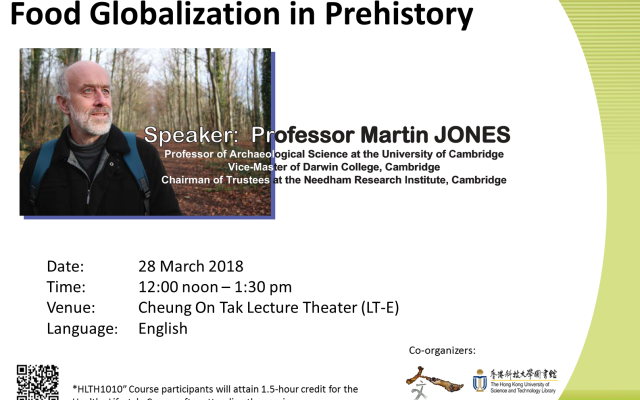
About the TalkAfter Christopher Columbus opened up sea routes between the Old Word and the New, the world’s food supply was transformed, with major crops moving between continents. Several millennia earlier, an equally radical transformation opened up land routes across the Old World, and major crops moved between eastern and western Eurasia. However, this earlier episode of food globalization has only recently come to light, thanks to novel possibilities of scientific archaeology.In this seminar talk, the results of those novel methods, and the various crop movements of the 3rd and 2nd millennia BC are explained. Professor Jones will go on to consider some key questions about those movements: first of all, how they happened and what were the corresponding movements of people; secondly, what were consequences of those movements, for the different societies emerging in different regions of the Old World.Remarks: For interested parties, please register at Library Event RegistrationHLTH1010 HKUST students may attain 1.5 hour credit for the Healthy Lifestyle Course after attending the seminar.About the SpeakerProfessor Martin Jones is the first George Pitt-Rivers Professor of archaeological Science at the University of Cambridge, Vice-Master of Darwin College, Cambridge, and Chairman of Trustees at the Needham Research Institute and a world renowned archaeologist. For forty years he has published reports of his archaeobotanical research, into the nature and development of agriculture in different parts of the world. In the 1990s, his work expanded from archaeobotany to embrace the novel field of archaeogenetics, subsequently engaging with stable isotope palaeodietary studies. His research group has played a lead role in combining these three methodological strands to investigate the human food quest in the past, and address its implications for present and future foodways.
Details
Library iTalks
Library iTalks
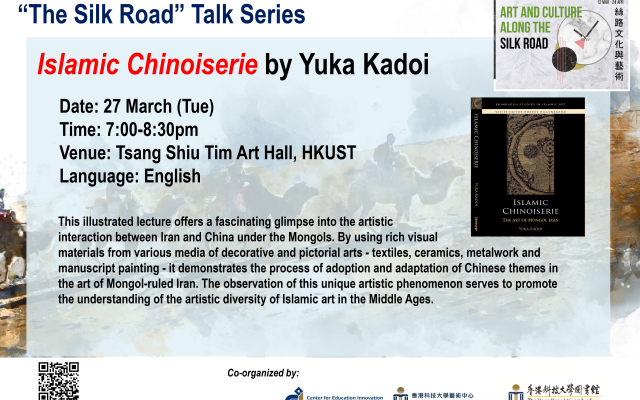
About the TalkThe Mongol invasion in the thirteenth century marked a new phase in the development of Islamic art. Trans-Eurasian exchanges of goods, people and ideas were encouraged on a large scale under the auspices of the Pax Mongolica. With the fascination of portable objects brought from China and Central Asia, a distinctive, hitherto unknown style - Islamic chinoiserie - was born in the art of Iran.This illustrated lecture offers a fascinating glimpse into the artistic interaction between Iran and China under the Mongols. By using rich visual materials from various media of decorative and pictorial arts - textiles, ceramics, metalwork and manuscript painting - it demonstrates the process of adoption and adaptation of Chinese themes in the art of Mongol-ruled Iran. The observation of this unique artistic phenomenon serves to promote the understanding of the artistic diversity of Islamic art in the Middle Ages.Co-organized by the HKUST Center for Education Innovation, the HKUST Center for the Arts and the HKUST Library, this event is one of the "Silk Road" Talks of the HKUST Arts Festival 2018.This talk is open to the public. For general enquiries, please contact (852) 2358-8049 / artsctr@ust.hk.About the SpeakerYuka Kadoi, PhD, is an art historian with the expertise in the art and material culture of the Persian cultural world after the seventh century. She is the author and editor of numerous publications, including Islamic Chinoiserie (2009; paperback, 2018; Chinese edition, forthcoming); The Shaping of Persian Art (2013); Arthur Upham Pope and A New Survey of Persian Art (2016); and Persian Art: Image-making in Eurasia (2018). She has curated several exhibitions, including a major loan exhibition of Persian art at the Liang Yi Museum, entitled "The Blue Road: Mastercrafts from Persia" (20 March - 24 June 2018).
Details
Library iTalks
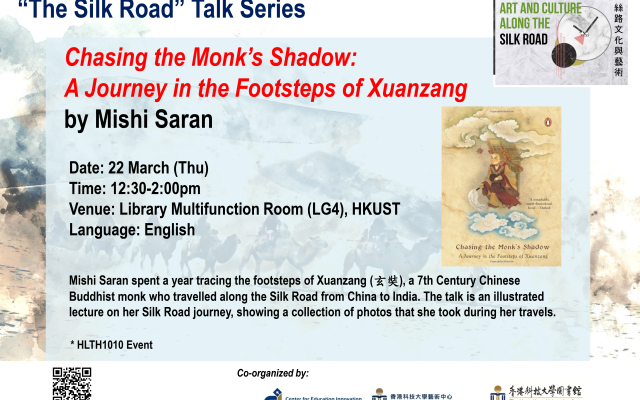
About the TalkDuring the talk, Ms Saran will introduce the experiences mentioned in her travel book-cum-memoir, Chasing the Monk’s Shadow: A Journey in the Footsteps of Xuanzang. The book was shortlisted for Indias 2006 Hutch-Crossword Award for Literary Non-Fiction, and long listed for Germanys 2006 Lettres Ulysses Award for the Art of Reportage. To research the book, Saran spent a year tracing the footsteps of Xuanzang, a 7th Century Chinese Buddhist monk who travelled along the Silk Road from China to India, passing through Uzbekistan, Kyrgyzstan, Pakistan and Afghanistan. Ms Saran will talk about her journey in Central Asia, drawing comparisons between her research on the Silk Road in the 7th century compared to her observations in the 21st century.Co-organized by the HKUST Center for Education Innovation, the HKUST Center for the Arts, and the HKUST Library, this event is one of the "Silk Road" Talks of the HKUST Arts Festival 2018.The talk is open to the public. Limited seat, please sign up at http://library.ust.hk/ce. Remarks: HKUST students may attain 1.5-hour attendance in the "Activities" module in Wellness & Personal Enrichment of the HLTH1010 Course. About the SpeakerFollowing an undergraduate degree in Chinese Studies from Wellesley College (USA), Mishi Saran worked in Hong Kong as a news reporter and as a freelance writer. Her articles have appeared in a variety of international publications including the Los Angeles Review of Books and Quartz, the Financial Times, the International Herald Tribune, the South China Morning Post and the Asian Wall Street Journal. Her short stories have won awards and been broadcast on the BBC.
Details
Library iTalks
Library iTalks
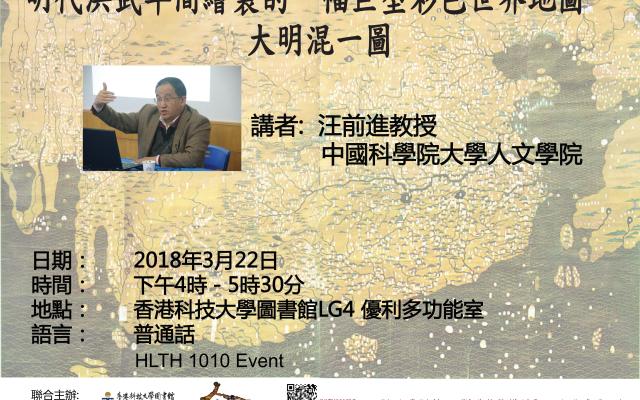
研討會簡介於鄭和之先:東亞最早的世界地圖 ──《大明混一圖》一幅珍貴而外界很少有人知曉的世界地圖──《大明混一圖》,約繪於明初洪武二十二年(1389年),三米見方的舊大陸地圖,東至日本、西至西歐和西非、北至西伯利亞、南至爪哇,較鄭和下西洋更早,現藏於北京中國第一歷史檔案館。中國古代地圖專家汪前進教授,將為我們解說《大明混一圖》的歷史地位和學術意義。名額有限,請報名留座 備註: 出席此座談會的同學可獲HLTH1010課程中"Activities"單元的"Wellness and Personal Enrichment"1.5小時學習時數。講者簡介汪教授現職中國科學院大學人文學院,曾任中國科學院自然科學史研究所研究員;他的學術範疇涵蓋中國地圖學史、中國地理學史、中外科技交流史等,對中國古地圖研究甚深。
Details