



News
Research Bridge

Research Bridge
Earlier this year, we introduced the Google Scholar PDF Reader Chrome extension. Recently, Google has enhanced the tool with a new feature: AI Outline, designed to help users read papers both quickly and in depth.
Research Tools
Research Bridge
Ithaka S R has launched a Generative AI Licensing Agreement Tracker to document deals between academic publishers and AI developers.
Academic PublishingAI in Research & Learning
Library Stories
Library Stories
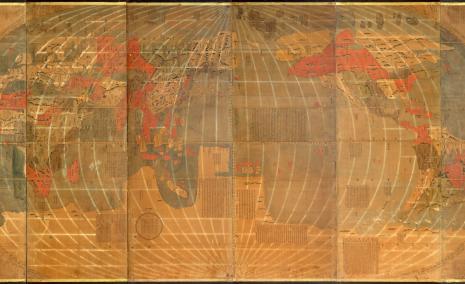
Did you know this is one of the most glamorous items in our Special Collections? Known as 坤輿萬國全圖, in elegant classical Chinese, literally meaning Map of the Ten Thousand Countries of the Earth, it also has a nickname in English – Ricci Map. Why Ricci in English? Why does this map, titled in Chinese, carry an Italian name in the English-speaking world? It’s an attribution to the mapmaker, Matteo Ricci (1552-1610). He was an Italian missionary of the Society of Jesus and one of the first Jesuits to arrive in Ming China. At the imperial court of Emperor Wanli 萬曆, he served as an expert in astronomy, geography, and mathematics. His map is the first world map based on European cartography but positioned China at the center of the world. However, Ricci did not create this map alone. He closely collaborated with Chinese scholars and artisans, including Li Zhizao 李之藻 (1565-1630), a scholar-official from Hangzhou.
Collection HighlightsStaff Stories
Research Bridge

Research Bridge
As GenAI tools such as ChatGPT become increasingly integrated into academic work, the Library has seen a growing number of inquiries about their responsible use, particularly on copyright, licensing, and academic integrity.
AI in Research & Learning
Library Stories
Library Stories
Hey everyone! We know that juggling studies and research can be a bit overwhelming, so we’re rolling out a brand-new program called “Grab & Grow”. These quick, 30-minute workshops are perfect for busy students and staff looking to boost their research skills without a huge time commitment. Whether you’re trying to figure out the library’s call number system or explore scientific research using open data, we’ve got you covered. Here is what you can look forward to: you’ll learn how to Manage your references effortlessly Create eye-catching presentations and videos with Canva, and Dive into scientific research using OpenAlex. These sessions are all about making your life easier and enhancing your efficiency in research. Plus, they’re engaging, so you’ll walk away with practical skills and use right away. So, if you want to level up your research capabilities and keep your research on point, join us for “Grab & Grow”. Keep an eye on our announcements for the schedule and grab your spot. Let’s make research fun and effective together!
Events & Programs
