


Library Stories
Library Stories
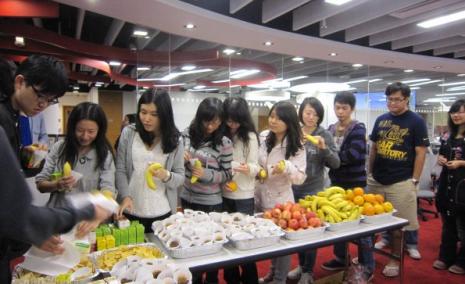
If this is your first exam season at HKUST, here’s a little heads-up: the next three weeks come with plenty of support and cheer across campus for you. If you’ve been here before, you already know the drill: your schools and many offices will be out in full force with encouragement, activities, food and drinks to help you recharge. At the Library, we have our own way of supporting you: Snack Breaks, a long-running tradition that is all about taking you away from your study seat and giving you a little treat. A Bite of History Snack Breaks started back in 2012, the same year the Learning Commons opened its doors. It was a fresh idea then, and it quickly got warm appreciation among students. Fast forward to today, and we’re in the 14th year of this program! As the library team gears up for another round of Snack Breaks, I couldn't help but wonder what those early breaks looked like. To my surprise, they could almost pass for last year’s! Same friendly vibe, same happy faces, same humble but always welcome snacks. Some traditions never age; and that is exactly what makes them special.
Learning CommonsNews
Library Stories
Library Stories
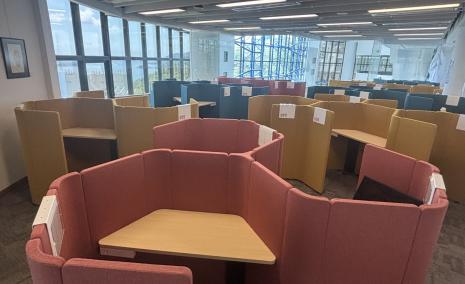
The 24/7 Learning Commons has been a great space since it opened in 2012. But in the recent Library survey you complained that it had no individual study options. We listened, and acted. Individual study carrels are now available 24/7 in the Learning Commons! These colorful carrels are built with sound-absorbent fabric panels, wooden study surfaces, and regular and USB power sockets. I hope you enjoy using them as much as I enjoyed buying them :-) And for those wondering where the previous tables went – we moved them up to the ground floor, replacing some book shelves which were no longer needed. Edward Spodick Associate University Librarian lbspodic@ust.hk
FurnitureNewsStudy Space
Library Stories
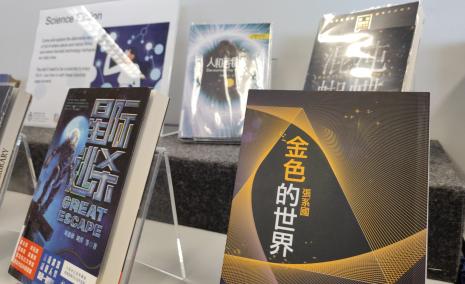
As autumn unfolds and the days grow shorter, it’s the perfect time to enjoy some fantastic science fiction. Sci-fi has gained immense popularity among recent generations, exploring themes like robotics, space exploration, time travel, and parallel universes—topics that resonate across various media. A new selection of best-selling sci-fi titles including eBooks and physical items is now on display near the G/F Leisure Reading Zone. Liu Cixin has emerged as a prominent figure in contemporary science fiction, with his novels The Three-Body Problem(三体) and The Wandering Earth(流浪地球) adapted into movies and television dramas. Mr. Liu’s works, from short stories to novels, are featured in this Sci-fi display. In addition to Liu Cixin's works, you will discover other timeless classics by H.G. Wells, such as The Time Machine and The Invisible Man, alongside with the classic series by Hong Kong novelist Ni Kuang such as Legend of Wesley(衛斯理傳奇之搜靈·盡頭). This diverse selection appeals to all sci-fi lovers, whether you’re an experienced reader or just starting to explore the genre. Science fiction is not only entertaining but also stimulates critical thinking about our world and its future.
CollectionsNews
Library Stories
Library Stories
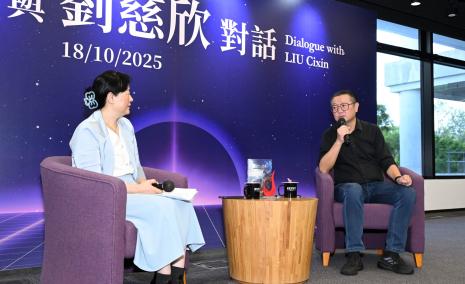
As a staff member at the HKUST Library and a devoted fan of>The Three-Body Problem since my student days, I never imagined that one day I would meet Liu Cixin (劉慈欣) in person, and right here at my workplace. From Ancient Maps to Galactic Orbits.On October 18, HKUST held its Congregation 2025, awarding an honorary doctorate to Mr. Liu Cixin, the first Asian writer to win the prestigious Hugo Award. The same afternoon, Dr. Liu came to our library for a talk. I had the privilege of accompanying him together with a few of my colleagues as he explored our exhibitions, rooftop garden, and special collections. He showed genuine curiosity and appreciation, particularly towards our displays of ancient Chinese maps.A Dialogue on Technology, Human Civilization, and the Future. The highlight of the library visit was of course the talk, held in dialogue-format and moderated byProfessor Liu Jianmei. The venue was packed. As an “insider”, I firsthand knew how overwhelming the demand was: Over 700 registered for just over a hundred available seats. It was harder to get than concert tickets The discussion covered a broad range of topics from how AI is shaking up creative writing, to the future of virtual worlds, and to the sociological implications of the Dark Forest theory.When asked about AI’s growing ability to write fiction, Dr. Liu candidly admitted that even he had experienced a decline in creative passion. AI-generated texts now often surpass human writing in fluency and style, making it difficult to evaluate student work or feel unique as a writer. Yet he also pointed out that human cognition itself is data-driven, much like large language models. As a science fiction author, Dr. Liu remains calmly optimistic. He doesn’t see AI as a threat, but as a potential guide for humanity’s future. “If one day we can’t leave the solar system, but artificial intelligence can,” he said, “then perhaps it can carry our dreams into the stars.” One of the final questions of the talk came from an audience member who asked how Dr. Liu comes up with such vast and original ideas. I was particularly interested in this question myself. His answer was refreshingly honest: most people assume that sci-fi writers effortlessly generate ideas like “laying eggs,” but in truth, it is extremely difficult. Even with intense effort, he said, it can take more than a decade for a good idea to surface. As both a reader and a librarian, I was deeply moved. It reminded me that true creativity isn’t the product of calculation, but of vulnerability of being shaken by the unknown and daring to imagine beyond it. As a Three-Body fan, I was most eager to hear his thoughts on the Dark Forest theory. Dr. Liu clarified that it’s not a metaphor for human society, but an extreme hypothetical model for cosmic sociology. When civilizations are separated by light-years and unable to communicate, “shoot first to survive” becomes a plausible strategy. He emphasized that humans, unlike alien civilizations in such scenarios, can communicate and cooperate. Applying the Dark Forest model directly to humankind is a misinterpretation.
NewsPeople
Library Stories
Library Stories
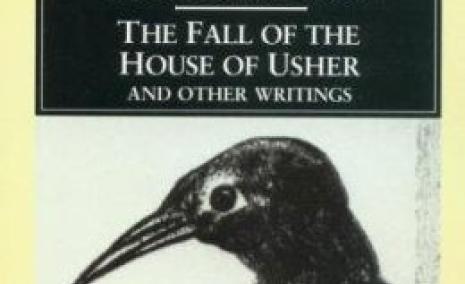
Here in the northern hemisphere, the nights are getting longer, and the weather becomes colder. As October draws to a close, the unofficial holiday, Halloween (October 31) approaches. Around this time of year, people often like to read or watch scary or ghostly things. Last month, the Library began its display of Horror Film Classics for the "Spooky Season". But what about reading? Shirley Jackson (1916-1965) is a classic mid-20th century writer whose works often touched on the uncanny. Her The Haunting of Hillhouse is available in print in the Library's collection (PS3519.A392 H3 1959) and in electronic format as public domain in Canada and Hong Kong from The Faded Page. It was also made into a film, called The Haunting (PN1997.A12 T865 2009 disc 1). The opening paragraph is justly famous for being an almost perfect opening for a ghost story. "No live organism can continue for long to exist sanely under conditions of absolute reality; even larks and katydids are supposed, by some, to dream.
CollectionsNews
