



A Taste of Digital Scholarship: Akha voices in one script & Visualizing the Huainanzi’s Intertextuality
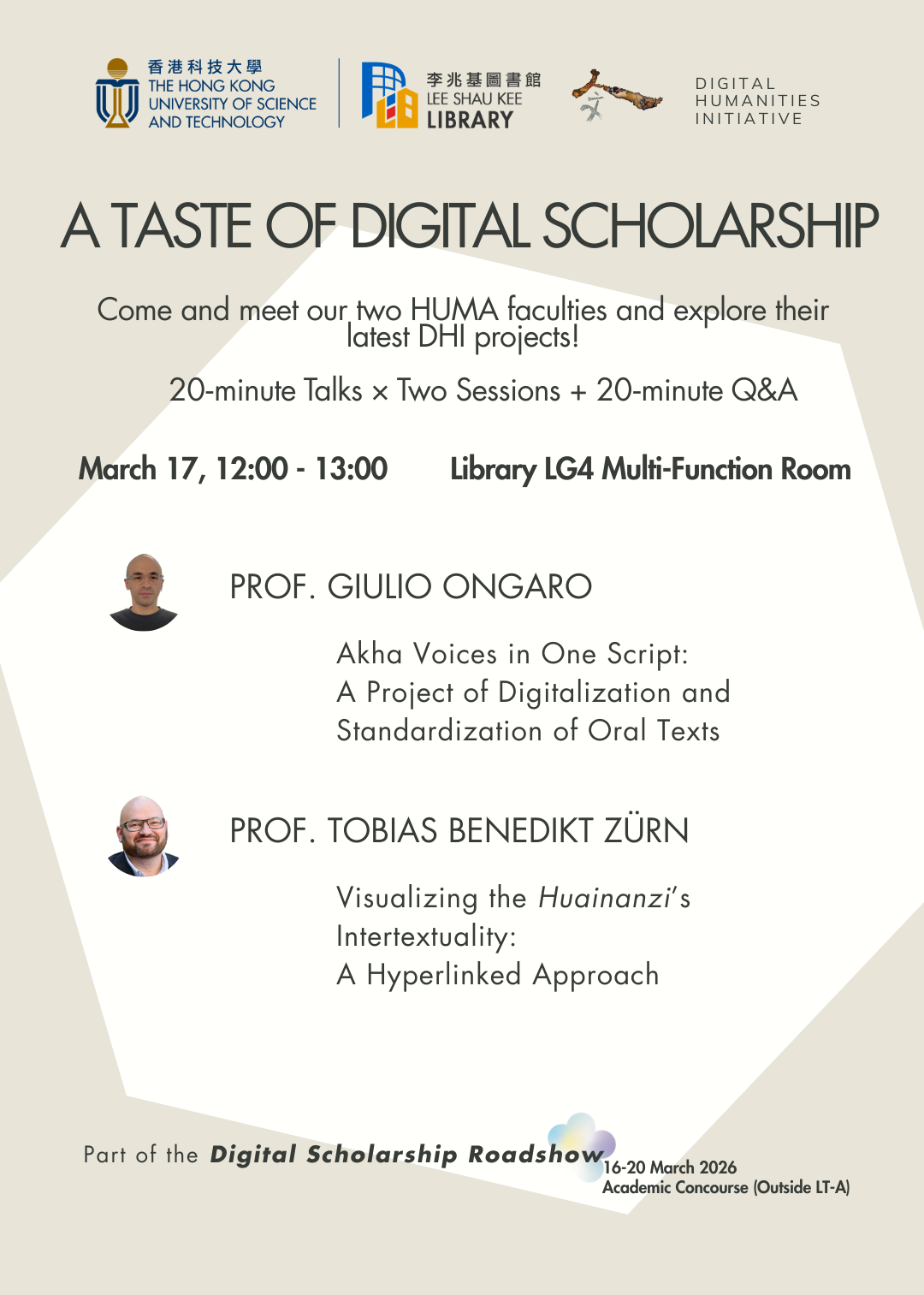
Come and enjoy a taste of Digital Scholarship as two HKUST HUMA faculties share on their recent projects!
Each will share for 20 minutes, followed by a 20 min Q&A session.
Prof. Giulio Ongaro - Akha voices in one script: a project of digitalization and standardization of oral texts
Abstract: The Akha, an ethnic group residing in the highlands of Yunnan, Laos, Thailand, Myanmar, and Vietnam, possess a vibrant oral tradition that has been meticulously documented by anthropologists since the 1950s. Central to this tradition are ritual texts that reflect the unique cultural and spiritual heritage of the Akha people. However, the use of varied, idiosyncratic writing systems by researchers across different periods and regions has created significant challenges for comparative analysis. Moreover, a substantial portion of these oral texts remains untranslated into English or Chinese, limiting their accessibility and understanding. In recent years, the Akha community has embraced a new Common Akha Orthography (CAO), which is gaining traction across the region. This project seeks to digitize a significant body of Akha material from the archives of four fieldworkers and convert these diverse writing systems into the standardized CAO. Additionally, we aim to explore the feasibility of developing translation software to facilitate the translation of Akha oral texts into English and Chinese, thereby enhancing the preservation and dissemination of Akha cultural heritage.
Prof. Tobias Benedikt Zürn (陶全恩) - Visualizing the Huainanzi’s Intertextuality: A Hyperlinked Approach
Abstract: The Huainanzi 淮南子 is a highly intertextual and comprehensive scripture from the early Western Han 漢 dynasty (206 BCE-9 CE) that Liu An 劉安 (c. 179-122 BCE), the king of Huainan 淮南, presumably produced with Masters of Methods (fangshi 方士) and several other retainers (Gao 2006: 1-2) in the middle of the second century BCE. Despite its obvious intertextual style, there is no edition of the Huainanzi that consequently displays this peculiar feature of Liu An’s text. This DH project generates a digital edition of the Huainanzi that visualizes its intertextual design with the help of a color-coded, hyperlinked interface. In so doing, it enables scholars to explore this peculiar feature of the Huainanzi more efficiently, hopefully resulting in a sound dismissal of a pertinent yet problematic scholarly truism: namely that Liu An’s text is a thoughtless, mere hodge-podge of pre-Han thought.
About the speakers:
Prof. Giulio Ongaro received his PhD in Social Anthropology from the London School of Economics in 2020. His research lies in the areas of medical anthropology and ethnopsychiatry. As part of his PhD, he conducted ethnographic fieldwork among the Akha people of highland Laos, studying their shamanic tradition, etiological knowledge, and system of ritual healing. He focused particularly on how healing rituals work and how people think that they work. In parallel to his anthropological studies, Prof Ongaro conducted research within the science of the ‘placebo effect’ (the empirical study of how therapeutic rituals can elicit clinically significant responses) in collaboration with an interdisciplinary team from Harvard Medical School. This collaboration led to a number of publications in neuroscience and philosophy journals. At HKUST, he teaches courses on cultural psychiatry, social anthropology, and human history. Bringing all the strands of his previous research together, he is currently writing a book on the global history of psychiatry.
Prof. Tobias Benedikt Zürn (陶全恩), born in Esslingen, Germany, is an assistant professor of premodern Chinese literature at Hong Kong University of Science and Technology. As a historian of Chinese religions and literature, he explores how academic disciplines project and perpetuate modern and Eurocentric concepts onto the past and non-Western societies, a process he calls “theoretical imperialism.” In particular, he focuses on various practices of embodiment and the transcultural and transmedia reception of the classic Zhuangzi to investigate the institutionalized reading strategies that govern recent interpretations of Daoism. His first monograph, titled Text/Bodies: The Huainanzi’s Self-Fashioning as a Powerful Scripture of the Way, reconstructs the earliest conceptualization of efficacious writings in East Asia. By investigating the Huainanzi’s textual design vis-à-vis its self-illustrations and earliest receptions, he creates a compelling critique of the common, logocentric practice in premodern Chinese studies to read texts first and foremost as discursive objects. He is also the co-founder of the international research project “Global Reception of the Classic Zhuangzi” and co-chair of the Daoist Studies Unit (DSU) at AAR. Among others, he has published his work in the Journal of Asian Studies and Method and Theory in the Study of Religion, two flagship journals in the fields of Asian studies and religious studies. He maintains two websites: tobias-zuern.org/ and zhuangzi-reception.org/.
12:00 noon - 1:00pm
LG4 Multifunction Room
12:00 noon - 1:00pm
LG4 Multifunction Room
LG4 Multifunction Room
12:00 noon - 1:00pm
Prof. Giulio Ongaro (HUMA)
Prof. Tobias Benedikt Zürn (HUMA)
Victoria Caplan (Library)

