




Library User Survey 2026
Library User Survey 2026
The Library conducted its annual Library User Survey in March 2026 to gather feedback from students, faculty, and staff on the quality and effectiveness of our services and resources. Your valuable opinions helped us identify areas for improvement and better serve the university community.
Survey Period: 16 March – 2 April 2026
Result Highlights
Thank you to the 1,777 members of the HKUST community who took part in our user survey. Below is a snapshot of who responded, how the Library is making a difference for our community, how each part of the Library’s services and facilities was rated, and what users said in their own words.
Participation Snapshot
Who responded, by role at HKUST
Who responded, by School or Unit
Overall Satisfaction
At the end of the survey we asked everyone one simple question: how satisfied are you with the Library overall? Here is what they told us.
“Overall, how satisfied are you with the Library’s services?”
Library Impact: How the Library helps students, staff, and faculty
We asked respondents whether the Library makes a real difference to their studies, teaching, research, or work. Each bar below shows how people responded across the agreement scale (Strongly Disagree to Strongly Agree); the number beside each bar is the average score out of 5.
Ratings on eight library service areas
We asked respondents to rate the Library across eight areas of what we do, from collections and study spaces to staff help and research support. The left chart shows the average score for each area; the right chart shows every individual rating question, colored by service area. Hover any point on the right chart to read the full question and its score.
Average score for each service area
Bars in grey indicate a service area below the survey-wide average rating of 4.13.
Every individual rating question
Emerging Services: Importance vs. Satisfaction
For three newer Library services (AI research tools, hexagon study carrels, and Library instruction on AI), we asked respondents both how important the service is to them and how satisfied they are with it. The chart positions each service by its average importance (horizontal) and satisfaction (vertical). Up-and-to-the-right means highly valued and well-delivered; down-and-to-the-right means valued but where users would like more.
Three emerging library services
Where Awareness Lags Behind: Three stories
In many of the rating questions, respondents could choose Never Used or N/A if they hadn’t tried the service. For some Library services, many people picked these options, while the people who had tried them rated them highly. The gap reflects outreach opportunities for us to act on. Here are three of these stories, and we’d love more of our community to discover what is already on hand.
1. Library Material Pickup Station
Launched in summer 2025, the Library Material Pickup Station lets you collect requested items from a self-service locker on your own schedule, with no queue at the service counter and no need to time your visit around opening hours.
2. Cultural programs: exhibitions, talks, and themed displays
The Library runs rotating exhibitions in the Library Gallery on the ground floor and the KPS Gallery on the 1st floor, themed book and movie displays, and talks on culture, innovation, and well-being.
We asked attendees how these programs contributed to them. Just over a thousand people responded, and their answers paint a clear picture: cultural programs give a moment of respite from study or work, a chance to learn something new, fresh perspectives, and a stronger sense of belonging to the campus community.
What cultural program attendees told us
The open-ended comments give a sense of which programs have left a mark. One faculty member writes that the thematic exhibitions and guided tours at the entrance of the Library are always very interesting.
Others remember particular favorites: a research postgraduate fondly recalls the special exhibition in G floor, I like the map show in 2024,
and an undergraduate, perhaps at the same exhibition, writes that they really like the map exhibition where I can sit and talk with people who are also interested.
Another respondent shared a recent favorite, the wartime diary exhibition 唐樓中的二戰日記, and added: Please continue to bring us high-quality exhibitions!
Last year’s talk by science-fiction author 劉慈欣 (Liu Cixin) drew its own warm response. An undergraduate wrote, simply, that the talk sparked my interest in studying science
(translated from Chinese). Another respondent described the event in even more personal terms: It let me meet Mr. Liu Cixin, my idol since childhood
(also translated from Chinese). A research postgraduate echoed that warmth, then added a wish: Last year, the library organized a talk with Cixin LIU, but the quota was very limited. Hopefully expand the quota in the future.
3. Hidden gems: University Archives and Special Collections
Some of the Library’s most distinctive holdings are also its quietest. The University Archives preserve HKUST’s institutional memory (documents, photographs, and records of the University’s growth), while the Special Collections hold antique maps, rare books, and unique primary materials.
For most respondents these collections are still unfamiliar territory. But for the ones who have explored them, the response is often one of discovery. “I didn’t know the university has an archive, or antique maps and rare books!!” one undergraduate wrote, going on to suggest guided tours organized around different themes.
Others have found these resources practically useful in their academic work. Another undergraduate told us that the FYP and MPhil archive really helped
when they were looking for examples for a UROP research project. A staff member describes the Archives as a solid collection of historical documents, great reference material for reports on University development.
Selected Comments
We received a total of 4,561 comments from our survey. Here are some examples across the topics raised most often. Appreciated ones are marked in green and constructive ones in orange.
Response and Action Plans
We have reviewed the survey results, suggestions and comments, and identified five key areas for action. Each area below includes a selection of user comments, the Library’s response, and the actions we will take in AY2026/27.
Sharing the study space fairly

“雖然不鼓勵使用者離開座位超過30分鐘,但仍有許多人在座位放下背包、電腦、筆記本等物品佔據座位,離席長時間後才回來。希望能提出措施,讓學生能均等地使用圖書館內的設施。”
“…It is common to find seats that are occupied without students actually sitting in them … is it possible to launch a schedule-based appointment system for the available seats just during those times?”
“Indicate the available spaces (seats) to facilitate seat search”
“…Could the library please consider more consistent enforcement of the noise rules in the quiet areas, regardless of who the group is?…”
“There are often some study rooms being booked by others but they never appear…”
The 30-minute rule and the quiet zones only work if they are enforced consistently. When they are not, the users who observe them lose out. We will continue to remove unattended belongings, and Library rules apply to all users equally.
We also recognize that study spaces across five floors cannot be managed by patrol alone. We will set clearer expectations for each zone and introduce systems that show whether a seat is in use.
- Introduce three defined sound zones across the building, supported by clear signage and posters: the Quiet Zone, the Focus Zone, and the Collab Zone.
- Install sound level meters at the Learning Commons and LG4, and strengthen patrolling.
- Pilot a Temporary Seat Hold System. Users will scan a QR code at their seat to register a short absence.
- Install occupancy sensing and live seat availability maps covering the individual study spaces in the Library. Interactive floor plans will show each space as Available, In Use or Temporarily Held.
- Create more individual study space. Additional study carrels will be installed where appropriate.
A more comfortable building

“It's too cold”
“我的個人意見是有關洗手間方面,雖然是個人問題,清潔工作也做得非常好,但可以提醒使用者要注意個人衛生和有公德心。”
“我覺得設施最需要改善。比如有些study room的插頭是壞的,無法使用。以及燈光感應問題,有時的燈光很暗。有些椅子髒了但是沒換過。”
“The most pressing issue currently facing the library is the inconsistent Wi-Fi signal on the lower floors…”
“[應該保留]小型的小組自修桌(LG4中庭位置)……我認為小型小組自修桌需求更大,桌子的數量卻減少了,很可惜”
Temperature cannot be set to one level throughout the building. Some floors house collections that need controlled conditions. This limits what we can adjust and where.
On cleanliness, several of you noted that the cleaning itself is done well, and that the difficulty lies in how shared facilities are left by other users. We agree. Alongside our own cleaning arrangements, we will remind users on user etiquette.
Within the space available in the current library building, we will continue to review furniture choices and layout.
- Work with the University’s Campus Management Office to try to adjust the temperature on certain areas.
- Assess the risk of mold to the collections on LG3 and LG4 and raise the temperature on those floors if it can be done safely. We will examine whether zoning within a floor can provide a warmer option without compromising the collections.
- Increase frequency of washroom cleaning, conduct regular large-scale cleaning after opening hours, and issue reminders on washroom etiquette.
- Test power sockets during term breaks so that faults are identified and rectified before they affect users.
- Map Wi-Fi weak spots and raise the findings with the University’s Information Technology Services Office for more wi-fi routers.
- Improve the variety of seating and furniture, through the additional hexagonal carrels on LG1, and through movable furniture for E-Learning Classrooms A and B. Replenish and refurbish new task chairs every term break.
Technology and AI at the Library

“整體很好,若能考慮引入自助式AI或機械人為使用者解決基本查詢則更理想。”
“scite.ai等资源帮我极大提升了科研效率,非常感谢!”
“圖書館員曾到我學的兩門課程講授AI工具和圖書館資源在課業和研究上的應用,非常豐富實用,幫助我更有效率學習。”
“Less integration of AI services.”
“…I found that their AI research platform services may not fully meet our needs. For instance, the research articles provided are often not from top-tier journals … Before these platforms are formally recommended to students, I would appreciate clarification on their intended use cases…”
Views on AI differ across the community. Our AI services work best when they serve a defined purpose, such as a session taught within a course, or a tool that supports a specific research task.
The Library chatbot currently answers from a fixed set of responses. We will rebuild it.
- Redevelop the Library chatbot from a static question-and-answer service into an interactive assistant capable of multi-turn dialogue and of executing user requests directly.
- Publish a Library AI webpage setting out the Library’s AI projects and services.
- Add and evaluate AI research tools, including Consensus from September 2026, with further tools under evaluation during the year.
- Revamp the Library’s e-learning. Video tutorials will be audited and refreshed, the e-learning site will be reorganized, and self-directed mini-courses will be developed in research, digital and AI literacy.
Getting to the collections

“An entire collection of online videos that i was heavily relying on for a large class disappeared overnight. I only discovered when the students found they couldn't access it…”
“Some resources like HBR, Sloan are not accessible to read even if there is a username, password shared.”
“very hard to use the access, need login everytime.”
“期刊搜尋在校外不方便,是否可以改成以連結期刊帳號登入?”
“…sometimes when computer systems are updated, links that work previously become disabled. We shouldn't have to clear our caches (losing valuable save data) to access the material.”
License terms change, sometimes with little notice to the Library. When a resource has to be withdrawn, you should hear it from us before access stops, not afterwards.
We evaluated an alternative remote-access service in 2024/25 and did not adopt it. Off-campus access remains inconvenient, and we are returning to it as a joint project across teams.
- Switch to single sign-on for key e-resources to reduce repeated authentication.
- Improve broken-link recovery, so that platform migrations and outdated addresses do not obstruct access to subscribed content.
- Add focused journals based on faculty recommendations, user needs and available budget, and continue to expand cost-effective transformative agreements.
Knowing what’s here

“宣傳方面,很少見到關於圖書館的宣傳,例如在社交媒體上”
“I attended a Library Research Workshop through MGMT2010 and it was really useful. It would be better if it was open to all and promoted through outlook.”
“定期發送有關活動推廣的電郵(只包含圖書館活動而非一般newsletter),確保內容簡潔,並附有報名方法/連結。”
“电邮提醒,电邮是职员接触频率最高的途径。其次是社交媒体,谢谢”
“I once attended [an] online tools fair on G/F in the library, where I got to know how many software resources are affiliated and available in our library website. These tools helped me guide through my research during my projects and strengthened my work.”
Several services are rated highly by those who use them but remain unknown to many others. This is a matter of promotion rather than service quality.
The survey shows which channels reach which groups. Email reaches almost all users. The mailing list reaches more people than the newsletter. We will concentrate on the channels that work.
- Revamp the Library Newsletter into an email publication so that Library news reaches users through the channel they use most.
- Implement a standard workflow for promotional campaigns across all Library units.
- Refresh new student orientation. A new online induction game will be released at the start of September 2026.
- Promote the collections more actively. We will share top-used books and journals at a glance, add posters for new e-book arrivals, and run a program of themed book and DVD displays.
- Sustain the exhibitions and events program, with exhibitions, iTalk series, wellness workshops, and snack breaks during examination periods.
(Aug 2026)
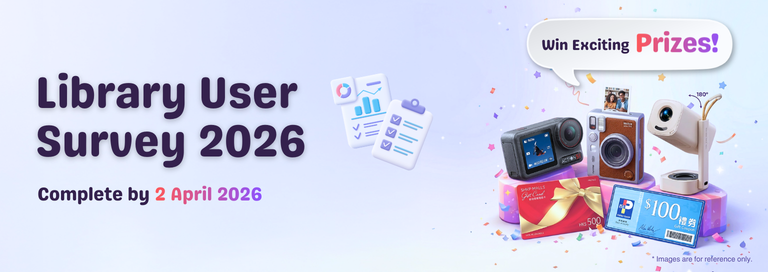
Lucky Draw Prizes
Lucky Draw Rules & Terms
- The lucky draw is open to all current students and staff (except library staff) of the University who complete and submit the Library User Survey by 11:59 pm on 2 April 2026.
- Each eligible participant may enter the lucky draw once only. Duplicate or incomplete submissions will not be counted.
- Winners will be selected at random. The lucky draw will be conducted on 9 April 2026, and winners will be notified by university email on 10 April 2026.
- Grand prize and second-tier winners must acknowledge receipt of the winning notification email and confirm their attendance at the prize presentation ceremony within 3 working days of being notified.
- A prize presentation ceremony is tentatively scheduled on 21 or 22 April 2026 around lunch time. Grand prize and second-tier winners are expected to attend in person. Exact date and venue will be communicated to winners directly.
- Third-tier prizes (supermarket vouchers) will be distributed separately without a formal ceremony. Winners will be advised of the collection arrangement by email and must collect their voucher within 10 working days of receiving the collection arrangement email.
- All prizes are non-exchangeable, non-transferable, and are not redeemable for cash or other prizes.
- The Library reserves the right of final decision in case of any dispute and the right to determine whether a person is eligible for the lucky draw.
If a grand prize or second-tier winner fails to acknowledge receipt of the winning notification email or fails to confirm their attendance at the prize presentation ceremony within 3 working days of being notified, or if a third-tier winner fails to collect their supermarket voucher within the designated collection period, the prize will be forfeited and reassigned to the next eligible participant on the lucky draw waiting list.
Lucky Draw Prize Presentation Ceremony
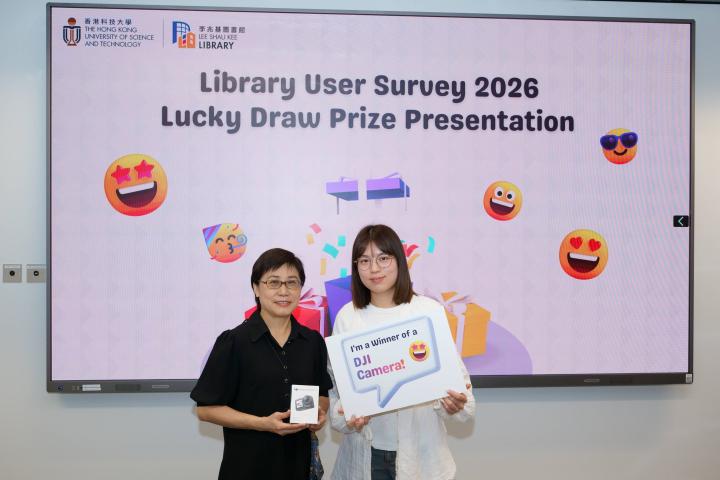
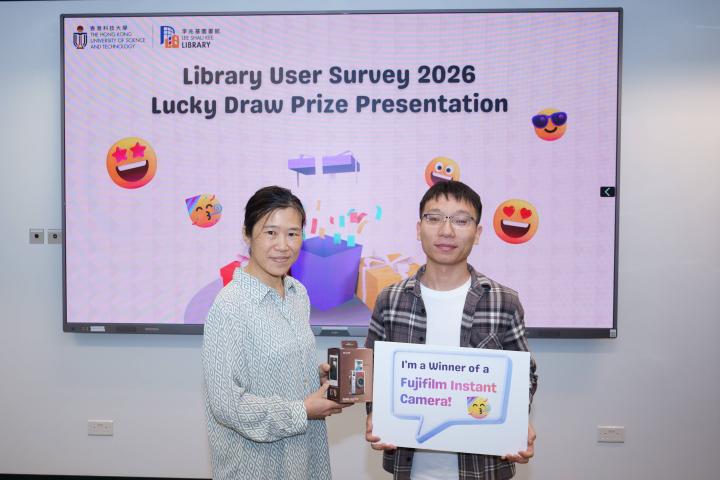
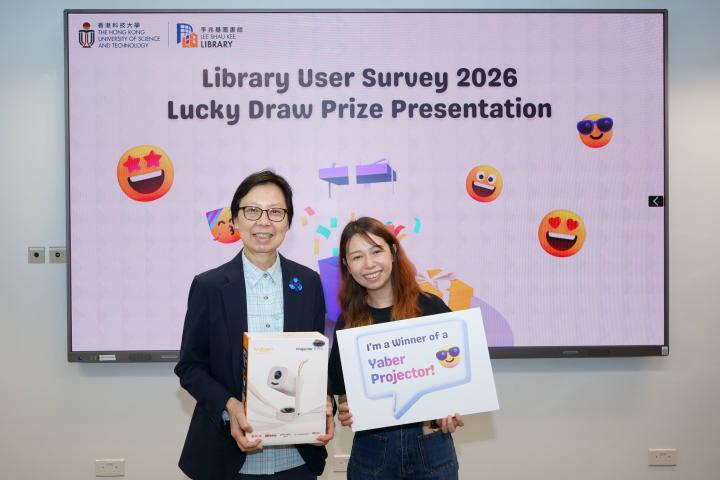
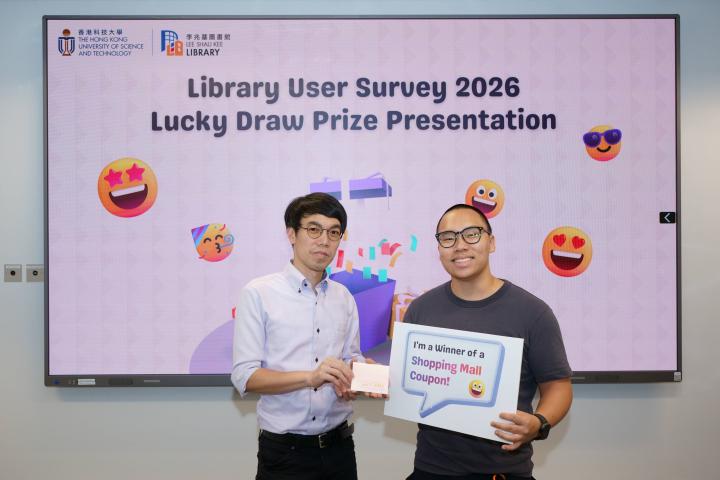
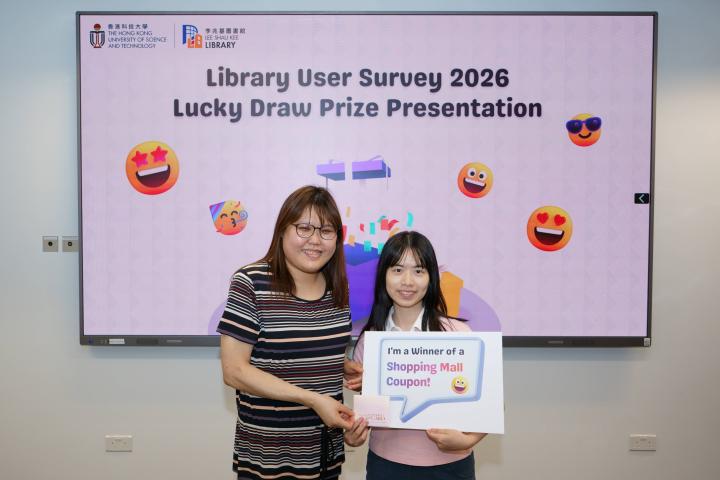
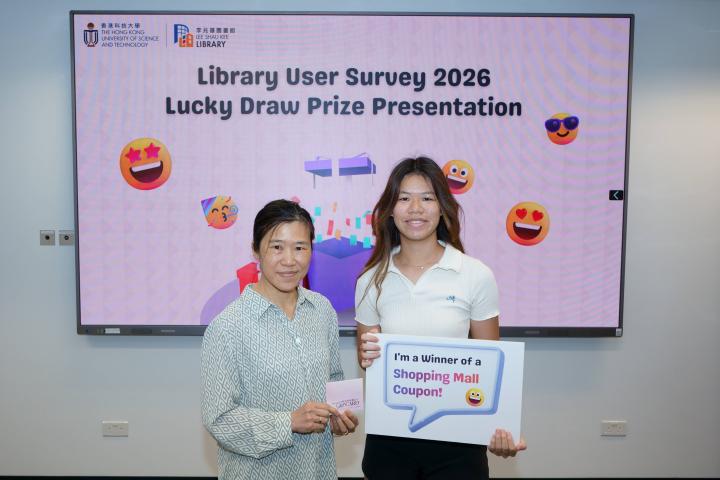
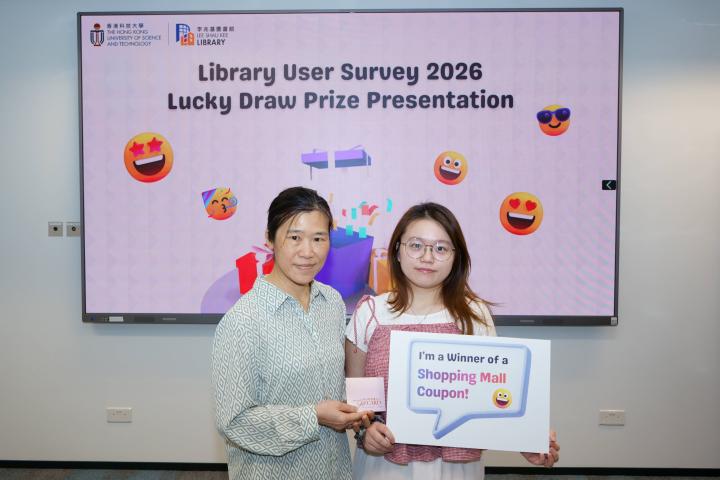
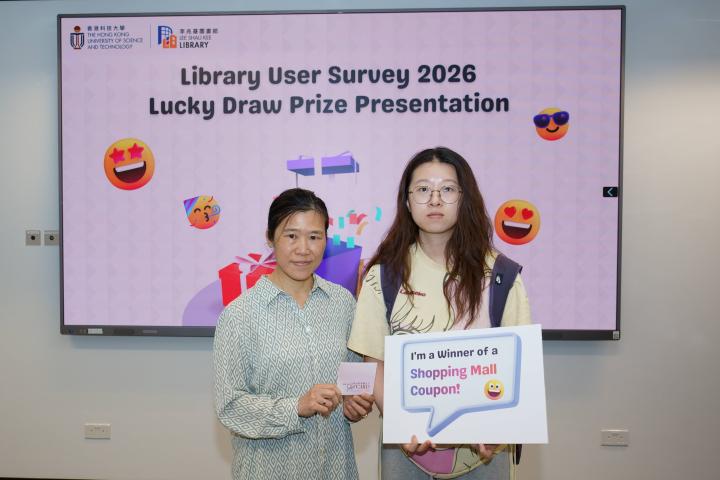
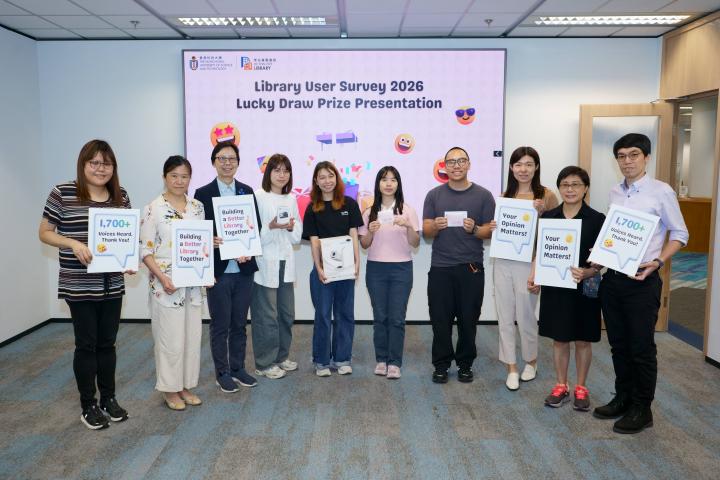
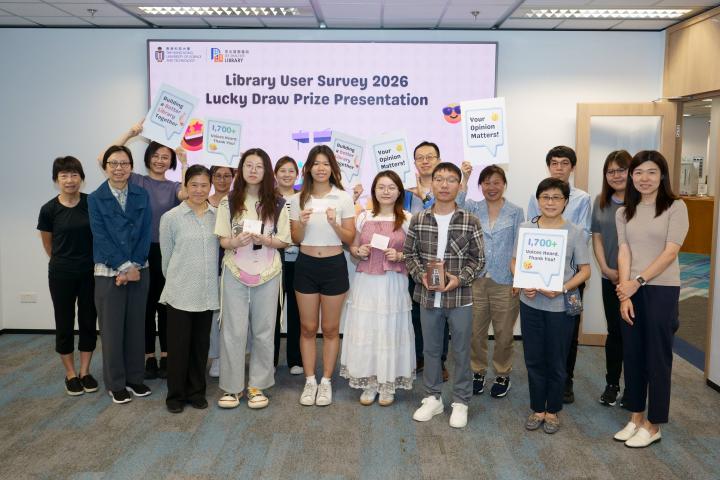
Two prize presentation ceremonies were held on 21 and 22 April 2026 to celebrate our grand prize or second-tier lucky draw winners. We sincerely thank all students and staff for participating in the Library User Survey 2026 and for joining us in this cheerful occasion.
Contact Us
If you have any questions or encounter any issues, please reach out to us:

“The library is like an oasis on campus. I’ve spent many hours studying and revising peacefully here, and it wouldn’t have been possible anywhere else.”
“Its vibrancy and openness to comments. It’s not easy, but the Library did listen to all the opinions and make itself a better place throughout these years.”
“I attended a Library Research Workshop through a course and it was really useful. It would be better if it was open to all and promoted more widely.”
“The library feels like home. I come here every day. Seeing the books, the art on the walls, the calligraphy and photography exhibits, switches my mood and lifts me up. It’s the pit stop on my study journey.”
“I was able to print urgently needed documents at 2 in the morning. I also found e-books from my country that I previously wouldn’t have been able to afford.”
“Some broken facilities such as screens or power sockets need to be repaired timely.”
“I would most like the Library to improve the availability and accessibility of study spaces during peak periods, with more quiet individual seats, more reservable group study rooms, and clearer real-time availability.”
“Wi-Fi signal needs to be stronger and more consistent, particularly on LG4 and the lower ground floors.”
“I think the individual study pods should be frequently cleaned.”
“More room bookings per week per user, and more solo study areas (e.g. hexagonal carrels).”