



A Taste of Digital Scholarship: Mapping Tartary & Study on the Bazi Basin Society
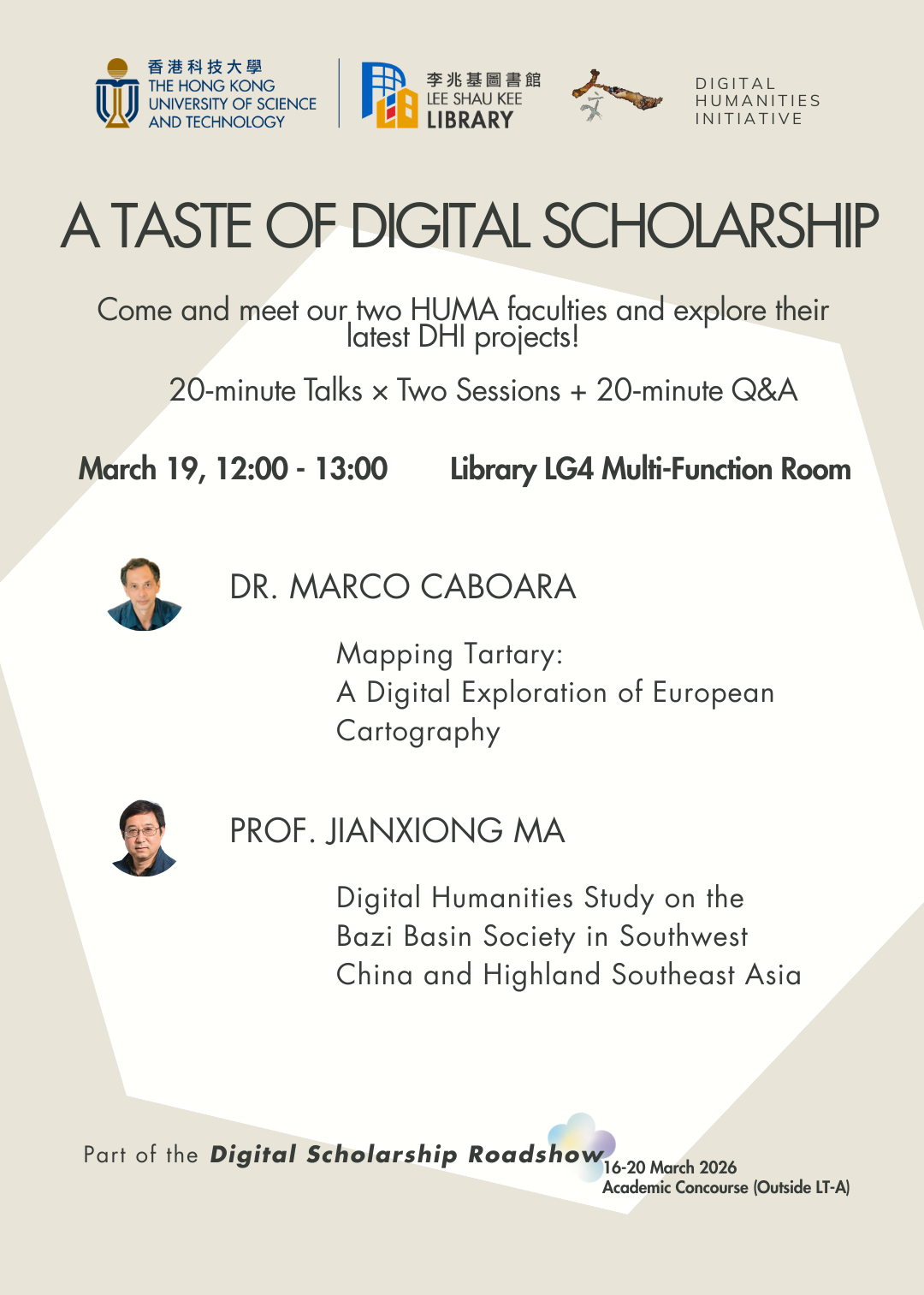
Come and enjoy a taste of Digital Scholarship as two HKUST HUMA faculties share on their recent projects!
Each will share for 20 minutes, followed by a 20 min Q&A session.
Dr. Marco Caboara - Mapping Tartary: A Digital Exploration of European Cartography
Abstract: The cartographic representation of Tartary in European maps from the 16th to the 18th centuries offers a unique lens through which to examine historical perceptions of geography, culture, and imperial power. This project aims to develop a digital platform that will enable scholars, students, and the general public to explore and analyze the evolving representations of Tartary in European maps. By utilizing Digital Humanities methodologies, we will create an interactive database that houses high-resolution images of these maps while providing contextual information, analytical tools, and visualization capabilities.
Prof. Jianxiong Ma - Digital Humanities Study on the Bazi Basin Society in Southwest China and Highland Southeast Asia
Abstract: Led by Professor Jianxiong Ma, this project aims to present the settlement patterns of the Han Chinese and indigenous ethnic minorities, as well as the migration history since the 15th century. We focus on the human settlement patterns around the Bazi Basin in the Yunnan and Guizhou Plateau, viewing this as a historical formation process influenced by the relocation of military garrisons and community organization reforms due to changes in national taxation policies. In the first phase of this research project, we conducted a detailed study of local documents from the Wanli period and digitized these records. Next, we established a GIS system and input data on the Baziwei and post stations to identify the postal routes of that time. This analysis helps us explain human settlements and the construction of ethnic identity under the geographical conditions of that era, as well as the relationship between ecology, politics, ethnic identity, and culture in shaping the social landscape of the southwestern border of China.
About the speakers:
Dr. Marco Caboara is a Senior Lecturer in the History of Cartography and the History of Science at HKUST. He received his Ph.D. from the University of Washington, Seattle with a study of the linguistic features of Classical Chinese Bamboo Manuscripts. For the past few years he has worked on research and development of the library’s map collection and a carto-bibliography of early European maps of China. His future plans include the continuation of the carto-bibliography into the nineteenth century and a companion volume dedicated to Chinese maps of China.
Prof. Jianxiong Ma is an Associate Professor of Anthropology in the Division of Humanities at HKUST. His books include The Lahu Minority in Southwest China: A Response to Ethnic Marginalization on the Frontier and Reinventing Ancestor: Ethnic Mobilization in China’s Southwest Frontier and the Historical Construction of Lahu (in Chinese). His present research focuses on the historical formation of the Sino-Burma frontier and ecological conditions of cultural diversity and ethnicity in southwest China, especially in Yunnan Province.
12:00 noon - 1:00pm
LG4 Multifunction Room
12:00 noon - 1:00pm
LG4 Multifunction Room
LG4 Multifunction Room
12:00 noon - 1:00pm
Dr. Marco Caboara (HUMA)
Prof. Jianxiong Ma (HUMA)
Victoria Caplan (Library)

