


Back to Events
#creative writing
Library iTalks
Library iTalks
3
4
10
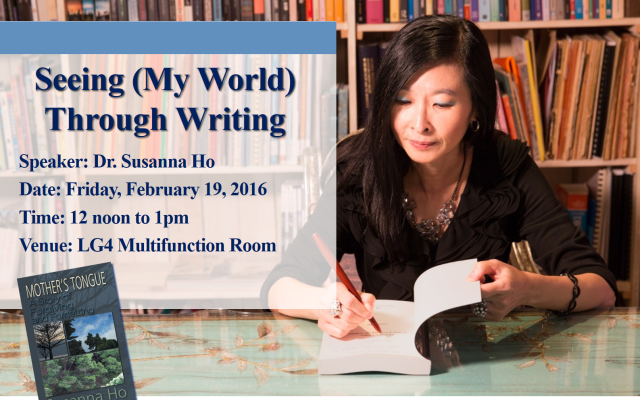
About the TalkDr. Susanna Ho of the Center for Language Education at HKUST will discuss and compare her two novels: Mother’s Tongue: A Story of Forgiving and Forgetting and her very recent, Who’s that Ant? Whose Dead End?. She will explore how she sees the world through the eyes of the main characters: a Nameless Woman, addressed as "Mum" in the first and an Ant in the other.In this book talk, she will share how she makes sense of her world through writing. Upon reading a section from the book, she will illustrate the source of inspiration, be it from a personal or world event, or a book that she was reading at the time of writing. We hope the presentation will illuminate both Dr. Hos work and the writing process itself.Copies of the books will be available for sale and signing.About the AuthorDr. Susanna Ho received her B.A. from University of Manitoba (majoring in English literature), her M.A. (Teaching English as a Second Language) from City University of Hong Kong, a PG Certificate of Education from the University of Hong Kong, and her PhD from Macquarie University, Sydney. At HKUST she teaches English for Academic Purposes and English for Specific Purposes at both postgraduate and undergraduate levels.Through her research in second language writing, interdisciplinary discourse, and autonomy in language learning, she explored her subjects’ writing practices and writing experiences and found each had a story to tell. It was through recounting their stories that her own childhood passion for writing was rekindled. Her first novel, Mothers Tongue: A Story of Forgiving and Forgetting was published in the USA in 2013 and her latest Who’s that Ant? Whose Dead End? is due out in early 2016.For enquiries, please contact Victoria Caplan at 2358-6756.
Details
2016-02-19
LG4 Multi-Function Room
Library iTalks
Library iTalks
4
16
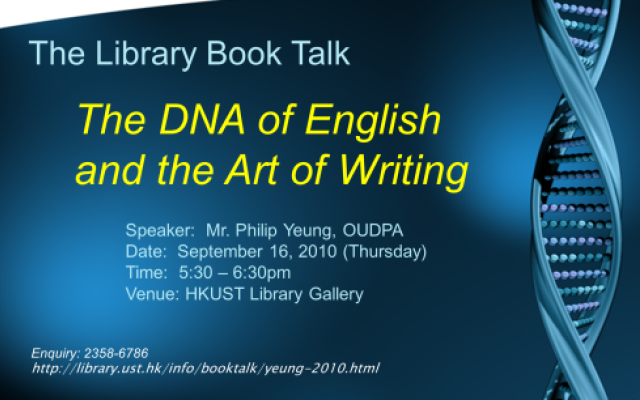
About the BookThe DNA of English and the Art of Writing / by Philip Yeung
(Forthcoming: Oxford University Press)There are thousands of books on writing, but this is the first to explore how "cracking the DNA of English" opens up many possibilities to write creatively. This is a book beyond grammar. It redirects our attention to the primary purpose of language learning: to write and to speak with impact.Sharing his writers point of view, Mr. Yeung explained his method that encourages you to look for the functions and patterns of language and discover what makes a piece of writing attractive.He considered issues like:What are the functional implications of English being an alphabetical language?Why do we need nouns, verbs, adjectives adverbs, and prepositions?How do sounds generated alphabetically offer possibilities for memorable writing?What areas cause non-native writers to stumble, and why?He also discussed how studying presidential speech writers helped him develop a formula for powerful writing. Whether you are a new writer or an experienced one, Mr. Yeungs talk had something to offer everyone.Power Point Presentation About the AuthorMr. Philip Yeung is speechwriter to the President of HKUST and Senior Communication Manager at the Office of University Development and Public Affairs. He was formerly a freelance speechwriter to many Hong Kong leaders, including the current Financial Secretary and the Secretary for Financial Services and the Treasury. He was a frequent contributor to the South China Morning Post on English language and education issues, and has delivered effective writing workshops to undergraduate and postgraduate students.Mr. Yeung completed his undergraduate and graduate education at the University of Toronto and studied briefly at Exeter College, Oxford University on a scholarship.In addition to his forthcoming book, The DNA of English and the Art of Writing, he has several other books in preparation: Winning over your Audience: The Neglected Art of Speaking with Impact, Empowerment English for the Disadvantaged, and English for Global Citizens.For enquiry, please contact Victoria Caplan at 2358-6786.
(Forthcoming: Oxford University Press)There are thousands of books on writing, but this is the first to explore how "cracking the DNA of English" opens up many possibilities to write creatively. This is a book beyond grammar. It redirects our attention to the primary purpose of language learning: to write and to speak with impact.Sharing his writers point of view, Mr. Yeung explained his method that encourages you to look for the functions and patterns of language and discover what makes a piece of writing attractive.He considered issues like:What are the functional implications of English being an alphabetical language?Why do we need nouns, verbs, adjectives adverbs, and prepositions?How do sounds generated alphabetically offer possibilities for memorable writing?What areas cause non-native writers to stumble, and why?He also discussed how studying presidential speech writers helped him develop a formula for powerful writing. Whether you are a new writer or an experienced one, Mr. Yeungs talk had something to offer everyone.Power Point Presentation About the AuthorMr. Philip Yeung is speechwriter to the President of HKUST and Senior Communication Manager at the Office of University Development and Public Affairs. He was formerly a freelance speechwriter to many Hong Kong leaders, including the current Financial Secretary and the Secretary for Financial Services and the Treasury. He was a frequent contributor to the South China Morning Post on English language and education issues, and has delivered effective writing workshops to undergraduate and postgraduate students.Mr. Yeung completed his undergraduate and graduate education at the University of Toronto and studied briefly at Exeter College, Oxford University on a scholarship.In addition to his forthcoming book, The DNA of English and the Art of Writing, he has several other books in preparation: Winning over your Audience: The Neglected Art of Speaking with Impact, Empowerment English for the Disadvantaged, and English for Global Citizens.For enquiry, please contact Victoria Caplan at 2358-6786.
Details
2010-09-16
Library Gallery (G /F), HKUST Library
