



Past Events
Library iTalks
Library iTalks
3
12
13
15
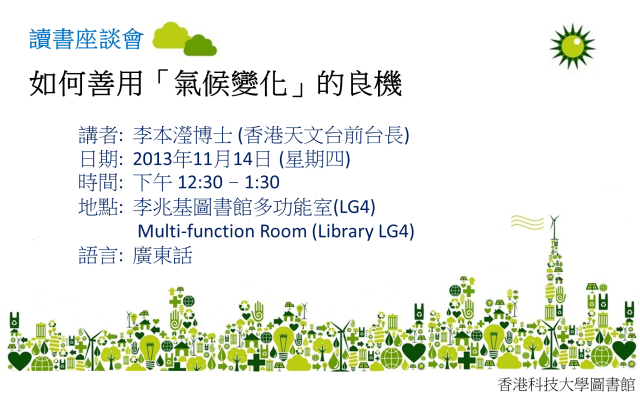
About the Talk我們每個人的生活方式,直接或間接影響着地球的資源消耗、碳排放和自然環境。而過度發展、消費和浪費所造成的氣候逆轉會給地球與人類帶來極大的威脅。保護大自然不僅利人,而且也可以應當益己。我們邀請到香港天文台前台長李本瀅博士與大家分享生活中你可能看不到的「有」與「無」,決策上你可能會忽略的「取」與「捨」,亦不會影響生活質素, 更可從中穫益。About the Author李博士先後於香港英皇書院和香港大學就讀,之後輾轉加入天文台工作,於2009年成為第十四任天文台台長。除了處理日常繁重的公務外,天文台台長還撰寫「台長網誌」,與市民大眾分享台長及其團隊專業的見解和客觀的想法。議題從日常天氣現象,氣候變化,到歷史故事和科學進程,可謂包羅萬有。 2011年,香港天文台把 網誌内的文章結集成書,取名《台長札記》(索書號: QC990.C6 H6643 2011 )。這書為香港政府長期暢銷刊物之一。2011年離開服務了31年的香港天文台後,李博士重返校園學習西班牙語及音樂,又繼續發展他對中西文化的興趣愛好,並參與慈善工作,真是退而不休,多彩充實。備註:李本瀅博士擁有個人網誌http://www.boon-ying-lee.blogspot.hk/ 分享他的所見、所聞和所想,歡迎覧閱。For enquiries, please contact Kevin Ho at 2358-6761.
Details
Library iTalks
Library iTalks
4
11
16
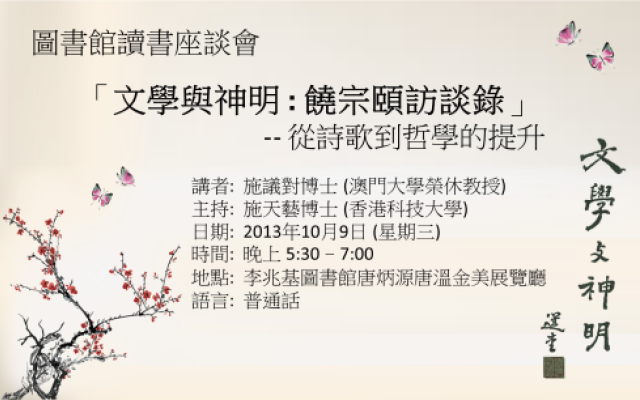
About the TalkProfessor Jao Tsung-I was delighted by the publishing of Professor Sze Yee Tui’s “Literature and God”, and thought it an impossible mission without divine inspiration. That is a question only the author can answer. The book took Prof. Sze more than a decade of researching and writing, and four years of editing. Just as the proverb goes, it takes ten years to grind a sword, so it took just as long to Prof. Sze to perfect every word in the book.Prof. Sze will take us through of how he wrote the book, and what he has learned from Prof. Yao. He will also give us a glimpse into the alluring world of his intellectual journey.本書以訪談形式,深入淺出,全面、系統地對饒宗頤學藝大世界作一概括描述。從橫的角度看,既展示饒公在史學、文學、經學乃至甲骨學、秦簡學、敦煌學諸多領域的獨特見解及建樹,又呈現饒公於詩、詞、文、賦及書法、繪畫、琴藝諸多方面的風貌及成就;從縱的角度看,則於宇宙觀、神學觀、藝術觀以及對世界萬物的認識論,作深入的探索及討論,頗多新創之見。全書正文七章,另有代序、緒論、附編以及饒宗頤學術年表。饒公其人,平易可親;饒公其學,莫測高深。為將饒公之學盡量加以淺析,力求使讀者容易理解,本書編纂,歷十度寒暑,又批閱四載,始畢其功。內容根據錄影、錄音及已刊文集,兩相校核,並依編纂者個人心得,編排、整理而成。是閱讀大師、走近大師的一部入門讀本。施教授的《文學與神明 : 饒宗頤訪談錄》(索書號: PL2264 .R36 2010) 已入館藏,可隨時借閱。 About the AuthorProfessor Emeritus Dr. Yee Tui Sze’s ancestral home was in Changhua County, the Granary of Taiwan. He is a professor and researcher in Chinese literature at the Faculty of Social Science and Humanities at the University of Macau, where he has been teaching classical literature and Chinese poetry (Ci) for more than two decades. He is the winner of several teaching awards, and served as the Associate Dean at the Faculty of Chinese of the University. Prior to the University of Macau, Prof. Sze was the Editor-in-Chief of Hong Kong New Asia Publishing, an Associate Researcher at the Institute of Literature, Chinese Academy of Social Sciences (CASS). Prof. Sze graduated from the Department of Chinese, Fujian Normal University, and went on in pursuit of his postgraduate research at the Centre for Language and Literature Studies of Hangzhou University, obtaining both of his MPhil and PhD in Chinese Literature from the Graduate School of CASS in Beijing. His two great mentors were Prof. Xia Chengtao and Prof. Wu Shichang, both were the leading authorities in Chinese literature. Prof. Sze’s doctoral thesis, Study on the Relationship Between the Lyric and Music, has been regarded by the fellow scholars as the most integrated thesis on Ci for the century, one of the most-highly cited theses of his field. Prof. Sze has further established the theory of Constructive Analysis of Ci based on the foundation laid by Prof. Wu Shichang.Prof. Sze is a prolific researcher whose publications include more than 20 sole-authored books, in addition to numerous articles and papers.施議對, 台灣彰化人。澳門大學榮休教授、中國社會科學院比較文學硏究中心學術顧問、河南大學兼職教授。中國社會科學院文學硏究所原副硏究員、香港新亞洲出版社原總編輯、澳門大學原中文學院副院長、社會科學及人文學院中文系教授。福建師範學院中文系畢業,杭州大學語言文學硏究室硏究生結業。中國社會科學院文學碩士、文學博士。曾師事夏承燾、吳世昌,專攻詞學,頗得真傳。所撰博士論文《詞與音樂關係硏究》,學界譽為近百年來詞學集成之作;並依吳世昌結構分析法,倡為詞體結構論,以示門徑。主要著作有:《詞與音樂關係硏究》《宋詞正體》(《施議對詞學論集》第一卷)、《今詞達變》(《施議對詞學論集》第二卷)、《詞法解賞》(《施議對詞學論集》第三卷)、《人間詞話譯注》《李清照全閱讀》《胡適詞點評》以及《當代詞綜》(四冊)等近二十種。For enquiries, please contact Edwin Leung at 2358-6708.
Details
Library iTalks
Library iTalks
4
8
9
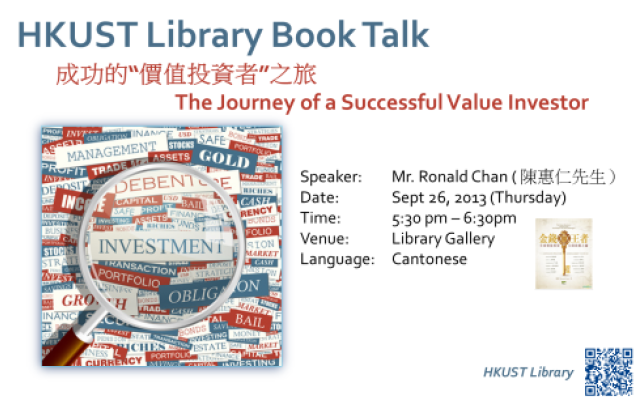
About the Talk"Success in investing doesnt correlate with I.Q. once youre above the level of 125. Once you have ordinary intelligence, what you need is the temperament to control the urges that get other people into trouble in investing." – Warren BuffettOn September 26th, Ronald Chan gave a fun and fascinating talk about value investing as a dynamic and ever-evolving investment strategy. He discussed his recent book "The Value Investors: Lessons from the Worlds Top Fund Managers" (Chinese translation: "金錢王者:全球價值投資大師致勝之鑰"), where he interviewed 12 value-investing legends from around the world to learn how their personal background, culture and life experiences have shaped their investment mindset and strategy.After the Talk, there was a sale of Ronalds books. He very generously donated the sale proceeds to the Library via our "Bookmark Me@UST" program to bookmark his two titles with a bookplate:The Value Investors: Lessons from the Worlds Top Fund ManagersBehind the Berkshire Hathaway Curtain: Lessons from Warren Buffetts Top Business LeadersThe bookplates say:"Never aim to be a person of success, but a person of value!" – Ronald ChanThanks again to Ronald for his generosity. "儘管你的智商指數達到125或以上,對投資成功與否並沒甚麼關連。其實只要擁有一般的智力,勝負關鍵取決於投資態度及自我控制的能力。" – 巴菲特陳惠仁先生在九月二十六日的讀書座談會中,有趣地講解價值投資其實是一個生氣勃勃、不斷演化的投資策略。他在其著作《The Value Investors: Lessons from the Worlds Top Fund Managers》)一書中訪問了全球十二位價值投資的傳奇人物,以了解在其投資思維模式及策略的形成過程中,他們的個人背景、文化環境和生活經驗所起的作用。陳惠仁先生在讀書座談會完結後銷售其著作,並將銷售所得全額透過科大"書海留名"計劃捐贈給圖書館。陳惠仁先生在圖書館藏書庫的兩部著作已貼上特別設計的圖書館藏書票:The Value Investors: Lessons from the Worlds Top Fund ManagersBehind the Berkshire Hathaway Curtain: Lessons from Warren Buffetts Top Business Leaders藏書票上印有陳惠仁先生的鼓勵字句:"Never aim to be a person of success, but a person of value!" – Ronald Chan再次感謝陳惠仁先生的參與和支持。 About the SpeakerRonald is the founder and Chief Investment Officer of Chartwell Capital Limited, an investment management company based in Hong Kong. He is a frequent contributor to financial newspapers and magazines in the Asia-Pacific region, and is the author of "Behind the Berkshire Hathaway Curtain: Lessons from Warren Buffetts Top Business Leaders." Ronald received Bachelor of Science degrees in Finance and Accounting from the Stern School of Business at New York University.陳惠仁先生畢業於紐約大學史登商學院,為香港 Chartwell Capital Limited 投資管理公司的創辦人及投資總裁。陳先生常於亞太區之財經報刊雜誌發表文章,並著有《Behind the Berkshire Hathaway Curtain: Lessons from Warren Buffetts Top Business Leaders》等書。For enquiries, please contact Celia Cheung at 2358-6768.
Details
