



Library Stories
Library Stories
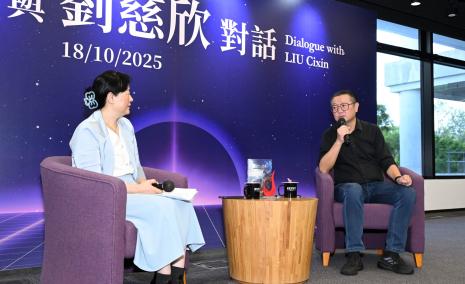
As a staff member at the HKUST Library and a devoted fan of>The Three-Body Problem since my student days, I never imagined that one day I would meet Liu Cixin (劉慈欣) in person, and right here at my workplace. From Ancient Maps to Galactic Orbits.On October 18, HKUST held its Congregation 2025, awarding an honorary doctorate to Mr. Liu Cixin, the first Asian writer to win the prestigious Hugo Award. The same afternoon, Dr. Liu came to our library for a talk. I had the privilege of accompanying him together with a few of my colleagues as he explored our exhibitions, rooftop garden, and special collections. He showed genuine curiosity and appreciation, particularly towards our displays of ancient Chinese maps.A Dialogue on Technology, Human Civilization, and the Future. The highlight of the library visit was of course the talk, held in dialogue-format and moderated byProfessor Liu Jianmei. The venue was packed. As an “insider”, I firsthand knew how overwhelming the demand was: Over 700 registered for just over a hundred available seats. It was harder to get than concert tickets The discussion covered a broad range of topics from how AI is shaking up creative writing, to the future of virtual worlds, and to the sociological implications of the Dark Forest theory.When asked about AI’s growing ability to write fiction, Dr. Liu candidly admitted that even he had experienced a decline in creative passion. AI-generated texts now often surpass human writing in fluency and style, making it difficult to evaluate student work or feel unique as a writer. Yet he also pointed out that human cognition itself is data-driven, much like large language models. As a science fiction author, Dr. Liu remains calmly optimistic. He doesn’t see AI as a threat, but as a potential guide for humanity’s future. “If one day we can’t leave the solar system, but artificial intelligence can,” he said, “then perhaps it can carry our dreams into the stars.” One of the final questions of the talk came from an audience member who asked how Dr. Liu comes up with such vast and original ideas. I was particularly interested in this question myself. His answer was refreshingly honest: most people assume that sci-fi writers effortlessly generate ideas like “laying eggs,” but in truth, it is extremely difficult. Even with intense effort, he said, it can take more than a decade for a good idea to surface. As both a reader and a librarian, I was deeply moved. It reminded me that true creativity isn’t the product of calculation, but of vulnerability of being shaken by the unknown and daring to imagine beyond it. As a Three-Body fan, I was most eager to hear his thoughts on the Dark Forest theory. Dr. Liu clarified that it’s not a metaphor for human society, but an extreme hypothetical model for cosmic sociology. When civilizations are separated by light-years and unable to communicate, “shoot first to survive” becomes a plausible strategy. He emphasized that humans, unlike alien civilizations in such scenarios, can communicate and cooperate. Applying the Dark Forest model directly to humankind is a misinterpretation.
NewsPeople
Library Stories
Library Stories
Here in the northern hemisphere, the nights are getting longer, and the weather becomes colder. As October draws to a close, the unofficial holiday, Halloween (October 31) approaches. Around this time of year, people often like to read or watch scary or ghostly things. Last month, the Library began its display of Horror Film Classics for the "Spooky Season". But what about reading? Shirley Jackson (1916-1965) is a classic mid-20th century writer whose works often touched on the uncanny. Her The Haunting of Hillhouse is available in print in the Library's collection (PS3519.A392 H3 1959) and in electronic format as public domain in Canada and Hong Kong from The Faded Page. It was also made into a film, called The Haunting (PN1997.A12 T865 2009 disc 1). The opening paragraph is justly famous for being an almost perfect opening for a ghost story. "No live organism can continue for long to exist sanely under conditions of absolute reality; even larks and katydids are supposed, by some, to dream.
CollectionsNews
Library Stories
Library Stories
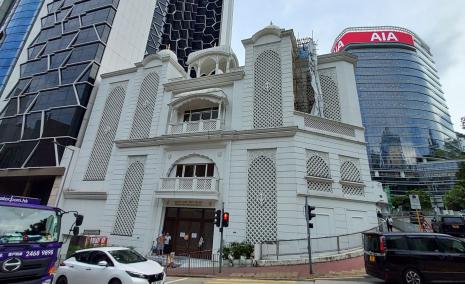
Five of us, without realizing that others had also signed up, joined a tour on 1 August Friday organized by the Diversity and Equal Opportunities Unit and guided by WEDO Global Cultural Ambassadors. The destination was the Sikh Temple (Gurdwara Sahib). History of the Sikh Temple The Gurdwara Sahib is the only Sikh temple in Hong Kong. Built in 1901 on land allotted to the Sikh community by the British government, the temple was damaged during World War II by a Japanese bomb. It was subsequently rebuilt with donations from both local Sikh and non-Sikh communities at its current location: 371 Queen’s Road East, Wanchai. Etiquette for Visitors Visitors to the Sikh temple are expected to follow a few important guidelines: Remove shoes and socks on the ground floor and place them in the racks provided, then wash feet before entering. Cover the head at all times. Beautiful blue headscarves were kindly provided by WEDO Global and given to us as souvenirs. Dress modestly, with long pants or skirts and tops that cover the shoulders. Refrain from bringing alcohol, cigarettes, tobacco, or meat onto the temple premises.
People
Library Stories
Library Stories
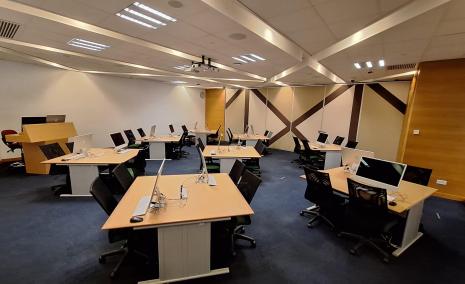
We are excited to announce that the upgraded iMac stations are now ready for use in the Library starting 29 August 2025, just in time for the new semester! More Than Just New Machines.The new iMac stations deliver faster performance and enhanced security. To better accommodate diverse study preferences, we've refreshed the space with a balanced mix of iMac stations and open seating. Whether you prefer working on our new iMacs or your personal laptop, a comfortable study environment awaits you. Overcoming Delivery Delays Despite delays in delivery, our team didn’t wait around. We proactively rearranged preparation work before their arrival in late July to expedite the process. Our goal was to ensure the new iMac stations would be ready before the semester began. Technical Challenge During setup, we encountered a challenge connecting the new iMacs to the HKUST domain to allow HKUST account login. To protect your privacy, we adopted an alternative solution using reborn software, which wipes all changes upon reboot and provides a secure and consistent user experience. A Team Effort Worth Applauding. Special thanks to the Systems Support Team colleagues for their efforts in deploying the new iMac stations. Their work went beyond installation—they managed iMac registration, software deployment, and thoroughly tested existing network cables to guarantee stable and reliable connectivity for all users. Visit Us in E-Learning Classroom A, LG1 The new iMac stations are located in E-Learning Classroom A, LG1. Please drop by and experience the upgrade firsthand. If you need help, our library staff are always ready to assist.Happy studying!
NewsStudy Space
Library Stories

Library Stories
You have probably already seen the new carrels on LG4. We went with a colourful mix in a 'hexagon' or honeycomb arrangement. We changed the carpet too, giving a more engaging and dramatic visual effect. Why this change? Previously, that area held several large reading tables and a collection of sofas. For the past couple of years we have been receiving complaints about noise travelling from there to higher floors, especially LG3 and G/F. And the recent LibQUAL user survey showed a strong student demand for more individual study carrels. And the sofas were really being underutilised, and sometimes used for sleeping instead of studying. So we killed two birds with one stone, as the western saying goes. Groups of students discussing were switched to individual study options meeting user demands for quiet individual study space.
FurnitureStudy Space
