


Research Bridge
Research Bridge
Using the Topic Modeling Tool developed under the Library’s DS CoLab project, we applied a natural language processing (NLP) approach to analyze posts from the HKUST Library’s Research Bridge Blog.
HKUST Research
Research Bridge

Research Bridge
In today's digital era, GenAI is transforming the way we approach research, learning, and teaching. To truly harness its power, it's essential to stay in control and accountable for your work.
Library Stories
Library Stories
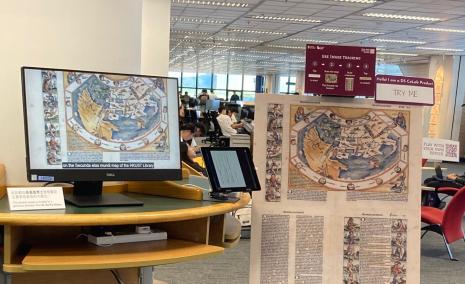
What's Up on the Ground Floor this September? You may have noticed something unusual just inside the G/F gates of the Library. What is it? A display of a digital humanities project for you to interact (play) with. What's the story? In spring semester 2025, 5 UG students worked with library staff as one of the DS CoLab projects to bring a 520 year-old map from the Library's collection to life. They used augmented reality (AR) technology to create an engaging and interactive visual way to explore the cultures and histories that went into the creation of "Secunda etas mundi", The Second Stage of the World, from Hartmann Schedel's Nuremberg Chronicle (1493). This map is a fascinating piece from the library’s Special Collections. It shows “The Second Age of the World” (out of 6), the stage between Noah’s Flood and the birth of Abraham. These ages were a periodization of world history (common in Christian Europe for about 1,000 years), first formulated by the North African Christian theologian, Augustine of Hippo (354-430 CE). A remarkable example of late medieval cartography, it combines knowledge from the Greek geographer Claudius Ptolemy with visual references from religion and mythology from Europe and the lands surrounding the Mediterranean.
CollectionsNews
Library Stories
Library Stories
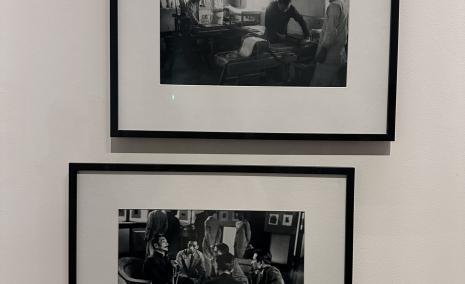
Did you know that Canton (Guangzhou) and Hong Kong, twin cities where Cantonese is the lingua franca, have much more in common beyond language? Modern art and visual culture born in the two cities share a legacy deeply rooted in the history of Modern China. M Museum’s recent exhibition “Canton Modern: Art and Visual Culture 1900s-1970s” showcases over 200 artworks – many on public display for the first time – from this lesser-known history. Sha Fei, a featured artist in this exhibition whose works are on loan from our Library’s Special Collections, is regarded as one of the most influential Chinese photographers of the 20th century. Born and educated in Guangzhou, Sha Fei, originally named Situ Chuan, came from an extended family that was well known for its artistically talented members, including a film director and two painters. Initially aspired to be a fine art photographer, Sha Fei turned his lens towards the working class and later, scenes of war during the 1930s-40s. This transformation was driven by a shared artistic vision among Cantonese artists highlighted in the M exhibition: the belief that art could influence people and transform society. Two of Sha Fei’s works on display at M , photos taken by the author. As a photojournalist, Sha Fei produced more than a thousand photo records of the Sino-Japanese War. Thanks to a generous donation from Sha Fei’s daughter, Ms Wang Yan, who reached us through Professor David Cheng Chang at the Division of Humanities, our Library now holds a collection of Sha Fei’s wartime photographs: Sha Fei Photographic Collection.
CollectionsPeople
