

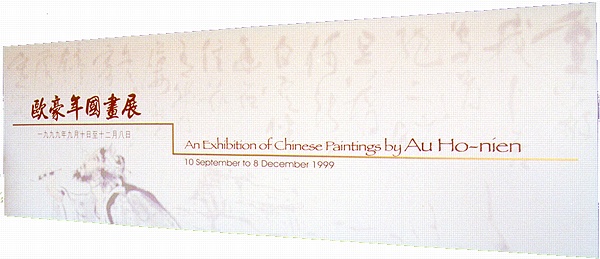
An Exhibition of Chinese Paintings by Au Ho-nien
Au Ho-nien on Lingnan School Painting
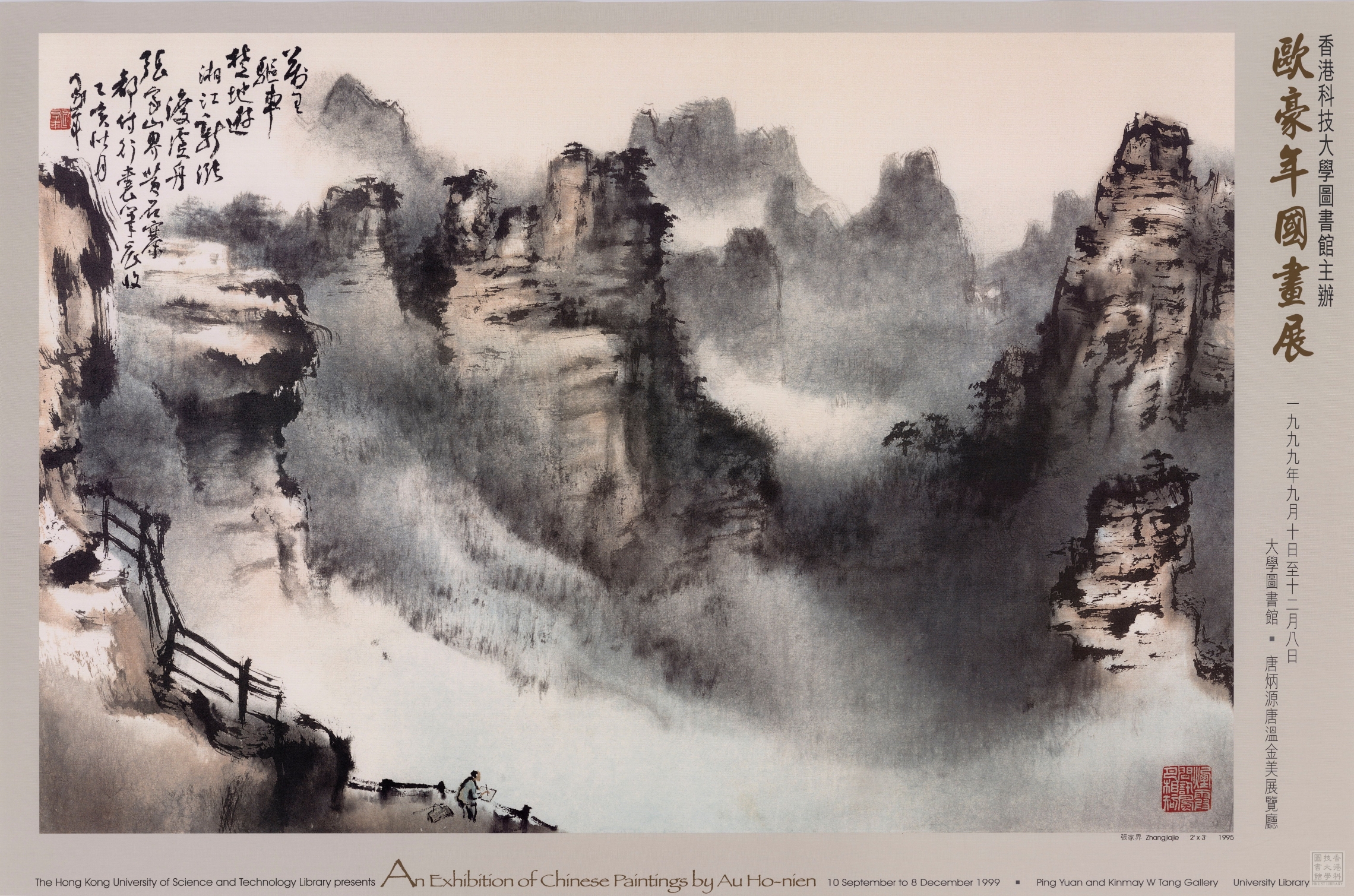
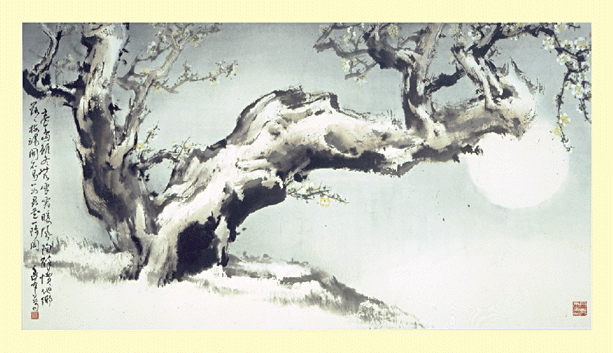
Although the Lingnan School stresses renewal and creativity, its essential spirit does not reside in rejection of traditional methods and inspiration. Rather, we consider ourselves heirs of tradition and we strive, clearly, toward a catholicity which reassesses traditional techniques and values, and reorganizes them into new images expressive of new feelings and a new spirit. Therefore within a single painting we may have the vigour of the ‘axe-cut modelling stroke’ or fu-p’i ts’un used by the Northern School, and the gentler modelling strokes like ‘unravelled hemp’ and ‘ox hairs’, ‘p’i-ma and niu-mao ts’un’ used by the Southern School. In ink usage we may combine both the rich moistness of a heavily watered brush with the dry rubbing effect of a parched brush. In composition, depending on the nature of each painting, we may have majestic mountains filling up the central space, a device favoured in the Northern Sung period, or we may place elements off to one corner, leaving space in the centre of the painting, evocative of Southern Sung painting. Some people say we stress gorgeous colours or that we have only managed to introduce a wider range of colours to traditional painting. I think that is a superficial view. Live, descriptive and at the same time expressive colouration is only a part of our endeavour. We also stress brushwork, as the best of traditional Schools do. For us, each contact between brush and paper must make sense, be alive, descriptive and expressive. We pay particular attention to the weight of each stroke, to the attack of its entrance, the movement of its exit. Look at the other Schools, they are limited to their few brush-idioms, their hallmark brush strokes. But in our case, we use also the hempfibre strokes p’i-ma-ts’un of the Southern School, we use wet strokes, dry strokes, splayed, ‘flying-white’ fei-pai strokes. We do not lock ourselves in brush-idioms or School traditions. Rather, we use whatever works, whenever they are effective in our painting.I love inkwash shui-mo painting. There are infinite shades of ink possible with the use of water in the ink. On the other hand I will not avoid the use of colours and stick to inkwash merely in order to appear to belong to the idealist painting orthodoxy, the wen-jen tradition. They claim that colours are cheap and seductive and ink alone is high-brow, scholarly or lofty. I think this is wrong, and feel sorry for them to have so limited their own artistic potential, so restricted their possibilities in painting.
We admire all the creative geniuses of the past, like T’ang Yin, the brilliant Lin Liang from Kuangtung, the inventive monks of the late-Ming (Shih-t’ao, Pa-ta shan-jen, Hung Jen and K’un-ts’an) and the so-called Eight Eccentrics of Yangchou who brought a new freshness into Flower and Bird compositions as well as landscapes. We are inspired by the Southern Sung master Liang K’ai’s spattered ink, p’o-mo figures, with that wonderful spontaneity! Or the extremely fine hairs on the ox paintings of Southern Sung masters. We seek exciting, inspiring, new compositions, unusual and heroic in mien. We avoid blindly repeating formulae, or being constricted in our choice of brush-modes, colours or themes by external considerations such as their reputation in the eyes of Tung Ch’i-ch’ang (the late Ming critic) or anyone else. Whatever makes a moving, effective picture, we will adopt. We seek to renovate, to create and recreate constantly, and we hope that the day will come when people will understand the truly creative, truly thoughtful nature of the Lingnan School.
Artist Biography
Au Ho-nien is widely recognized as one of the world’s foremost artists in Chinese painting today. He is the Huagang Chair Professor of Art at the University of Chinese Culture in Taipei. This is a prestigious position and a most eminent accolade for an artist in Taiwan. Besides being a master painter and calligrapher, he is also an accomplished seal carver, a connoisseur of Chinese art, and a cultivated scholar of the Chinese classics.Born in Guangdong Province in 1935, Au Ho-nien became a student of Zhao Shao-ang, a renowned master of the “Lingnan School” of painting in 1952. After almost half a century, Au is now himself one of the great masters of this school of painting.
Among the distinctive elements of Au Ho-nien’s style is a skillful use of the traditional principles of “broken ink” and “dry brush” harmonized with the technique of water and pigment infusion. He likes to apply ink tones and color washes directly while sparing the use of outline, thus achieving an exciting effect which emphasizes dimension and distance.
In his painting, Au Ho-nien strives to bring forth the visual harmony of nature by playing with delicate patterns and by balancing light and shade. His painting possesses a special quality of liveliness, elegance, and sublimity.
Au’s calligraphy is characterized by vigorous and forceful brush strokes and is individual in style. His expertise in calligraphy has increased the dexterity of his brushwork, enabling him to more easily reach his artistic goals, fulfilling the philosophy of the Lingnan School: “taking nature as teacher and relying on one’s own intelligence”.
4:30 pm
Ping Yuan and Kinmay W Tang Gallery
Public Lecture & Demonstration
Speaker: Professor Au Ho-nien
Date: 9 September 1999
Time: 2:30 – 4:00 pm
Venue: Foyer, 7/F., HKUST
Language: Putonghua
