



DS Student Learning Journey WANG Yingrui Ray DS S002-v2
WANG Yingrui, Ray
Year 1, BEng in Electronic & Computer Engineering
See below the words from Ray regarding his experience on this project !
Ray is our student intern who actively participated in our project about Library AI Chatbot-V2 during the period of Feb – May 2026.
Project Overview
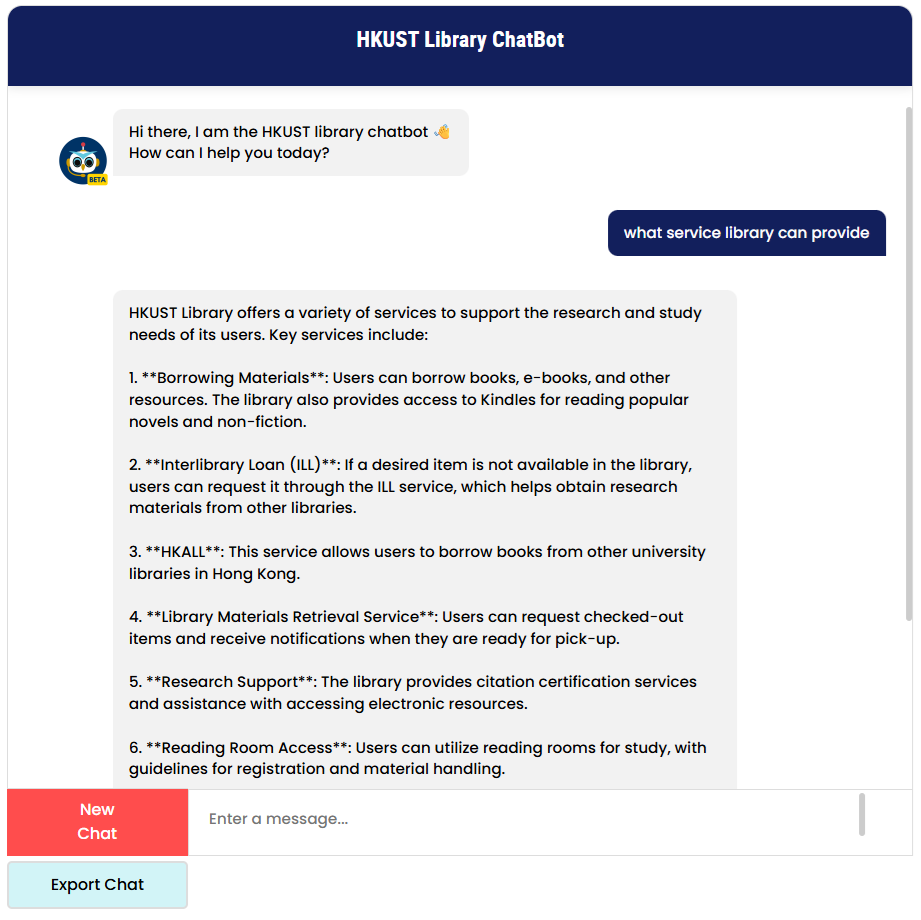
After the initial development of the HKUST Library AI Chatbot, I took over the project and continued improving it over the following months. As a Year 1 student, this was my first time working on a system that combines AI, APIs, and a real user interface, so a big part of the experience was learning by doing.
My main focus was to make the chatbot:
- More useful for real users
- More consistent in its responses
- Easier to expand in the future
During this process, the system gradually developed into a multi-agent chatbot, combining: A RAG (Retrieval-Augmented Generation) agent for answering questions, a Search agent using HKUST’s PowerSearch for retrieving real library resources and a Coordinator agent that decides which agent to use. In addition, an architecture for easy expansion of future agents.
My Approach
Since I was still new to many of the technologies, my approach was simple:
- Break problems into small parts
- Test different solutions
- Improve step by step
Instead of redesigning everything at once, I focused on incremental improvements to both the backend logic and the frontend experience.
What I Worked On
1. Improving the Search Agent (HKUST PowerSearch Integration)
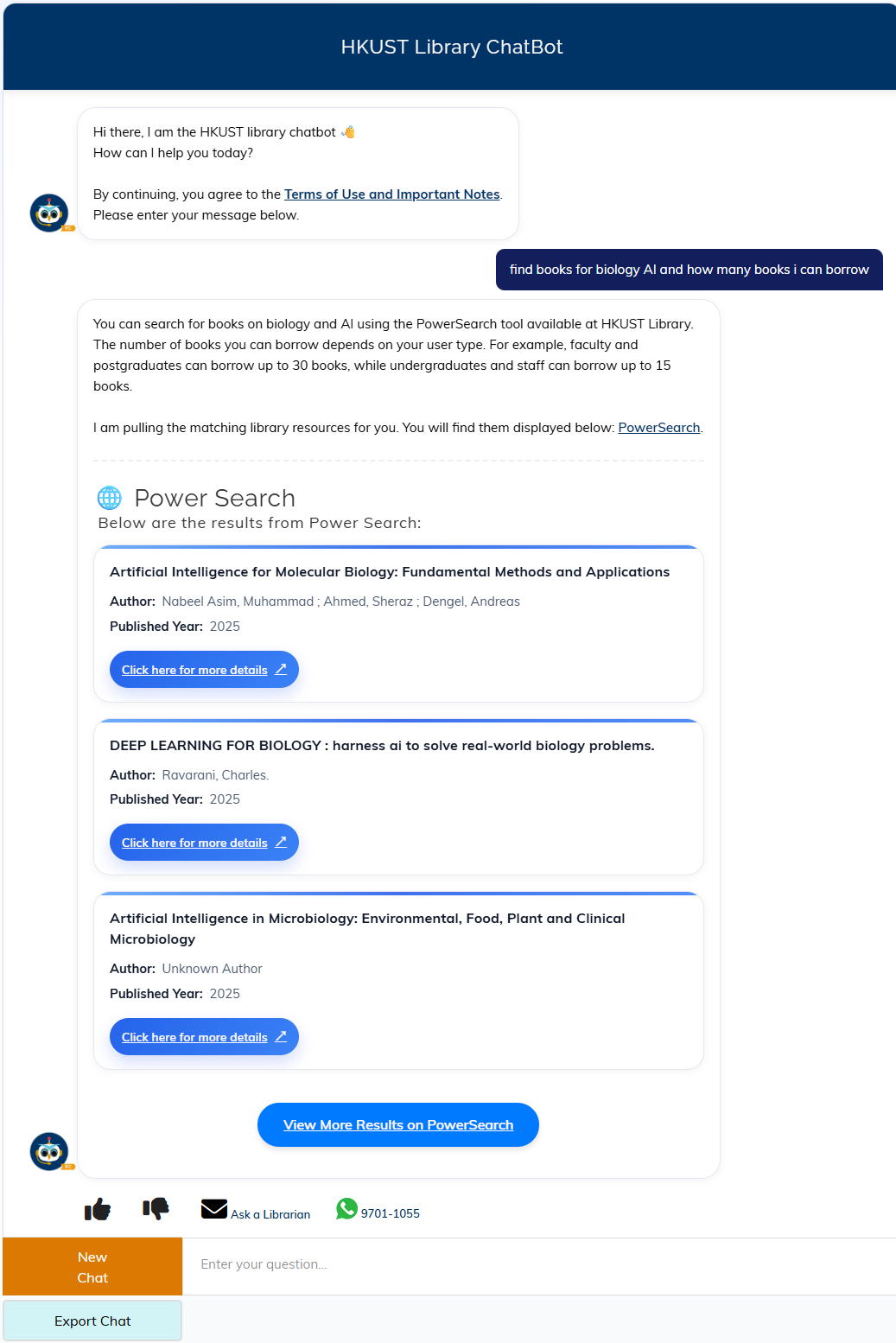
One of my main tasks was refining the search agent, which connects to HKUST PowerSearch system. I worked on fixing formatting issues such as:
- Adding auto-date filtering parameters so results can be more relevant
- Improving how the system handles follow-up searches
- Logging search results for tracking and debugging
These changes made the search results:
- More accurate
- Easier to read
- More consistent across different queries
2. Moving to a Multi-Agent System
Previously, the chatbot behaved more like a single system, also agents were used, the mechnism was only one-agent-at-a-time. During my work, it started to function more like a multi-agent setup, where different parts handle different tasks.
- The RAG agent explains information
- The Search agent retrieves real resources
This allows the chatbot to:
- Provide explanations and actual search results
- Be both informative and practical
3. Frontend and Output Redesign
I also redesigned parts of the frontend to improve usability. Key changes include:
- Changing backend output from HTML to JSON, making it easier to manage
- Designing a new response display using JavaScript and CSS
- Ensuring consistent formatting across different types of responses
- Master the end-to-end RAG AI system architecture, focusing on backend logic and system prompting
- Optimize communication efficiency between the frontend CMS and backend APIs
- Integrate third-party vendor APIs with AI systems to expand data ingestion capabilities
I also added a button that allows users to open search results directly in their browser with pre-set filters.
This connects the chatbot more directly with the actual library system.
4. Feedback System
To support real users and future improvements, I worked on feedback features:
- In addition to the thumbs up / thumbs down feedback, I redesigned the comment option
- Created an option for users to enter their email for direct contact
- Set up automatic feedback emails to staff
What I Learned
From this project, I gained experience in:
- Multi-agent system design (basic level)
- Working with APIs (HKUST PowerSearch integration)
- RAG-based chatbot systems
- Frontend–backend integration (JSON, JS, CSS)
- Debugging and improving real-world systems
- Work on the application development on Linux environment
More importantly, I learned how to:
- Approach unfamiliar problems
- Test and refine ideas
- Build something step by step