


DS Student Learning Journey YU Xiaocong DS P005
YU Xiaocong
MPhil Student in Humanities
This project is funded by a generous donation from Dr. Ko Pui Shuen.
Xiaocong is the project’s Research Assistant. Though hesitant to try digital tools at first, he eventually found that engaging with them has “vitalized” static historical materials and, surprisingly, part of him as well. Read his sharing below !
01 — Introduction
I am YU Xiaocong, an MPhil student at the School of Humanities and Social Science (SHSS). I would like to share my research contributions and insights from this project.
02 — Project
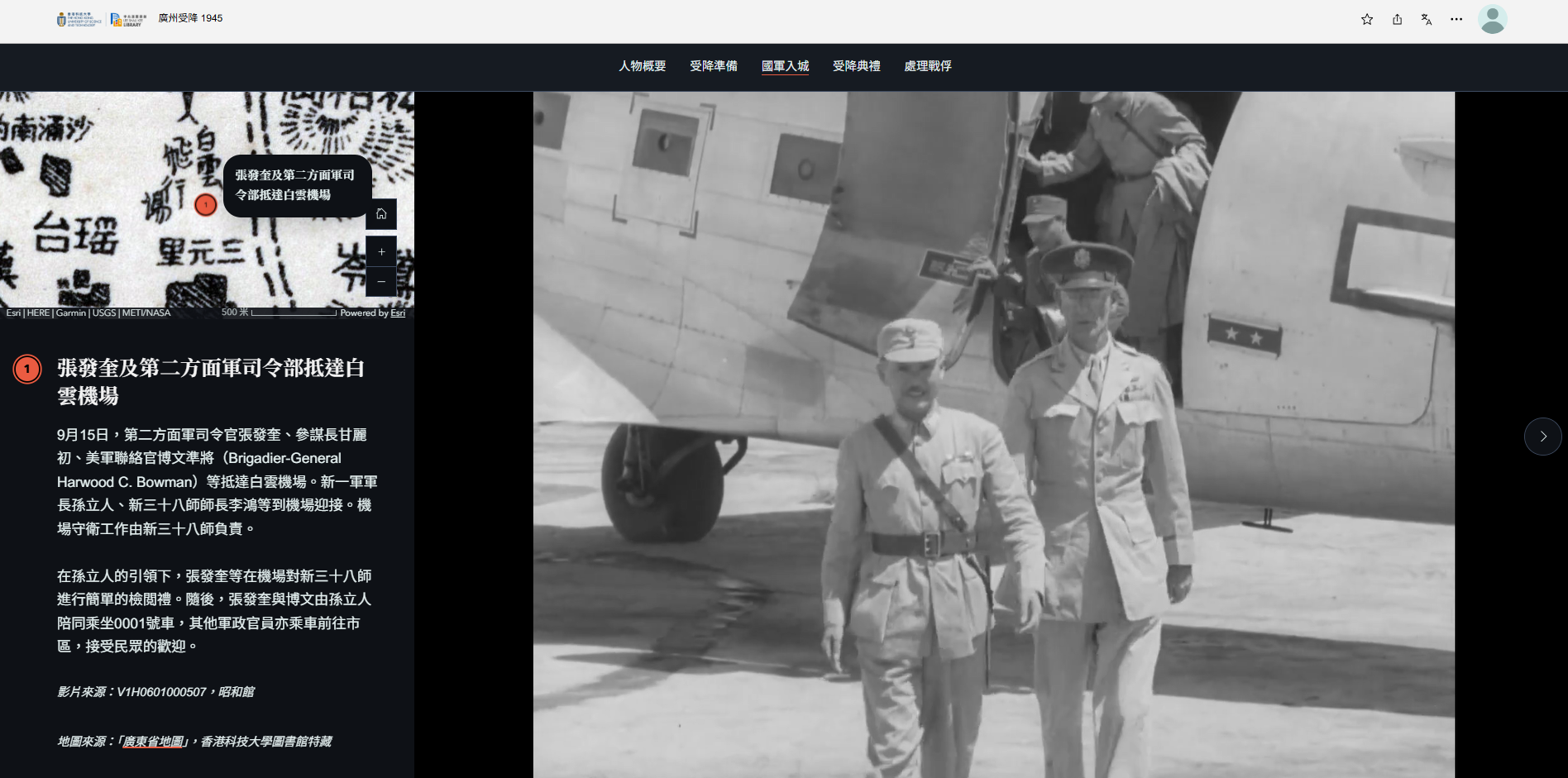
StoryMaps Screenshot -Arrival at White Cloud Airfield
Collaborating with the library team to reconstruct the narrative of China's victory in the War of Resistance through StoryMaps has been a deeply inspiring academic journey.
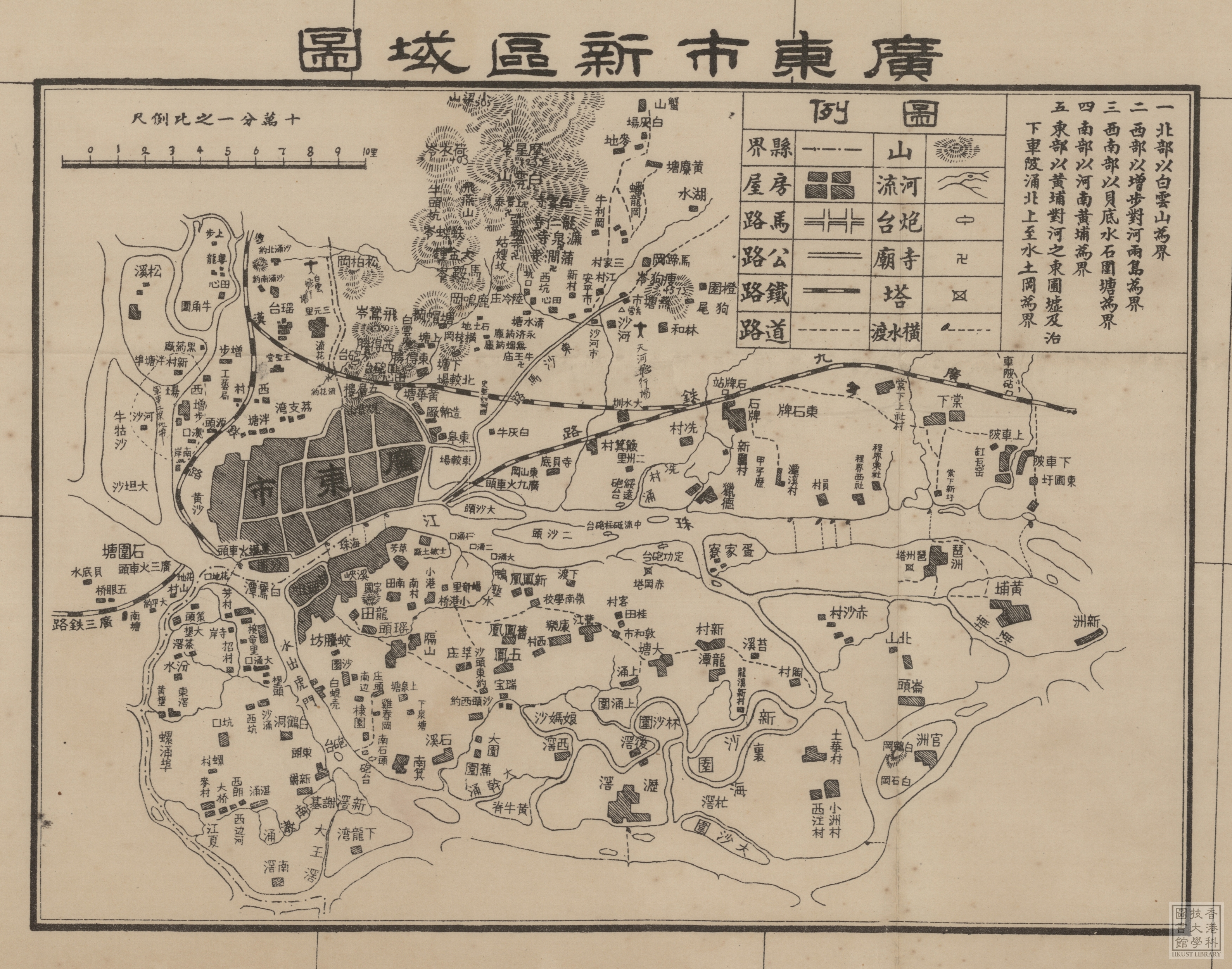
Our project focuses on a lesser-known historical moment: the Nationalist Government’s recovery of Guangzhou (Canton, 廣州) in 1945. Although the "victory" appeared fleeting amidst the looming shadows of the Civil War, the grand entry of the elite New First Army into Guangzhou remains a significant event that deserves historical recognition.
This project aims to restore the historical grandeur of the victory in Guangzhou more than 80 years ago through the interactive presentation of maps, images, and documents.
03 — My Role
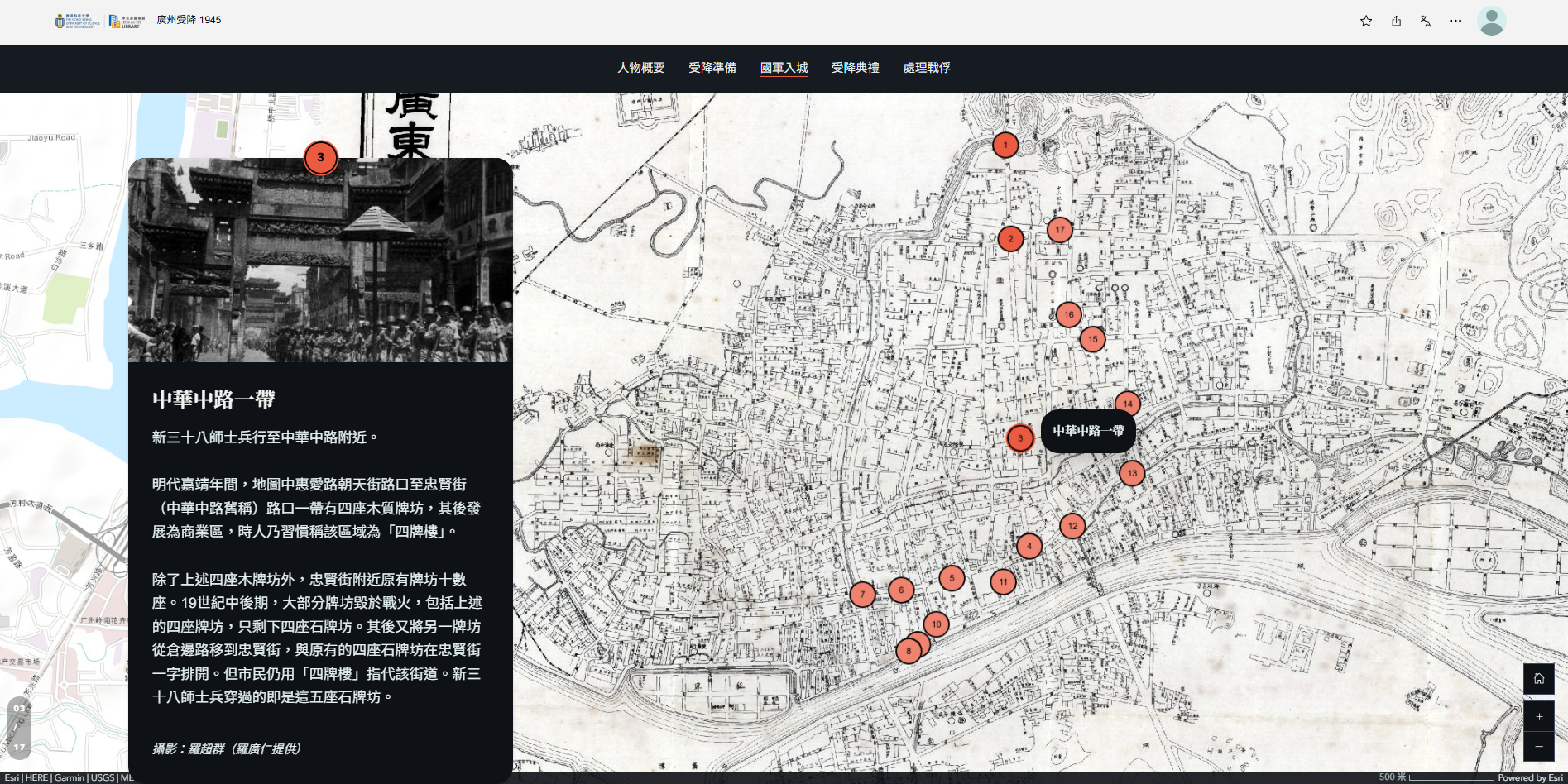
StoryMaps Screenshot - Georeferencing of Victory Parade
As a Humanities graduate student, my primary responsibilities involved archival research and narrative writing. I sought to clarify the historical trajectory between Japan's surrender and the formal surrender ceremonies, striving for historical authenticity.
One of my core task was to interweave geospatial analysis with storytelling. By meticulously examining archival photographs and film footage, I verified specific filming locations, achieving a precise integration of historical narrative and geographic space.
04 — Precious Photographs
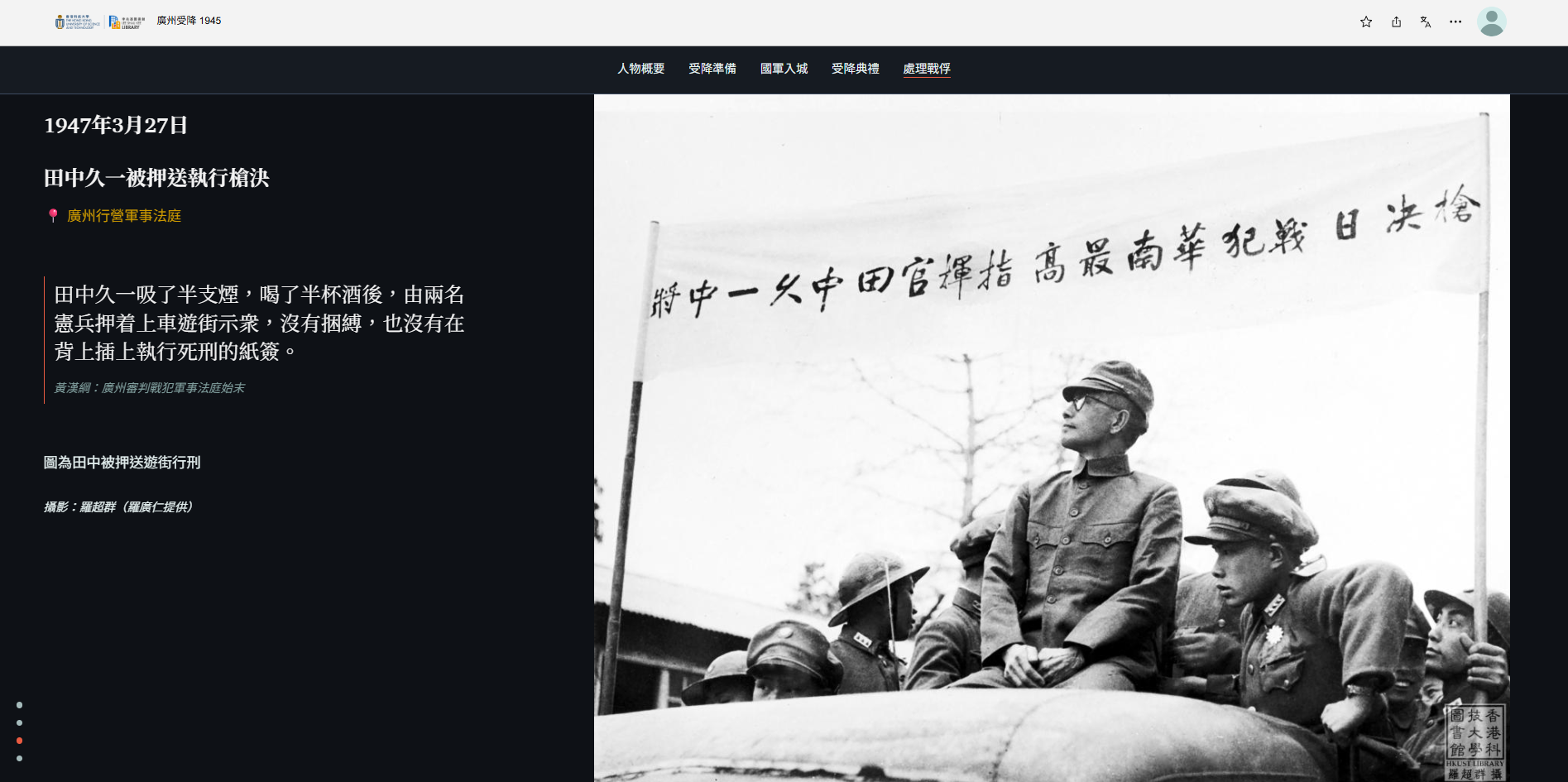
StoryMaps Screenshot - Mr. Lo Chao-Chun's Photograph
Through the introduction of Professor David Cheng CHANG, the project received the full support of Mr. LO Kwang-Jen (羅廣仁). The precious photographs preserved by his late father, Mr. LO Chao-Chun (羅超群)—a former journalist for Da Guang Bao (大光報)—are the heart of this project.
Confronted with historical images lacking metadata, I used cross-referencing and comparative analysis. This allowed me to embed the moments documented by the photos into the digital map, allowing them to "return to the scene" in a digital space.
05 — AI for Newspaper OCR
ResearchBridge Article - 1940s Newspaper AI OCR Test
Through my work on this project, I have gained a deep understanding of how digitalization enhances research efficiency.
This project involved processing a vast number of Chinese newspapers from the 1940s. These materials had been digitized as images, yet they lacked a searchable and extractable text layer to do effective and efficient research. I collaborated with the team to use AI models for Optical Character Recognition (OCR) on a large scale. This significantly shortened the document organization cycle and effectively reduced potential errors from manual entry.
We also conducted comparative tests on the accuracy of different AI models in dealing with the challenges presented by the unique layouts and fonts often found in Chinese Newspapers from the Republican era.
This exploration ended up serving two purposes: it added academic interest and established a reliable data foundation for subsequent research.
→ "The Cognitive Gap in the Archive: Benchmarking Multimodal LLMs on 1940s Chinese Newspapers"
06 — A New Beginning
As a newcomer to Digital Humanities, the technical expertise of the library specialists has been eye-opening. I started out hesitant to try digital tools, but the Library team encouraged and guided me to take a step further and explore beyond the boundaries of a "traditional" Humanities student.
Engaging with digital tools “vitalized” static historical archives and, surprisingly, has “vitalized” part of me too. This collaboration broadened my academic horizons, and gave me new methodologies for digital storytelling to use in my future historical research.