

Recent Works — Katherine Chang Liu and Julia Nee Chu
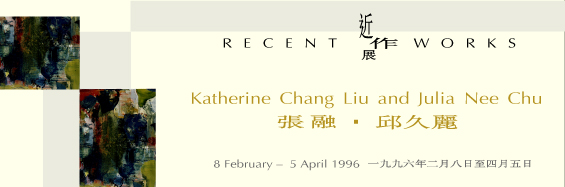
Resonant Visions
Being Chinese, I see mark making as a natural extension of my heritage. To me, drawing is not limited to capturing a likeness of something, but rather it is how I think with a line. I am always watching that I don’t become flippant with any drawing or mark-making. I caution myself to be as authentic as I can be and to keep as much integrity as I can while I work. These paintings are becoming more and more internal as I work along. But I do believe I paint because the action of painting is truly the most engaging thing I know.*
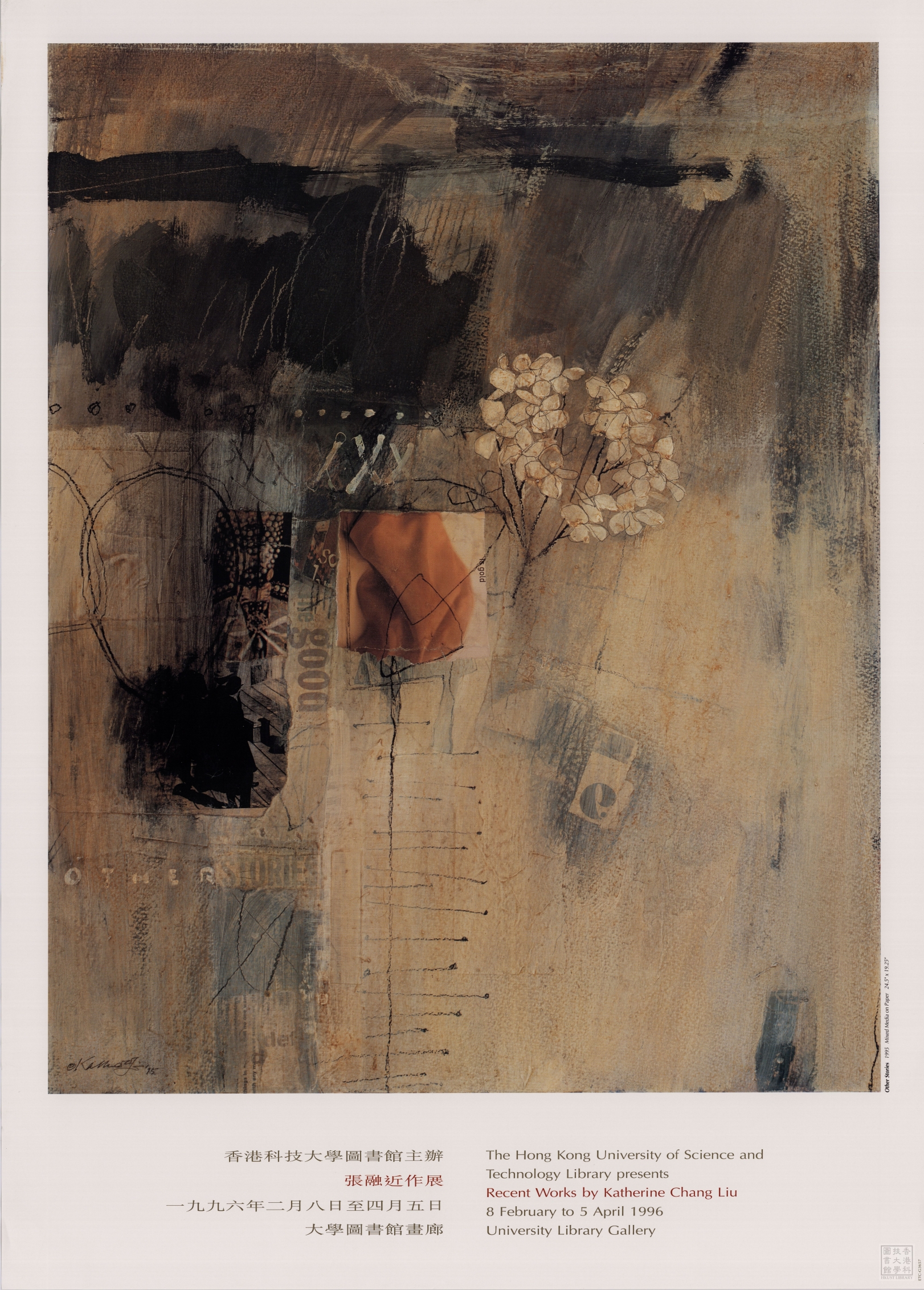
As the world faces a new millennium, reviewing the many groundbreaking events that have transpired in the twentieth century seems both timely and inevitable. Each revolution À whether political, sociological, or technological À has engendered a reaction that crosses cultural parameters. The complexities of society are mirrored by the multivalent directions that artists have taken and by the many styles they have spawned in this century. Throughout these years, a fragile balance has been maintained between control and chaos, between intellect and intuition. Keeping these aesthetic tenets in mind, it is easy to understand that the work of Katherine Chang Liu truly reflects the times.
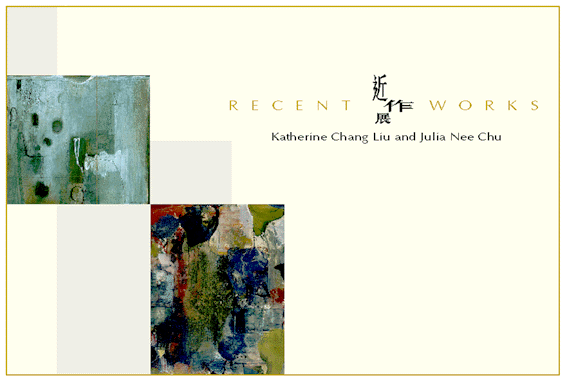
Examining Liu’s delicate abstractions, one captures a glimpse of various trends, specifically Cubism, Futurism, Dada and Surrealism, Abstract Expressionism, and even Pop Art. While fusing the automatic gesture and the appropriated object, she has discovered her own luminous palette and fluent vocabulary. In Liu’s most recent paintings, the artist applies earthen tones of russet, wheat, charcoal, and sage in layers, producing a rich surface from which ethereal, shadowlike forms materialize.
Venturing into fresh territory with this new series, Liu punctuates her compositions with realistic imagery in the hopes that these distinctive details will amplify her visual poetry. Sometimes drawn, sometimes cut and pasted, these elements À a head, a ball, a piece of fruit, a chair, a hat, an architectural element À simultaneously emerge and dissolve onto a vaporous ground. Once inhabiting her subconscious, these images now float through Liu’s atmospheric fields of color, striking a visceral chord in the viewer that is both familiar and magical. Liu clarifies this curious mnemonic sensation, saying:
This recent body of work is based on my fascination with memories and the mysteries of children’s games. Games which are played out either alone or with a group. Games which are either from my own childhood or games in general. They can also be real or imaginary for the child.
Indeed, the artist’s “games” become resonant visions that lead the viewer into a contemplative realm in which submerged voices, images, and events from childhood spring to the memory.
Liu’s games are not necessarily ones with rules or winners. Rather, they are games that use an object as the catalyst for the imagination, as one realizes when examining specific compositions. In Liu’s Chance, the apples and the paper cut-outs bring to mind a diversion (mildly reminiscent of roulette) that young girls in the United States often play. Rotating an apple by the stem, the child slowly recites the alphabet. The artist recalls:
Spin the stem once and say “A,” then spin and say “B,” then “C,” and so forth. When the stem eventually breaks, this letter À whether “D” or “G” or “L” À is then the initial of the first name of a girl’s future boyfriend or husband. I think a lot of the girls’ games somehow deal with this fascination, mystery and wishing for the identity of this future mate.
Most children love to act out roles and dressing up in grownup clothes is an activity they do with great relish and fascination. As they role-play, children often speculate on who they will be when they become adults. This harmless exercise is the subject of Child’s Game #1 and Child’s Game #2. Liu also probes into such concepts as captivity and freedom À ideas that children sometimes engage in, albeit innocently À with two related compositions, Child’s Game #3 and Child’s Game #4. With a bottle, an outstretched hand, and a winged creature, Liu remembers her childhood in Taiwan:
I spent quite a lot of my early evening hours (5-7 p.m.) at a University Library park grounds. My sister and I would spend endless hours gathering grass hoppers, fire flies and crickets, and try to make homes in a bottle for them by adding a bit of dirt and plants. Sometimes we built rather elaborate home sites for these insects, before feeling very guilty and letting them go free.
Liu’s ultimate source is the subconscious: While these intimate dreamscapes recall visions from one’s childhood, they also illustrate the key role that the inner voice plays in the artist’s oeuvre. Rather than giving her work a narrative function, Liu believes that each piece serves as a map that delineates her emotions at a specific moment. She elucidated this concept recently, saying:
What I am trying to put down in a visual form is this vision, this reflection of all things that relate to my internal life of this time period. That’s why the paintings take on the role of a map for me. Because of the fact that my work is rather intimate, I am never quite sure what the viewer may see.
Indeed, Liu’s psyche is exposed with candor and trust in these new works. Through her subtle use of collage, her rich vocabulary, and her inherent sense of rhythm, line, and composition, a spontaneous freedom is imparted that is poetic, mystical, and cerebral in its effect. In her continuous quest to maintain a visual equilibrium between intent and intuition, Katherine Chang Liu achieves a spiritual harmony with these evocative paintings that reveals her great insight and integrity.
*All statements were provided by Ms. Liu in correspondence with the author in November and December 1995. I am extremely grateful to the artist for her gracious assistance in writing this essay. She was most generous with her time and thoughts.
Trinkett Clark
Curator of Twentieth-Century Art
The Chrysler Museum of Art
Norfolk, Virginia
@ 1995
Introduction to Julia Nee Chu’s Works
Artists draw inspiration from different sources. Some are influenced by what they see around them, others are moved by experiences and aesthetics they encounter everyday, while some others draw from their heritage and things learned early in their lives. No matter what the source or sources are, artists reveal in their work ideas and concepts that are of particular significance and importance for them. In traditional Chinese painting, nature occupies a paramount place among the subject matters preferred by artists. Reverence for nature is as primordial as civilization itself. In Chinese art, the natural world has been depicted by countless Chinese artists throughout the centuries, it would not be surprising to find artists of Chinese origin today who still find themselves attracted to nature and all the power and energy it embodies.
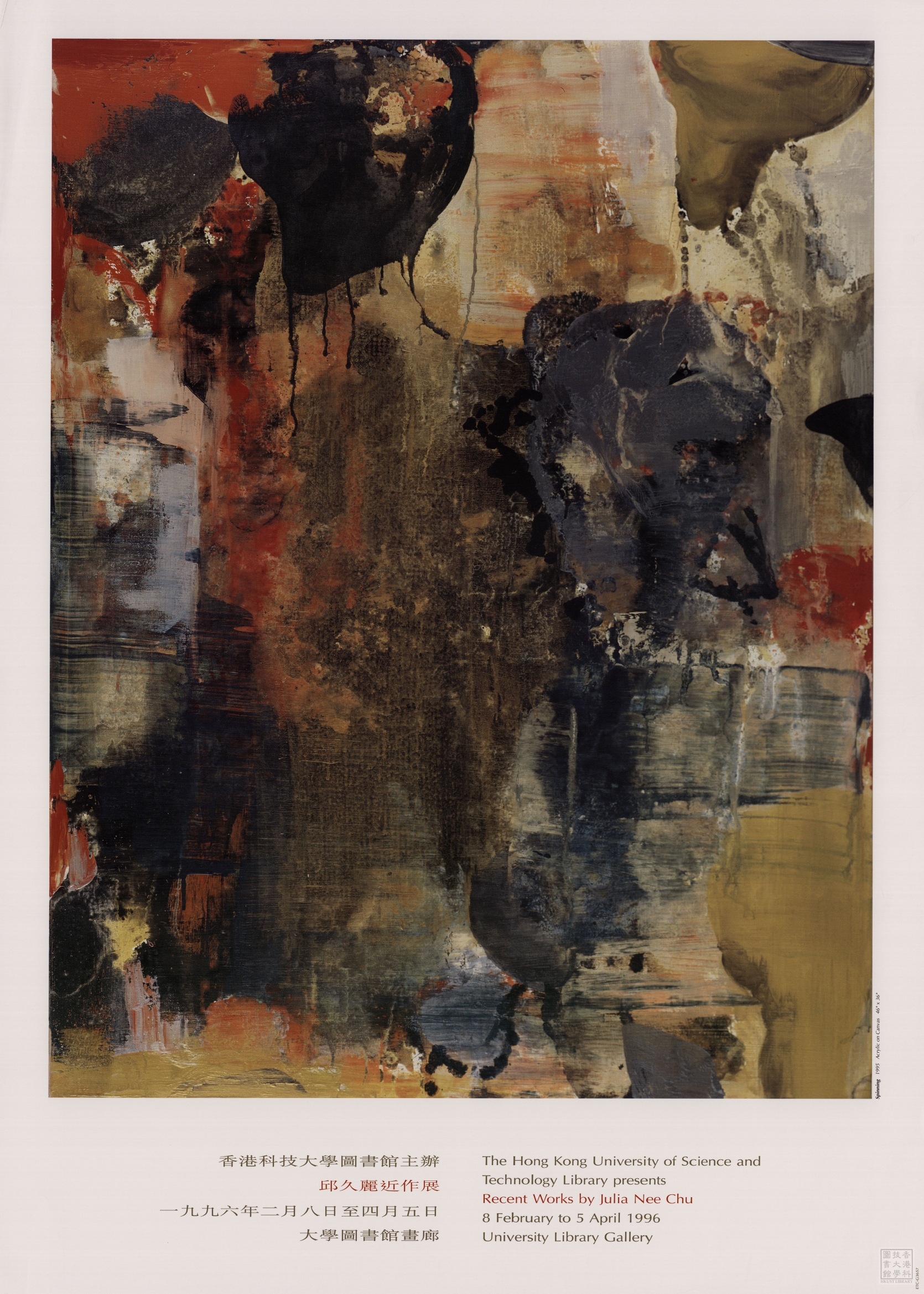
To say that Julia Nee Chu is an artist of Chinese ethnicity who shows great affinity for nature does not really tell us much about her or her work. Born in Shanghai, Chu has lived in Los Angeles since 1970s, and received her M.F.A. degree from the University of California, Los Angeles. Chu found herself working in the gestural idiom of Abstract Expressionism because of the many similarities of this particular style with the Chinese concepts of ink painting, such as the notion of “writing from the mind”, drastic abstraction, and usage of a dynamic, free flowing brush to build a texture of strokes that makes space tangible.
Chu’s paintings, however, do not resemble anything Chinese. Traditional Chinese painting never advocated total abstraction À likeness to the object depicted is very important. Her images are abstracted landscapes À scenes of the mind. We have to look closely to discern forms. Layer upon layer of paint are applied to the canvas, other times, she lets the paint drip from her brush onto the large surface of the canvas laid out on the floor of her studio in Santa Monica, CA. Chu’s style is clearly influenced by Abstract Expressionism, but instead of the raw power and muscular gestures that can be seen in the brushwork of Jackson Pollock or Willem de Kooning, Chu’s compositions reveal the refinement and fluidity characteristic of Asian calligraphy. The end product is a blend of color, textures, and shapes that emphasizes the free movement of the brush, the free-spirit mindedness of the artist in the creative process.
A recurrent motif in Chu’s work is the top. The spiral movement of this conical form represents kinetic energy, and energy is manifested in nature through time, where nothing is permanent, everything changes. As in Chinese philosophical doctrines, Chu sees nature as all encompassing, where humans are just a small part constantly searching for placement and orientation in the universe.
Chu does not force herself to depart or reject her Chinese heritage. Chinese philosophy has always played a role in Chu’s paintings, it gives them thematic content as art is never without context. Her heritage is dear to Julia Nee Chu, and she has opted to reveal it without inhibition. As nature nourishes man, her heritage nourishes her art.
Manni Liu
Curator, Chinese Culture Center of San Francisco
July 1995
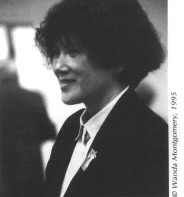
Katherine Chang Liu, born in China, was educated in Taiwan and the U.S., and received her M.S. from the University of California, Berkeley.
She has held many solo, invitational and juried exhibitions of her work in the United States, Canada, Australia, Taiwan, Hong Kong and Macau. Her introspective work subtly combines western modernism with elements of Chinese heritage; the paintings have been collected internationally by private collectors as well as public institutions.
Ms. Liu now lives in West Lake, California.
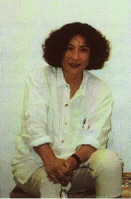
Julia Nee Chu was born in China and educated in the US, receiving her B.A. and M.F.A. from the University of California, Los Angeles.
She has held many solo and group exhibitions in the United States, Canada, Yugoslavia, Japan, Korea, Hong Kong, and Macau. Her dynamic and expressive abstracts, which combine western modernism with Chinese traditions, are collected internationally by private collectors as well as public institutions.
Ms. Chu currently resides in Pacific Palisades, California.
4:30pm
University Library Gallery
An opening reception will be held at 4:30 pm on 8 February, 1996, in the University Library Gallery.
This will be preceded by a Conversation with the Artists at 3:00 pm.