


Back to Events
#sustainability
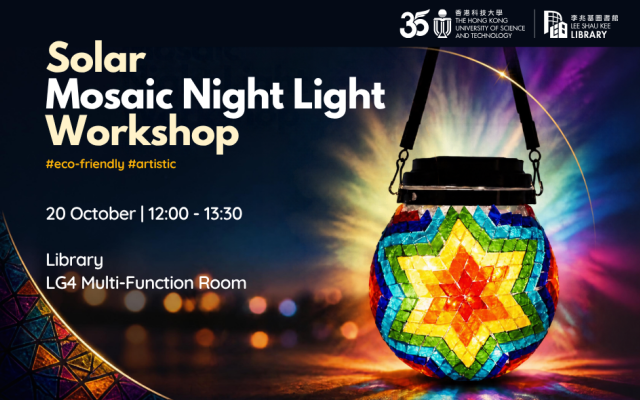
Open
HMAW 1905
7
12
13
Details
2026-10-20
12 pm - 1:30 pm
LG4 Multi-function Room
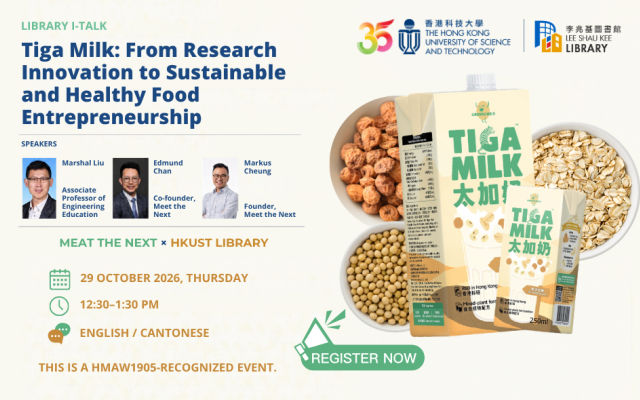
Library iTalks
HMAW 1905
2
3
12
Details
2026-10-29
12:30 pm - 1:30 pm
LG4 Multifunction Room
Library iTalks
HMAW 1905
9
11
12
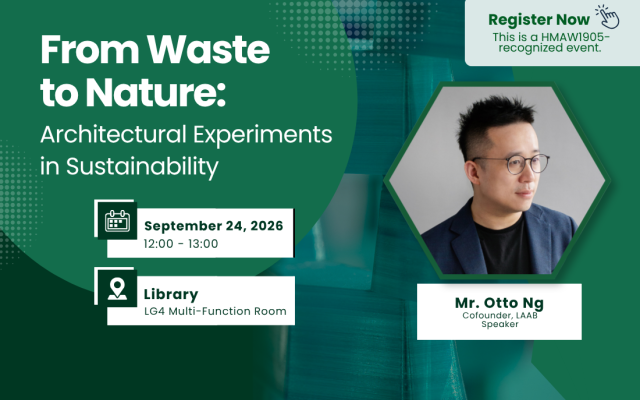
From Waste to Nature: Architectural Experiments in SustainabilityAs cities face unprecedented climate challenges, sustainable architecture must evolve beyond green walls and solar panels. It requires a fundamental rethinking of materials, structures, and urban infrastructure.Mr. Otto Ng from LAAB Architects will share how their interdisciplinary laboratory designs for the future of green living. Highlighting experimental projects - including a zero-waste 3D-printed pavilion in Paris, the flood-resilient Tsui Ping River revitalization, and the breathable urban micro-climates of K11 MUSEA - this talk bridges the gap between human habitats and the natural world.From Waste to Nature challenges ourselves to stop treating designs and buildings as static boxes and start engineering them as adaptable, circular systems capable of actively healing our cities.Speaker:Otto Ng, Cofounder, LAABDrawing on his research at MIT and global experience across the US, UK, and Italy, Otto co-founded LAAB Architects - an interdisciplinary laboratory dedicated to social and sustainable innovation. Otto leads a studio culture that focuses on both bold experimentation and pragmatic execution, resulting in placemaking, ecological projects like K11 MUSEA and the Tsui Ping River Revitalization.LAAB’s innovative approach has earned numerous international accolades, including the Japan Good Design Best 100, the AIA International Award, and the Design Anthology Award for Sustainability. To further democratize design, Otto and his team launched commaa in 2024 - a cultural venue and specialty coffee house designed to foster community connection through art and architecture.Otto holds a BA in Architectural Studies (First Class Honours) from HKU and a Master of Architecture from MIT. He has also shared his expertise as an Assistant Professor at HKU, lecturing on design coding and making. This talk supports the following UN Sustainable Development Goals (SDGs):SDG 9: Industry, Innovation and InfrastructureSDG 11: Sustainable Cities and CommunitiesSDG 12: Responsible Consumption and ProductionThis is a HMAW1905-recognized event in the "Personal Enrichment & Community Service" category under the "Self-directed Experience" of HMAW1905: Behavioral Foundations of University Education: Habits, Mindsets, and Wellness. To receive 1.5 hours, you must attend the event in full and miss no more than 10 mins.The talk will be recorded and photos will be taken during the talk. By attending or participating in this event, you are giving your consent to be photographed and video recorded and you are waiving any and all claims regarding the use of your image by the University.
Details
2026-09-24
12:00 pm - 1:00 pm
LG4 Multifunction Room
Library iTalks
Library iTalks
HMAW 1905
2
12
15
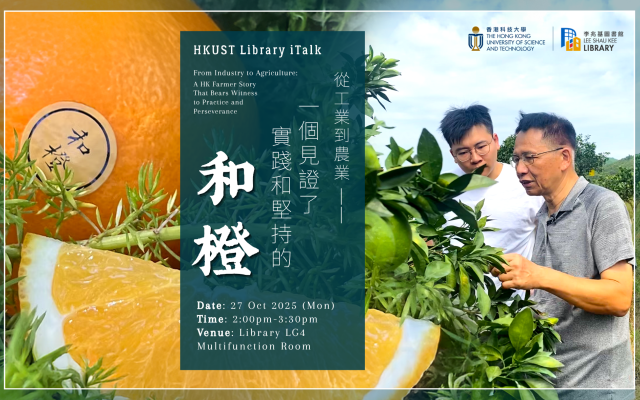
「和橙」由香港實業家李道德創立,致力以生態種植方式培育有機橙,推動可持續農業發展。是次講座將由李先生之子李泓翀先生主講,分享從工業到農業的轉型歷程,並探討品牌背後的理念與實踐,包括:工業背景轉型契機與農業初心和橙理念與品牌故事農場實踐與創新品牌成長與社會責任未來展望李道德先生亦將親臨現場,與觀眾交流並回應提問。講者簡介李泓翀 (Mr. LI Hung Chung)
華盛頓州立大學經濟學學士,現為信興實業國際有限公司總經理及綠色農產有限公司創辦人。
Bachelor of Arts in Economics (University of Washington), General Manager (Shun Hing Industrial International Limited), Founder of Green Produce Limited?? Language of talk: ??? (Cantonese)This talk supports the following UN Sustainable Development Goals (SDGs):
SDG 2: Zero Hunger
SDG 12: Responsible Consumption and Production
SDG 15: Life on Land
This is a HMAW1905-recognized event in the "Personal Enrichment & Community Service" category under the "Self-directed Experience" of HMAW1905: Behavioral Foundations of University Education: Habits, Mindsets, and Wellness.To receive 1.5 hour, you must attend the event in full and miss no more than 10 mins.The talk will be recorded and photos will be taken during the talk. By attending or participating in this event, you are giving your consent to be photographed and video recorded and you are waiving any and all claims regarding the use of your image by the University.
華盛頓州立大學經濟學學士,現為信興實業國際有限公司總經理及綠色農產有限公司創辦人。
Bachelor of Arts in Economics (University of Washington), General Manager (Shun Hing Industrial International Limited), Founder of Green Produce Limited?? Language of talk: ??? (Cantonese)This talk supports the following UN Sustainable Development Goals (SDGs):
SDG 2: Zero Hunger
SDG 12: Responsible Consumption and Production
SDG 15: Life on Land
This is a HMAW1905-recognized event in the "Personal Enrichment & Community Service" category under the "Self-directed Experience" of HMAW1905: Behavioral Foundations of University Education: Habits, Mindsets, and Wellness.To receive 1.5 hour, you must attend the event in full and miss no more than 10 mins.The talk will be recorded and photos will be taken during the talk. By attending or participating in this event, you are giving your consent to be photographed and video recorded and you are waiving any and all claims regarding the use of your image by the University.
Details
2025-10-27
Library (LG4) Multi-function Room
Library iTalks
Library iTalks
HMAW 1905
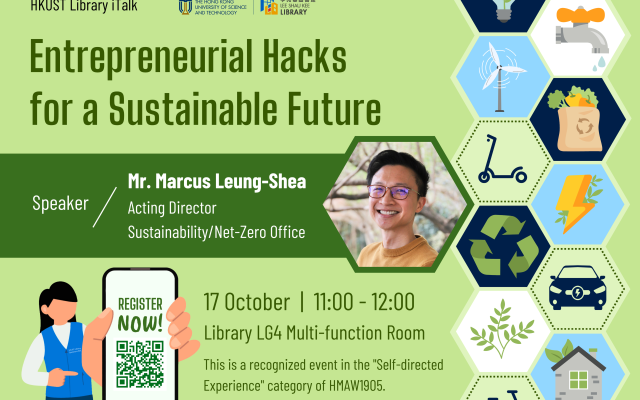
About the TalkSustainability is more than choosing to do the right thing, it is about finding inventive ways to make the right thing the desirable thing.This sharing will have examples of how all of us can approach today’s sustainability challenges with everyday entrepreneurial tools and skills. Registration: https://lbcube.hkust.edu.hk/ce/event/10243 About the SpeakerMarcus provides leadership for HKUST’s Net-Zero 2045 initiatives, focusing on decarbonisation strategies, adoption of green technologies, and exploring and implementing new-step change initiatives to make sustainability a practical reality on HKUST’s campus. His experience ranges across management consulting, corporate strategy, and entrepreneurship, with a focus on systems thinking and digital transformation. Marcus holds a B.A. in Public Health from Johns Hopkins University, a Master’s in Healthcare Administration from George Mason University, and an MBA from HKUST. NotesThis is a HMAW1905-recognized event in the “Personal Enrichment & Community Service” category under the Self-directed Experience of HMAW1905: Behavioral Foundations of University Education: Habits, Mindsets, and Wellness.To receive 1.0 hours, you must attend the event in full and miss no more than 10mins.The talk will be recorded and photos will be taken during the talk. By attending or participating in this event, you are giving your consent to be photographed and video recorded and you are waiving any and all claims regarding the use of your image by the University.
Details
2024-10-17
Library (LG4) Multi-function Room
Library iTalks
Library iTalks
HMAW 1905
11
13
17
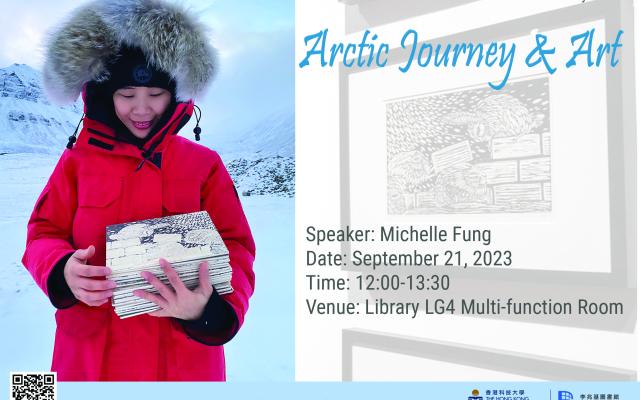
Description of talk: In fall 2022, Michelle Fung (https://www.michelleksfung.com/) went to the world’s northernmost town, Longyearbyen, to participate in the Arctic Circle, a 17-day residency program where international artists, filmmakers and musicians lived and worked on-board a ship. For fourteen days, the group sailed off the uninhabited international territory of Svalbard, an Arctic archipelago just 10 degrees latitude from the North Pole. They made daily landings to work on their projects. They rode inflatable boats called zodiaces, watched icebergs, hiked, and thus observed and researched the Arctic land as well as the sea.During her residency, Michelle created woodcuts for Northlandia, one of the five imaginary countries in her ongoing 2084 world-building project. She then an extra ten days in Longyearbyen, for more inspiration and artistic work.In this talk, she will share on her personal Arctic journey and on the Northlandia Arctic Woodcuts she created there. She will also share her scholarly and journalistic insights on climate change and the delicate Arctic landscape.Registration link: https://lbcube.hkust.edu.hk/ce/index.php/event/9676/ About the Speaker Michelle Fung (馮捲雪): An interdisciplinary artist, Michelle Fung’s lifelong oeuvre revolves around a grand dystopian world-building narrative set in year 2084. Her works have been presented extensively in international museums, galleries and university exhibitions and film festivals. A friend of HKUST, her solo exhibition Plastic, Plastic, Every Where was held at HKUST in 2019 (https://www.michelleksfung.com/hkust-2019). She holds a BFA, The University of British Columbia, Canada and MVA, Hong Kong Baptist University, Hong Kong.
Details
2023-09-21
Library (LG4) Multi-function Room
Library iTalks
Library iTalks
12
13
15
About the Talk - Powerpoint slides
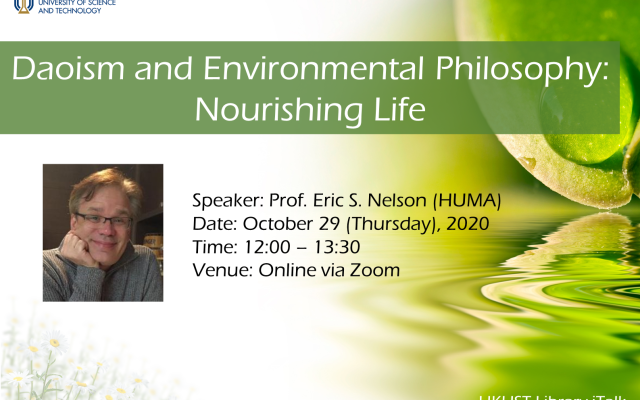
Daoism and Environmental Philosophy: Nourishing LifeThe early Daoist text the Daodejing is popularly and anachronistically thought to speak in direct ways to ecology and the environment. Such prevalent ways of reading the text persist even as they are frequently criticized in the Sinological and Daoist scholarly community. While the Daodejing was composed across different historical contexts with diverse purposes in mind, the text continues to speak to questions of how to individually and socially live and interact with human and inhuman life and the natural world.In discussing my new book Daoism and Environmental Philosophy: Nourishing Life, I reexamine the extent to which the Daodejing and other early Daoist texts can be suggestive for addressing the contemporary environmental crisis. I consider whether and how early Daoist conceptions and practices of emptying (xu 虛), stilling (jing 靜), and making plain (su 素), responsive attunement (wuwei 無為), and nourishing life (yangsheng 養生 ) can be interpreted and reimagined in critical ecological models that indicate different more nurturing ways of dwelling and becoming with our environment and the myriad things (wanwu 萬物), in their own respective tendencies and ways of becoming (ziran 自然). Notes: (i)HLTH 1010 - HKUST students may attain 1.5 hours credit for the Healthy Lifestyle Course after attending the talk. (ii)This event will be recorded using video and photography. About the SpeakerEric S. Nelson is Associate Professor of Humanities at the Hong Kong University of Science and Technology, having joined in 2014.
He received his PhD from Emory University. His areas of teaching and research include modern European, East Asian, and intercultural/comparative philosophy and religion. He is particularly interested in questions of communication, interpretation, and social interaction (hermeneutics and ethics).
His other book, Chinese and Buddhist Philosophy in Early Twentieth-Century German Thought, was published in 2017 and he has published over seventy articles and book chapters on Chinese, German, and Jewish philosophy.
Daoism and Environmental Philosophy: Nourishing LifeThe early Daoist text the Daodejing is popularly and anachronistically thought to speak in direct ways to ecology and the environment. Such prevalent ways of reading the text persist even as they are frequently criticized in the Sinological and Daoist scholarly community. While the Daodejing was composed across different historical contexts with diverse purposes in mind, the text continues to speak to questions of how to individually and socially live and interact with human and inhuman life and the natural world.In discussing my new book Daoism and Environmental Philosophy: Nourishing Life, I reexamine the extent to which the Daodejing and other early Daoist texts can be suggestive for addressing the contemporary environmental crisis. I consider whether and how early Daoist conceptions and practices of emptying (xu 虛), stilling (jing 靜), and making plain (su 素), responsive attunement (wuwei 無為), and nourishing life (yangsheng 養生 ) can be interpreted and reimagined in critical ecological models that indicate different more nurturing ways of dwelling and becoming with our environment and the myriad things (wanwu 萬物), in their own respective tendencies and ways of becoming (ziran 自然). Notes: (i)HLTH 1010 - HKUST students may attain 1.5 hours credit for the Healthy Lifestyle Course after attending the talk. (ii)This event will be recorded using video and photography. About the SpeakerEric S. Nelson is Associate Professor of Humanities at the Hong Kong University of Science and Technology, having joined in 2014.
He received his PhD from Emory University. His areas of teaching and research include modern European, East Asian, and intercultural/comparative philosophy and religion. He is particularly interested in questions of communication, interpretation, and social interaction (hermeneutics and ethics).
His other book, Chinese and Buddhist Philosophy in Early Twentieth-Century German Thought, was published in 2017 and he has published over seventy articles and book chapters on Chinese, German, and Jewish philosophy.
Details
2020-10-29
Zoom
Library iTalks
Library iTalks
3
12
13
15
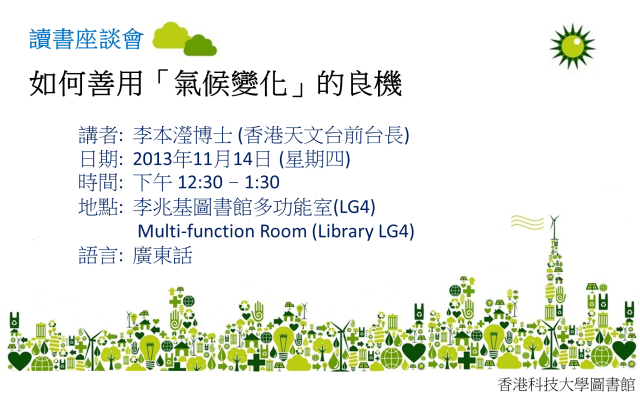
About the Talk我們每個人的生活方式,直接或間接影響着地球的資源消耗、碳排放和自然環境。而過度發展、消費和浪費所造成的氣候逆轉會給地球與人類帶來極大的威脅。保護大自然不僅利人,而且也可以應當益己。我們邀請到香港天文台前台長李本瀅博士與大家分享生活中你可能看不到的「有」與「無」,決策上你可能會忽略的「取」與「捨」,亦不會影響生活質素, 更可從中穫益。About the Author李博士先後於香港英皇書院和香港大學就讀,之後輾轉加入天文台工作,於2009年成為第十四任天文台台長。除了處理日常繁重的公務外,天文台台長還撰寫「台長網誌」,與市民大眾分享台長及其團隊專業的見解和客觀的想法。議題從日常天氣現象,氣候變化,到歷史故事和科學進程,可謂包羅萬有。 2011年,香港天文台把 網誌内的文章結集成書,取名《台長札記》(索書號: QC990.C6 H6643 2011 )。這書為香港政府長期暢銷刊物之一。2011年離開服務了31年的香港天文台後,李博士重返校園學習西班牙語及音樂,又繼續發展他對中西文化的興趣愛好,並參與慈善工作,真是退而不休,多彩充實。備註:李本瀅博士擁有個人網誌http://www.boon-ying-lee.blogspot.hk/ 分享他的所見、所聞和所想,歡迎覧閱。For enquiries, please contact Kevin Ho at 2358-6761.
Details
2013-11-14
Library Multifunction Room (LG4), HKUST Library
Library iTalks
8
12
13
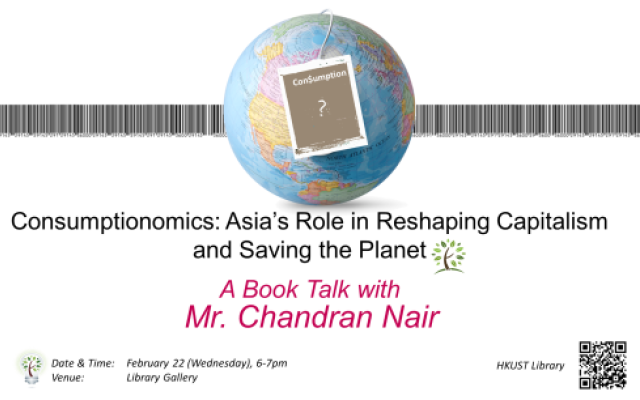
About the TalkFor many years consumption has driven the engine of global capitalism. In the recent financial crisis, we continue to see the Wests leading economists and policy makers urging Asia to consume more to help save the global economy. This view, shaped by conventional wisdom, refuses to acknowledge both the undesirable effects of consumption and the limits to growth.In Consumptionomics: Asias role in reshaping capitalism and saving the planet, Chandran Nair, argues that this conventional view needs to be replaced by a more rational approach to such challenges, and offers ideas as to possible solutions
Details
2012-02-22
Library Gallery (G /F), HKUST Library
Library iTalks
Library iTalks
8
12
13
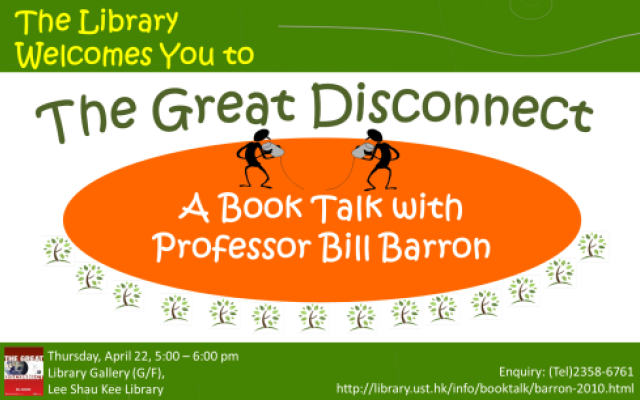
This event was held in conjunction with HKUSTs 2010 Environment Week.About the BookThe Great Disconnect / by Bill Barron
(Multiple locations HD75.6 .B3627 2009)The world economy has grown to the limits of what our planet can sustain. Climate change is the most talked about, but we are also reaching limits of water, crop land, and marine fisheries. The biosphere is too stretched; the system cannot continue as it has for the past several decades."Moving to a more sustainable development path will require making truly basic changes in what, how, and how much is produced and consumed. That, in turn, will require nothing less than restructuring the economy, a make over of consumer lifestyles, and re-examining values."In this work, Dr. Barron raises important questions. Asking these questions is the only way we can ever hope to reach possible answers. Questions like:What is the difference between economic growth and economic development?Can continuing technological advances allow indefinite economic growth?Can market mechanisms substitute for limited natural resources?Once our basic material needs are met, what is the "good life"?
About the Author Prof. Bill Barron is a faculty member of HKUST Division of Environment. An environmental economist, he received his PhD in Economics for Public Decision Making from the Department of Geography and Environmental Engineering at Johns Hopkins in 1980. From 1980-1986 he worked at the USs renowned Oak Ridge National Laboratory on assessing energy technologies. He has also served as an advisor on energy issues to the Liberian and Pakistani governments.A Hong Kong resident for over 20 years, Prof. Barrons work has focused on environmental aspects of transport policy, urban planning, and energy use. He also works with the public policy think tank Civic Exchange, in both advisory (Board of Directors 2003-05) and research capacities.Before joining the newly created Division of the Enviroment, Prof. Barron was a member of HKUSTs Institute for the Environment, which published his book The Great Disconnect in 2009.For enquiry, please contact Victoria Caplan at 2358-6786.
(Multiple locations HD75.6 .B3627 2009)The world economy has grown to the limits of what our planet can sustain. Climate change is the most talked about, but we are also reaching limits of water, crop land, and marine fisheries. The biosphere is too stretched; the system cannot continue as it has for the past several decades."Moving to a more sustainable development path will require making truly basic changes in what, how, and how much is produced and consumed. That, in turn, will require nothing less than restructuring the economy, a make over of consumer lifestyles, and re-examining values."In this work, Dr. Barron raises important questions. Asking these questions is the only way we can ever hope to reach possible answers. Questions like:What is the difference between economic growth and economic development?Can continuing technological advances allow indefinite economic growth?Can market mechanisms substitute for limited natural resources?Once our basic material needs are met, what is the "good life"?
About the Author Prof. Bill Barron is a faculty member of HKUST Division of Environment. An environmental economist, he received his PhD in Economics for Public Decision Making from the Department of Geography and Environmental Engineering at Johns Hopkins in 1980. From 1980-1986 he worked at the USs renowned Oak Ridge National Laboratory on assessing energy technologies. He has also served as an advisor on energy issues to the Liberian and Pakistani governments.A Hong Kong resident for over 20 years, Prof. Barrons work has focused on environmental aspects of transport policy, urban planning, and energy use. He also works with the public policy think tank Civic Exchange, in both advisory (Board of Directors 2003-05) and research capacities.Before joining the newly created Division of the Enviroment, Prof. Barron was a member of HKUSTs Institute for the Environment, which published his book The Great Disconnect in 2009.For enquiry, please contact Victoria Caplan at 2358-6786.
Details
2010-04-22
Library Gallery (G /F), HKUST Library
