




How Data Management Plans Evolved in 2026

Six years ago, the Library began to develop our research support services on data management planning. In early 2020 we piloted a DMP SandBox so our researchers could try writing a data management plan via a simple web form. That same year we talked about the promise of the machine-actionable DMP (maDMP), a future in which a plan is not a static document but structured information that systems can read, exchange, and act on. And in 2022 we launched our local DMPTool@HKUST instance with a template built around six areas of good practice.
The landscape we were planning for has since moved, and in 2026 it moved sharply. This spring, the two largest research funders in the United States (NSF and NIH) both rewrote what a data management plan is. It is worth understanding what changed, because the debate it has triggered goes to the heart of what a DMP is for.
Key changes in summary
Within roughly 10 weeks, both funders replaced the researcher-written narrative plan with a short, structured form that the funder controls.
- NSF retired the familiar two-page PDF upload. From 27 April 2026, a Data Management and Sharing Plan must be completed as a web form inside Research.gov, with fields generated per directorate (see PAPPG 24-1 Supplement 2 and the Research.gov DMSP overview).
- NIH replaced its 2023 narrative DMS Plan with a one-page 2026 Pilot format: seven elements, five of them answered Yes / No / Not Applicable, with only short narrative boxes for limitations. It is mandatory for application due dates from 25 May 2026 (NOT-OD-26-046).
The Debate: Shorter, but not smarter?
The community response, captured well in the FORCE11 Upstream blog and on the DMPTool blog, has been genuinely mixed, and it is worth noting the debate from both sides.
What is favored:
Structured forms reduce ambiguity, make expectations consistent across proposals, and lower the administrative burden at the point of application.
Three key concerns:
- A new silo. When a plan lives entirely inside a funder's submission system, without an API or an export in a standard format, it loses its interoperability, and the information becomes hard to reuse. As the Upstream authors put it, key details can stay "locked within" the funder system, forcing researchers or institutions to recreate the plan elsewhere. This is the opposite direction from the maDMP vision of a plan that other services can register, link, and act on.
- Collaboration gets harder. Data management planning is a team activity that involves the researcher, co-PIs, and support staff such as data librarians. When the plan is drafted directly inside a proposal portal that only the PI can access, that collaborative step becomes awkward, and the opportunity to bring in help can disappear.
- Thinner thinking. A page of Yes/No boxes may reduce the planning that used to happen before data collection. Decisions about repositories, formats, and access get deferred to later in the project, when the options are often narrower and the choices more expensive to change.
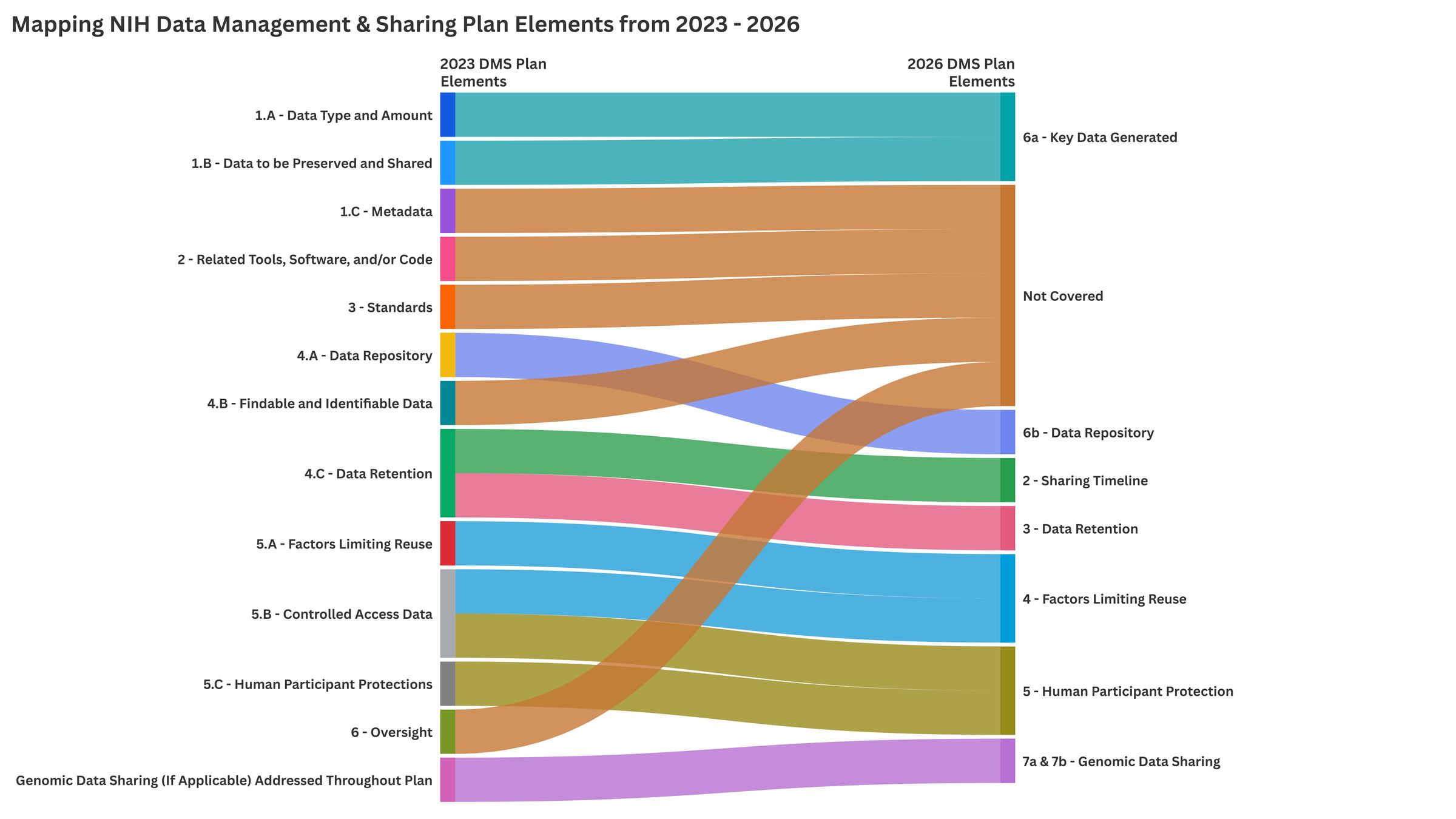
When a group of librarians mapped the old NIH plan onto the new one, several elements that used to prompt a real decision, such as metadata, related tools and code, and standards, turned out to have nowhere to land in the 2026 form:
The bigger picture: The plan is only part of the story
If we take a step back from the mechanics of NSF or NIH, two larger currents are worth watching:
From "data" to "data, code, and software"
In our own recent post on publisher data policies, we watched the compliance surface shift steadily away from the grant application and toward the manuscript. For example, PLOS Biology made code sharing a condition of publication from the start of 2026, and it will not be the last journal to do so. This is the trend that ultimately touches every author, funded or not: more and more, it is the journal rather than the funder that decides whether your data and your code ever see daylight, and it makes that decision at the point of submission, when it is far too late to go back and organize things properly.
A different direction entirely: The UKRI model
While the two big US funders were busy shrinking the plan into a form, UK Research and Innovation (UKRI), the umbrella body above the UK's research councils, spent the same period building the opposite: not a shorter form, but a single, broader, FAIR-anchored framework that harmonizes the councils' separate policies. If the American move is burden reduction, the British one is consolidation and ambition; together they tell us that "the evolving DMP" is not one trend at all, but a fork in the road. UKRI expects to publish its final policy and first guidance in summer 2026, applying to new funding from 2027. And because it rests on principles rather than one country's submission form, it is a more useful reference for a university shaping its own guidance than any checkbox page.
What this means for HKUST researchers
Whether these changes reach you comes down to who funds your work and where you publish. Generally speaking, there are three scenarios:
- You hold or collaborate on US federal funding, such as an NIH or NSF grant, a US subaward, or a co-PI role. What changed is the mechanics: your plan is now a form completed inside the funder's system, not a document you attach to your grant proposal.
- You publish in journals that mandate data or code sharing. This group is growing fast. Far more HKUST authors will need to meet a journal policy than a funder form.
- You simply want the data management efforts to pay off. This is the case that outlasts every policy change.
The last one is what our research data service was built for. The DMPTool@HKUST walks you through questions surrounding data management practices. Our instance is institution-hosted and deliberately funder-agnostic. If you need the live NSF or NIH templates, use them where they now live, inside Research.gov and the NIH forms, or draft in the public dmptool.org, which has published mirror templates of the NSF web form and the 2026 NIH format. We are reviewing what these shifts mean for our own template and guidance, and will keep this space updated.

