




Ig Nobel Prizes 2026 – Serious Fun

The start of September does not just herald the beginning of a new academic year in the Northern Hemisphere; it is also the time for the annual Ig Nobel Prizes! The Ig Nobels have been awarded for the past 36 years. Hosted by the magazine Annals of Improbable Research, they honor scientists whose research:
“…make people LAUGH, then THINK. The prizes are intended to celebrate the unusual, honor the imaginative — and spur people’s interest in science, medicine, and technology.”
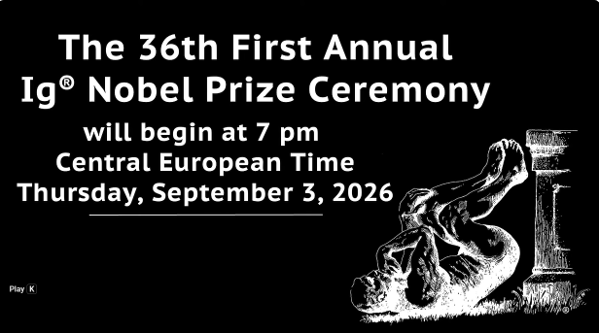
The 2-hour 2026 ceremony, held on September 3, was posted on YouTube.
In 2026, ten prizes were awarded. Here are some highlights, copied with light editing from the Ig Nobel website, with the full list here.
ECONOMICS (USA, MEXICO, CANADA)
Paul Piff, Daniel Stancato, Stéphane Côté, Rodolfo Mendoza-Denton, and Dacher Keltner, who amassed evidence that upper-class people are more likely to take from a child’s supply of candy, and engage in other kinds of unethical behavior.
REFERENCE: “Higher Social Class Predicts Increased Unethical Behavior,” Paul K. Piff, Daniel M. Stancato, Stéphane Côté, Rodolfo Mendoza-Denton, and Dacher Keltner, Proceedings of the National Academy of Sciences, vol. 109, no. 11, 2012, pp. 4086–4091. doi.org/10.1073/pnas.1118373109
BIOLOGY (BRAZIL, AUSTRALIA)
João Miguel Alves-Nunes, Adriano Fellone, Selma Maria Almeida-Santos, Carlos Roberto de Medeiros, Ivan Sazima, and Otavio Augusto Vuolo Marques, who gently stepped on various parts of various venomous snakes (repeatedly, at various temperatures, at various times of day) to try to learn what does and what does not induce a venomous snake to bite a human.
REFERENCE: “Study of Defensive Behavior of a Venomous Snake as a New Approach to Understand Snakebite,” João Miguel Alves-Nunes, Adriano Fellone, Selma Maria Almeida-Santos, Carlos Roberto de Medeiros, Ivan Sazima, and Otavio Augusto Vuolo Marques, Scientific Reports, vol. 14, 2024, article 10230. doi.org/10.1038/s41598-024-59416-6
- N.B. The editors retracted this article on 11 February 2025.
PHYSICS (CANADA, USA, CHINA, SAUDI ARABIA)
Randy Hurd, Zhao Pan, Tadd Truscott, and Kaveeshan Thurairajah, for theoretical and experimental attempts to design a splash-free urinal.
REFERENCE: “Splash-free Urinals for Global Sustainability and Accessibility: Design Through Physics and Differential Equations,” Kaveeshan Thurairajah, Xianyu (Mabel) Song, J.D. Zhu, Mia Shi, Ethan A. Barlow, Randy C. Hurd, and Zhao Pan, PNAS Nexus, vol. 4, no. 4, April 2025, pgaf087. doi.org/10.1093/pnasnexus/pgaf087
TECHNOLOGY (CHINA, CANADA, USA, EGYPT)
Justin Puma, Zhen Yang, Evan Johnston, Zixin Zhang, Xiaoyi Lan, Lingzhi Zhang, Hongyu Hou, Zixin He, Ali Afify, Megan Creighton, Jianyu Li, and Changhong Cao, for pioneering the use of mosquito proboscises as high-resolution 3D printing nozzles, a process called “Necroprinting.”
REFERENCE: “3D Necroprinting: Leveraging Biotic Material as the Nozzle for 3D Printing,” Justin Puma, Zhen Yang, Evan Johnston, Zixin Zhang, Xiaoyi Lan, Lingzhi Zhang, Hongyu Hou, Zixin He, Ali Afify, Megan A. Creighton, Jianyu Li, and Changhong Cao, Science Advances, vol. 11, no. 47, November 19, 2025. doi.org/10.1126/sciadv.adw9953
PEACE (USA, ARGENTINA, AUSTRALIA)
Jaimie Arona Krems, Rebecka Hahnel-Peeters, Laureon Merrie, Keelah Williams, and Daniel Sznycer, for documenting that we value friends who are vicious to people we dislike.
REFERENCE: “Sometimes We Want Vicious Friends: People Have Nuanced Preferences for How They Want Their Friends to Behave Toward Them Versus Others,” Jaimie Arona Krems, Rebecka K. Hahnel-Peeters, Laureon A. Merrie, Keelah E.G. Williams, and Daniel Sznycer, Evolution and Human Behavior, vol. 44, no. 2, 2023, pp. 88–98. doi.org/10.1016/j.evolhumbehav.2023.02.008
How are the awards decided upon?
Anyone can nominate, and the Ig Nobel Board of Governors receives thousands every year. It then …
“sifts through the nominations, narrowing the list to a group of finalists. The Board then investigates whether each of the finalists (a) exists, and (b) has actually done what the nomination claims.”
Awardees are contacted privately and can decline the honor if they choose.
The 2026 ceremony was held in Zurich on September 3rd, the first time that it was held outside the USA. The first 35 ceremonies (1991–2025) all took place in Massachusetts. Going forward, the plan is to have it in Switzerland every other year and in other cities in the interim years.
So, watch, read, and enjoy! The Ig Nobels remind us that research can be serious fun, and who knows, maybe one of the readers of this column will win one 😊
